
 Rating 6/10
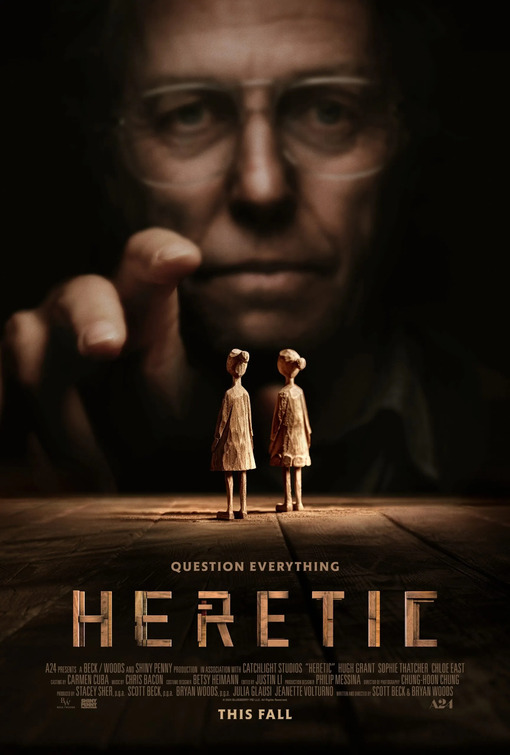
What we believe shapes our lives. It dictates our choices, values, and fears. But what truly influences why we think what we do? Heretic, a new horror film, delves into this question with a provocative theory. It explores the possibility that religious faith isn’t just a matter of personal conviction but something susceptible to manipulation and outside influence. This unsettling premise will surely spark discussion—and, for some viewers, even frustration.
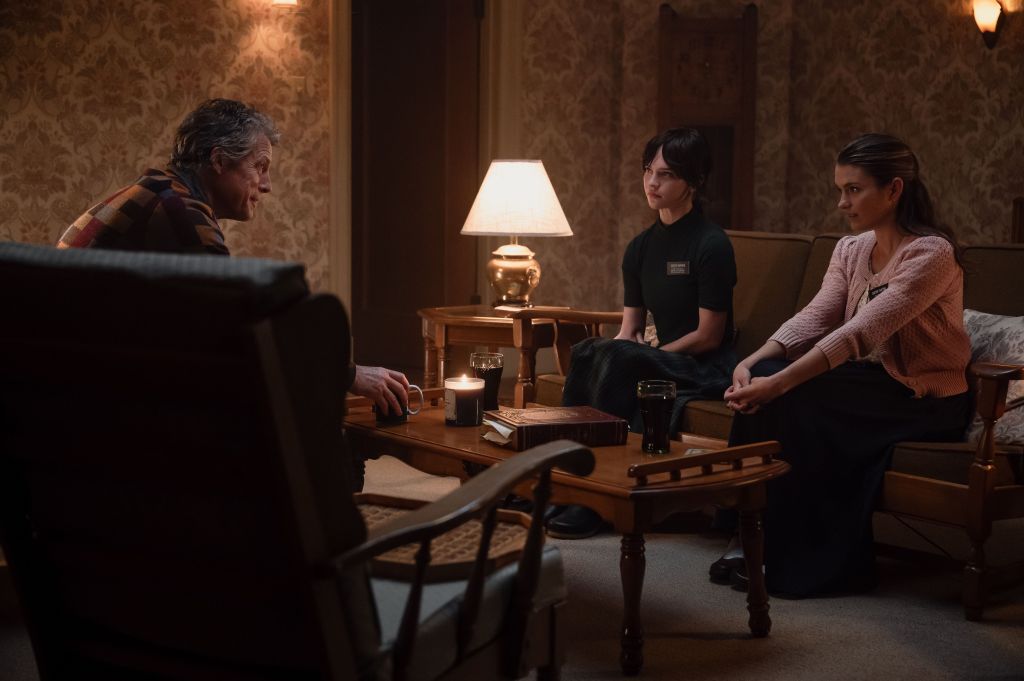
Sister Barnes (Sophie Thatcher) and Sister Paxton (Chloe East) are missionaries from the Church of Jesus Christ of the Latter-day Saints. They visit the secluded home of the creepy Mr. Reed (Hugh Grant) because he expressed a desire to learn more about becoming a Mormon. He initially seems open to having a friendly conversation, but it’s all a ruse as he has no desire to seek spiritual enlightenment. Things take a dark turn when the young women realize they cannot leave through the front door and their cell phones have no signal. Reed’s theological discourse soon reveals an obsession with the nature of belief and the power to control others’ perceptions. The evangelists are put through disturbing tests of faith, ultimately forcing them to confront what is real in Reed’s twisted “experiment.”
Heretic had all the makings of a thoughtful horror picture; one poised to explore the nature of religion with depth and intelligence. The opening stress-filled setup hints at an astute blend of humor and scares. Unfortunately, a tale that begins with such promise dwindles in the second half. The saga subverts biting wit for familiar horror tropes, eschewing the originality that initially set it apart.
Mr. Reed doesn’t stop at questioning individual convictions but goes further. He brings up the shared overlaps among Judaism, Christianity, and Islam by making superficial analogies. Examples include the various iterations of Monopoly and how “The Air That I Breathe” by The Holies was surreptitiously re-written as “Creep” by Radiohead, which got reworked later as “Get Free” by Lana del Rey.
Mr. Reed’s pontifications are amusing but not nearly as profound as the writer-directors think. Their superficiality falls far short of discrediting the world religions he seeks to condemn. Nevertheless, Hugh Grant skillfully portrays a devilishly witty villain—with an air of control. He’s playing God while simultaneously criticizing and hypocritically becoming the very thing he condemns. His ability to manipulate words and, by extension people, makes him a compelling figure in the early stages.
The screenwriters are clearly writing for the villain. He gets all the best lines and the most time to make his argument. Scott Beck and Bryan Woods are a screenwriting (A Quiet Place) and directing (65) team with a longstanding creative partnership dating back to high school in Iowa. Their upbringing in the heartland has influenced their writing process. Both have spoken how their roots in a small, tight-knit community helped them create emotional narratives that hint at themes of faith, human frailty, and moral conflict.
Thankfully, Heretic allows its female leads to shine a little too. Sophie Thatcher and Chloe East portray capable women who confidently challenge Mr. Reed’s arrogant and dismissive view of them and their beliefs. The account is most enjoyable when the reclusive Englishman is presented as merely a peculiar, intellectual captor—holding the two protagonists as prisoners via a psychological game of philosophical insights. Their verbal sparring is a delight. However, when the chronicle takes a sharp turn, reducing him to just another violent psychopath, the tension faded, and I lost interest. The beginning is outstanding, but I pray the next Beck/Woods movie has a better ending.
11-07-24
4 Responses
Excellent review Mark. I will say that I did actually really enjoy Heretic, but I can definitely see how it may not be everybody’s cup of tea. It’s funny, because I watched the Greatest Christmas Pageant Ever directly after seeing this and I can confidently say that those people might have found this film blasphemous and a little bit insulting if nothing else. The thing I found so troublesome – towards the end – wasn’t so much the religious aspect, but how expendable women are. I don’t know why that left such a bad taste in my mouth, knowing the statistics and all – it’s not a surprise, but it just made me a bit sad. I won’t say much more since I don’t want to give away too much, but as you saw the end you know what I’m talking about.
The number of victims was genuinely disturbing. The cold presentation of their lives gave me an uneasy feeling as well.
Commenting on your review of Heretic:
This movie kept my interest the whole way through. Their verbal sparring was certainly delightful. Sadly the ending was lost on most. Consider watching the last 10 minutes and pay special attention to the art in the rooms in which Paxton walked through. Such paraphernalia might rekindle your interest all the more. Let me know what you make of this scene!
Cheers,
Jason
I’m intrigued. I will admit the production design got progressively more eerie. A cozy and charming house became truly unsettling by the end. It’s the little details—the house itself was a character.