
 Rating 7/10
When I heard that September 5 had to do with the Munich massacre of 1972, my mind immediately went to Steven Spielberg’s Munich (2005). His tense, complex thriller concerned the Israeli response to the tragedy. Spielberg’s film examined the psychological toll on the Mossad agents tasked with retaliating against those responsible. Other depictions, such as the TV movie 21 Hours at Munich (1976), have focused on the hostage crisis itself, dramatizing the failed rescue attempt and the horrifying escalation of events.
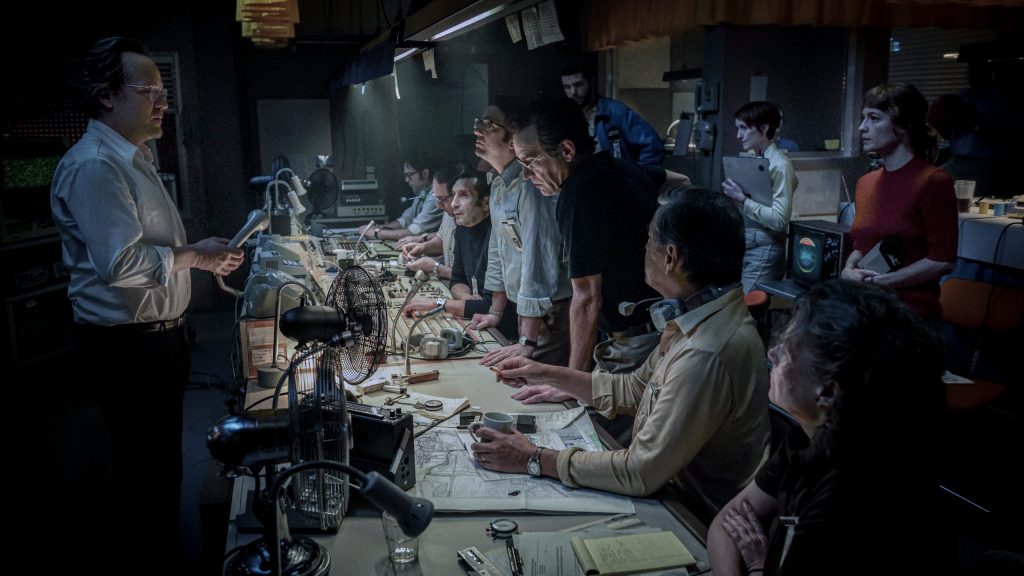
What sets September 5 apart is its frame of reference. Instead of focusing on the Palestinian militants, the victims, or the geopolitical aftermath, this saga unfolds through the eyes of a television crew, who found themselves thrust into reporting on an attack happening in real time. This vantage point offers a unique look at how journalism and a live broadcast intersect during history in the making.
As the official network broadcasting the Olympics, ABC Sports was initially there to celebrate athletic achievement. Its president, Roone Arledge (Peter Sarsgaard), is there to steer his staff into crafting emotionally compelling sports coverage. This includes the head of the control room, Geoffrey Mason (John Magaro), and the head of operations, Marvin Bader (Ben Chaplin). When the Palestinian terrorist group Black September takes Israeli athletes hostage in the Olympic Village, the media team must pivot to cover the evolving crisis. Arledge contends it makes no sense to leave the reporting to an anchorman in Washington, D.C., when his people are there on the scene. They’re aided by a German translator, Marianne Gebhardt (Leonie Benesch).
I can appreciate that this is a limited and unconventional angle from which to approach this story. Compared to the life-and-death drama developing outside, the stress within the control room is trivial. Yet, as the standoff escalates, the crew becomes an essential conduit of information, forming how the world learns of this ordeal. The live coverage grows ethically fraught as their broadcasts inadvertently aid the gunmen. Additionally, the relentless drive to break the news before anyone else sometimes comes at the cost of accuracy. The role of the media and how they shape public perception are explored.
These ethical dilemmas form the crux of the drama, which has the intensity of a you-are-there eyewitness account. The Oscar-nominated screenplay by Moritz Binder, Tim Fehlbaum, and Alex David takes these concerns seriously, elevating the tension through a claustrophobic setting that amplifies the weight of each decision. As the situation escalates toward its tragic conclusion, the journalists are left to grapple with their responsibility. The terrorist attack reached a broadcast audience of 900 million, shaping history. It was one of the first major global news events where live television played a critical role. September 5 does an admirable job of making the case as to why this perspective is relevant.
01-16-25
2 Responses
This was an intense situation, and they did a very good job at showing us how these events happened in real time. I was riveted. 3 1/2 🌟
I agree—the real-time approach increased the tension.