

 Rating 8/10
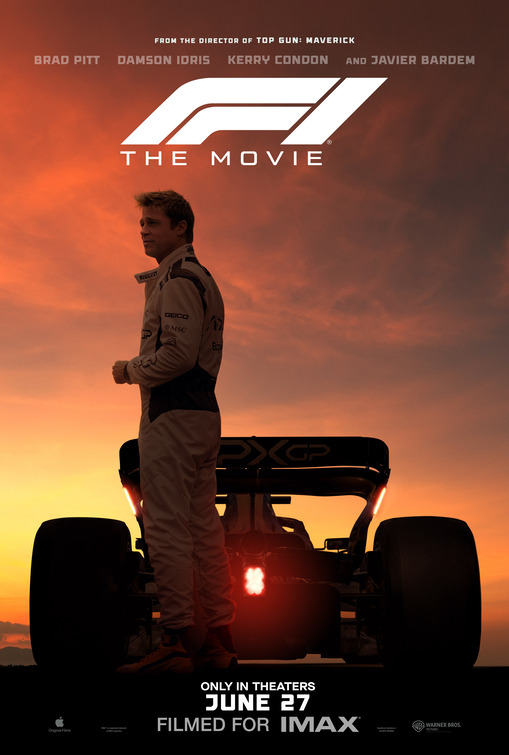
From the guys that brought you Top Gun: Maverick—director Joseph Kosinski and producer Jerry Bruckheimer—comes F1: The Movie, co‑produced with seven‑time world champion Lewis Hamilton. Writer Ehren Kruger (Dumbo, Transformers: Age of Extinction) brings his take to a visceral sports drama, while Kosinski and Bruckheimer deliver the spectacle. Starring at the center is Hollywood royalty Brad Pitt (Moneyball, Once Upon a Time in Hollywood).
Sonny Hayes is a once-celebrated American Formula One driver whose career was cut short in the 1990s after a devastating crash. He is currently a drifter living out of his van and bouncing between races. Hayes is recruited by struggling team owner Ruben Cervantes (Javier Bardem) for a surprise comeback mid-season. With the crew falling apart, Hayes must navigate a tense partnership with hotshot rookie Joshua Pearce (Damson Idris) under the guidance of technical director Kate McKenna (Kerry Condon). It’s a chronicle that combines fast-paced action with a tale of second chances. F1 offers a behind-the-scenes look at the intense pressure of the world’s most demanding motorsport.
The account leans heavily on well-worn tropes—aging veteran, rivalry with the young upstart, last-chance redemption, corporate backstabbing—so much so that this Formula One tale runs on a well-worn formula of its own. And yet, clichés admittedly endure because they resonate with people. They’re a reliable shorthand that audiences connect with emotionally. Ah, but what truly elevates the film is its craftsmanship: racing sequences are cut with razor‑sharp precision, every frame engineered for maximum velocity, delivering a visceral rush.
F1 blends fact with fiction. Director Joseph Kosinski shot on location during actual Grand Prix weekends, including Silverstone, Monaco, Las Vegas, and Abu Dhabi. Brad Pitt and Damson Idris drove specially adapted Formula 2 cars so they could genuinely race alongside real drivers like Lewis Hamilton, Max Verstappen, and Charles Leclerc. To capture footage inside the cockpit, the filmmakers used ultra-light, IMAX-quality cameras—sometimes mounting up to four miniature cinema rigs per car. With Lewis Hamilton’s mentoring, the actors drove at speeds nearing 180 mph under real race conditions amid practice and qualifying sessions. This approach helped achieve exceptional realism while filming during live Formula One events.
This is a slickly produced, action-packed extravaganza. It rarely surprises on a narrative level but undeniably delivers excitement. The saga doesn’t stray far from the familiar, but its true aim is obvious—to dazzle. And in that, it succeeds, often playing like a high-end commercial for the sport itself. The world of elite motorsport is experiencing a surge in global popularity—especially in the U.S. F1 doubles as both a crowd-pleasing story and a glossy showcase designed to glamorize and expand the brand’s appeal. It’s a fusion of fiction and spectacle—part narrative drama, part carefully constructed advertisement. Whether you see that as a flaw or a feature depends on how you feel about having your heart race while being sold something. I was so dazzled, I didn’t mind.
06-26-25