
 Rating 8/10
Thomas Pynchon’s 1990 novel, Vineland, was a sprawling account of California during the Reagan years, tracing the legacy of the 1960s counterculture. Pynchon imagined former radicals struggling to persist in a society where they were being watched and suppressed by the state. Director Paul Thomas Anderson’s new movie carries that spirit forward. He swaps the Vietnam War for U.S. border tensions, but keeps the focus on people torn between rebellion and retreat.
The saga opens roughly sixteen years before our current era. A revolutionary collective called the French 75 raids an immigration center along the Mexico–U.S. border and frees detainees. Their leader, Perfidia Beverly Hills (Teyana Taylor), humiliates their commander, Colonel Steven J. Lockjaw (Sean Penn). She becomes both the object of his pathological racism and a sexual preoccupation. Her partner is Bob Ferguson (Leonardo DiCaprio), also known by aliases such as “Ghetto Pat” and “Rocket Man.” Along with the group, they stage raids, robberies, and bombings against institutions they view as symbols of systemic oppression. Out of this fraught personal and political partnership, they have a daughter named Willa together.
Anderson presents their exploits with a critical eye, showing both the ethos of their ideals and the cracks that undermine them. A bank heist turns disastrous when Perfidia guns down a security guard (Peter N. Lyas III). The minimum-wage worker personifies the very working class they claim to champion. The murder calls their ideals into question.
Fifteen years later, Bob is now raising Willa (Chase Infiniti) as a single father while remaining loosely tied to radical activities. Lockjaw, still obsessed, conducts raids on the French 75 and its supporters. One of these sweeps forces Deandra (Regina Hall), a former ally of Perfidia, to intervene. She extracts Willa from a school dance to protect her from Lockjaw’s forces. Bob subsequently enlists the help of Sergio St. Carlos (Benicio del Toro), a martial arts instructor who operates on the fringes of seditious activity.
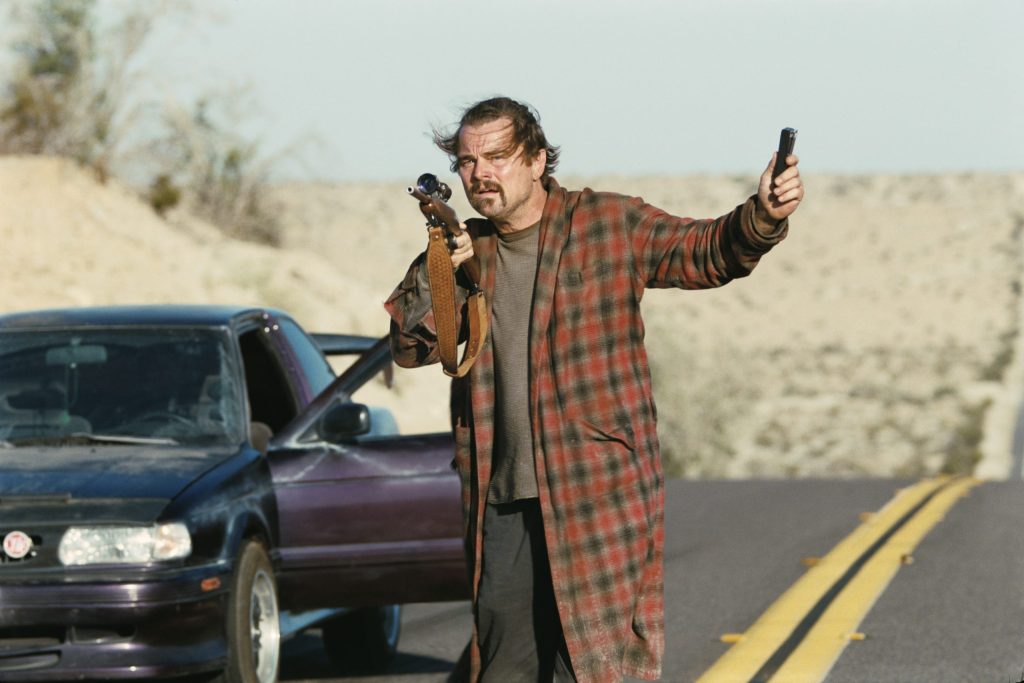
Bob has changed a lot with age. No longer the idealistic young rebel, his mind has grown hazy from habitual marijuana use.. In an extended humorous sequence, he struggles on the phone to remember the correct passwords that will connect him to his daughter within the resistance. “Maybe,” the operator replies flatly, “you should have studied the rebellion text a little harder.” It’s an unexpected send-up of bureaucracy within the radicalized left. The rebels are just as entangled in red tape as the institutions they oppose.
Anderson’s film adapts Pynchon’s satire from its original decade, reframing it as a timeless tale of revolt. However, at its core, the picture is a profound tale of a father striving to protect and guide his daughter. Leonardo DiCaprio delivers one of his most vulnerable performances. Bob is a relatable, deeply compassionate father, but now a weary relic of his former ancharist self. Bob’s attention to raising Willa anchors the story, underscoring the stakes behind actions that clearly break the law. The audience is invited to empathize with these lawbreakers not because their deeds are justified, but because of their commitment to family and loyalty. They are relatable and human.
Sean Penn’s Lockjaw, meanwhile, is a symbol of pure excess: a man of grotesque obsession in a display that verges on a cartoon. His fixation with the French 75 intensifies with an opportunity to join a white nationalist organization called the Christmas Adventurers. Penn gives a menacing performance that sears itself into memory. His behavior, complete with bizarre facial tics, crosses the line into ludicrousness. It’s unforgettable for its intensity and its absurdity.
Paul Thomas Anderson has crafted this saga with such precision. Every frame and note serves the narrative. Johnny Greenwood’s minimalist score, dominated by piano and percussion, injects a palpable tension. Michael Bauman’s cinematography adds sweeping aerial shots and intimate close-ups. In a surreal moment, Bob is guided by skateboarding teens who gracefully navigate the urban environment, gliding, leaping, and vaulting across the cityscape in a way that recalls the kids on bikes in E.T. Bob misses a jump and plummets forty feet. Yet the scene of young guides carrying a battered activist forward delivers a kinetic thrill. The climax is another manifestation of pure cinema. A Mustang Cobra pursues a Dodge Charger over a hilly ribbon of blistering highway that undulates in the desert. That desert car chase is destined to rank alongside the legendary pursuits in Bullitt and The French Connection.
In the end, the movie isn’t asking us to endorse Bob’s crimes. Yes, the chronicle is political, but not overtly partisan. You won’t hear mentions of Trump, ICE, Antifa, or other modern touchstones. What lingers is the question of what insurgency does to a person and to a family over time. At its center, this is the drama of a father’s mission to protect and reunite with his daughter. And it’s on that level, stripped of ideology, that the narrative resonates most. What rings through the ages is the enduring bonds that make life worth living.
09-25-25
2 Responses
When a movie is long, but keeps me entertained throughout, I feel good. I agree, you root for the story as opposed to all the bad things they did. I loved it. The action, the emotion and the performances especially. It’s been a while since I’ve seen a movie this good. 4 ⭐️
I felt the same! When I saw it was almost three hours, I got worried, but I was hooked the whole way through.