
 Rating 7/10
If you think about it, the story of Jacob and Esau is one of the Bible’s most shocking cases of identity theft. Jacob, the younger son of Isaac and Rebekah, deceives his nearly blind father into giving him the blessing meant for his older brother, Esau. Disguised as Esau, Jacob convinces Isaac, who is initially suspicious, to bestow upon him authority and prosperity. When the deception is uncovered, Isaac is displeased, but the blessing cannot be revoked. Jacob keeps the reward, and the Bible seems to simply shrug and say, “Good job, kid.” Jacob becomes the chosen heir to God’s covenant. There are no consequences.
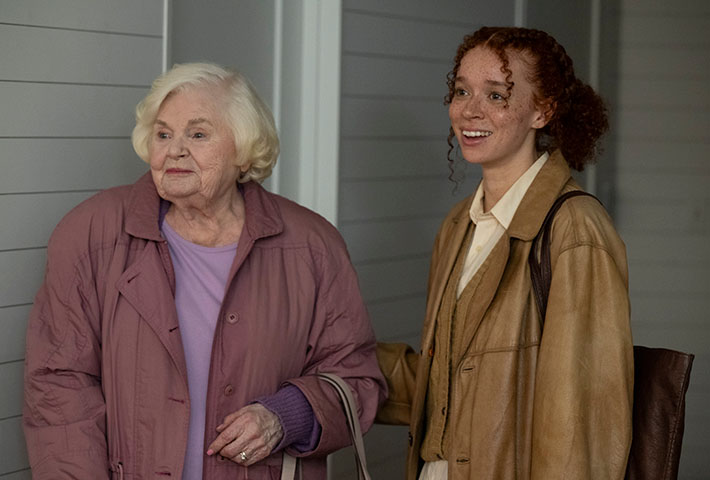
In Eleanor the Great, a woman likewise presents herself as someone she is not. Eleanor Morgenstein (June Squibb) is a 94-year-old widow who moves in with her daughter (Jessica Hecht) and grandson (Will Price ) after the death of her longtime friend and roommate, Holocaust survivor Bessie Stern (Rita Zohar). Struggling with grief and feeling restless in new surroundings, Eleanor attends a Holocaust survivors’ meeting at the Jewish Community Center. There, she shares a story that catches the attention of Nina (Erin Kellyman), a journalism student coping with the loss of her mother and living in the shadow of her famous anchorman father (Chiwetel Ejiofor). What begins as a class interview soon blossoms into an unexpected friendship, sensitively handled in Scarlett Johansson’s directorial debut.
Eleanor the Great is an ethically fraught yet tender character study, anchored by June Squibb’s warm performance. Eleanor’s lie may frustrate some viewers, but she remains deeply human throughout. Her actions rooted not in ambition but in loneliness and a yearning for connection. As Eleanor’s bond with Nina deepens, she finds the attentive ear and emotional intimacy that are missing from her daughter and grandson. The film becomes a meditation on grief.
Screenwriter Tory Kamen’s script is witty and perceptive, maintaining a delicate balance. Eleanor’s moral ambiguity is troubling, yes, but it also stems from sympathetic motives. Like Jacob, she bends the rules to claim a reward. Yet where Jacob’s deceit is driven by ambition, Eleanor’s is more complex. There’s a personal desire to be seen, but also a wish to preserve and share the life of a late friend. In doing so, she forges a new friendship that softens the isolation of her twilight years. By the end, that renewed sense of purpose genuinely moved me.
10-02-25
3 Responses
June Squibb is an amazing actress. So natural, she makes you believe this story is real. She handles these situations the way a real no nonsense woman would. I liked this a lot. 3 1/2 ⭐️
Looking for parallels to profiting from a lie – at least until exposed – and, on reflection, maybe even after – and involving Nazis in both cases: try Lillian Hellman and “Julia”.
That’s a good parallel. I hadn’t thought of Julia, but there’s definitely a similar thread of deception and moral ambiguity.