
 Rating 5/10
Spoiler Warning: This review assumes you’ve seen The Black Phone. Spoilers for the 2021 picture follow. If you haven’t seen it, I’d suggest watching the superior original before reading on.
The Black Phone told the story of Finney Blake, a shy teenager kidnapped by a sadistic killer known as the Grabber and held captive in a soundproof basement. Guided by the voices of his past victims through a mysterious black telephone, Finney ultimately turned the tables, snapping his captor’s neck and freeing the spirits trapped there. It was a clever horror hit in the summer of 2022, and it was self-contained. So, a sequel seemed unnecessary. After all, the Grabber was very clearly dead.
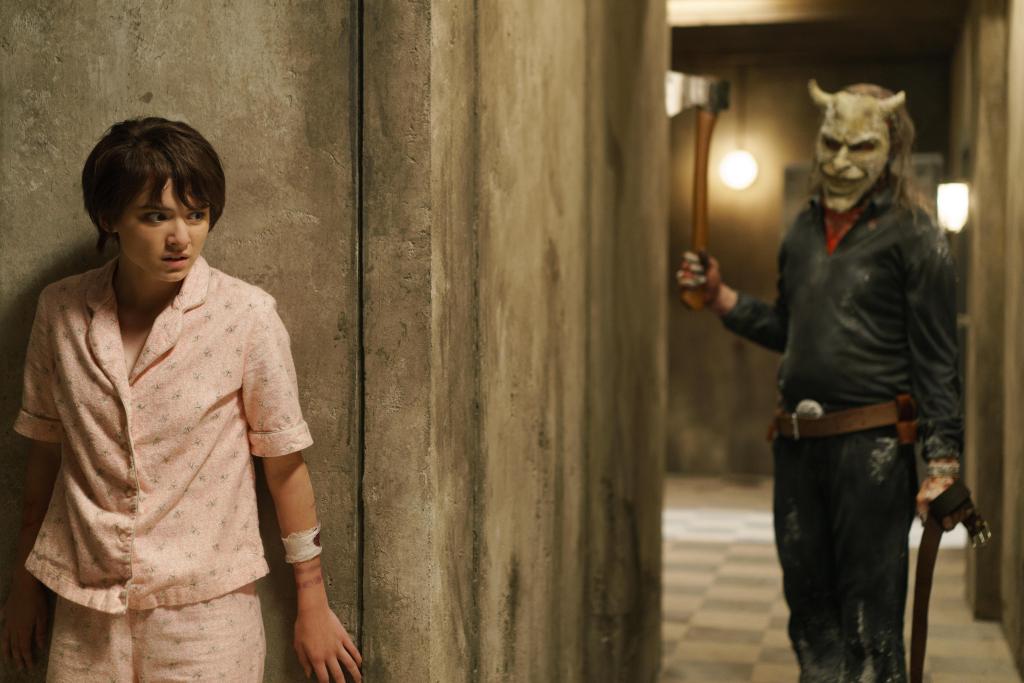
In this continuation, that vengeful spirit isn’t going to let a little thing like his own death stop him. The phone becomes a conduit not just to the spirits of the dead children, but to their murderer himself, now a restless entity reaching into the world of the living. Much like Freddy Krueger, the Grabber (Ethan Hawke) returns not as a living man, but as a malevolent presence that invades dreams and psychic visions, especially those of Gwen (Madeleine McGraw), who still carries her mother’s supernatural gift. Her visions lead to an abandoned Christian youth camp somewhere in the Rocky Mountains, where every night, she watches helplessly as the masked predator hunts the children he’s already claimed.
Gwen discovers that her late mother (Anna Lore) once stayed at that same camp, and she convinces her brother, Finney (Mason Thames), and friend Ernesto (Miguel Mora) that they need to investigate. They quickly land jobs at the place and head up to visit and meet the camp’s current owner, Mando (Demian Bichir). But wouldn’t you know it, a blizzard blankets the whole area and conveniently traps anyone from leaving.
What this account has going for it is a creepy aesthetic. The snowbound setting lends a real sense of isolation. The cinematography by Pär M. Ekberg significantly adds to the atmosphere. A third of the tale unfolds in the ghostly realm where Gwen’s dream sequences are shot using Super-8 cameras to evoke an otherworldly vibe. Unfortunately, mood is not enough to save this picture. The screenplay, written by director Scott Derrickson and C. Robert Cargill, stretches a weak premise to nearly two hours. The spiritual escalation, where the Grabber continues to kill children in their sleep, is a forced attempt to turn him into another iconic villain, akin to Freddy, Jason, or Michael Myers.
Seems like we’ve gotten a new horror flick every week this year. Some have been outstanding, so the bar is high. However, sampling familiar elements from the genre’s past is not enough to justify this blatant attempt at launching another franchise. Black Phone 2 may be calling from beyond, but this time, there’s nothing on the line but static.
10-16-26
2 Responses
First of all, I love the last line. Clever. It did feel like I was watching a “Nightmare on Elm St.” movie. It was pretty good. I liked a little more than you. It did its job on the scared. 3 ⭐️
Honestly, I struggled to find the right way to end this review. I felt I’d said everything I needed to. I wrapped it up with a glib line that gave a sense of finality. I’m glad you liked it.