
 Rating 6/10
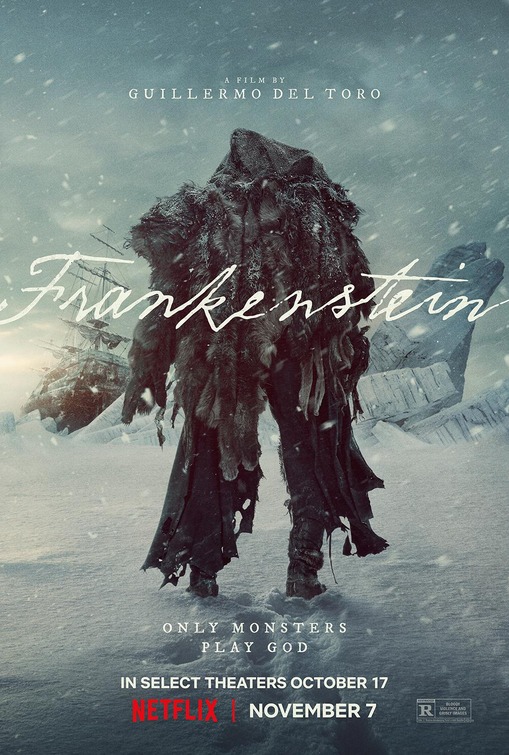
Mary Shelley’s Frankenstein has been endlessly reborn, from James Whale’s 1931 classic starring Boris Karloff as the lumbering monster, to his 1935 follow-up Bride of Frankenstein, often hailed as the horror genre’s first masterpiece. It took on a new spirit in Hammer Studios’ Technicolor revivals of the 1950s and 1960s, with Peter Cushing and Christopher Lee, and later in Kenneth Branagh’s manic Mary Shelley’s Frankenstein (1994), featuring Robert De Niro. The myth even crossed over into satire with Mel Brooks’s Young Frankenstein (1974). Stage, television, and animated retellings have kept the story alive for generations. Now, more than two centuries after its publication in 1818, Guillermo del Toro offers his own vision: the true monster isn’t the Creature at all, but the man who made him, which isn’t exactly a shocker. What’s new is how completely del Toro commits to that idea.
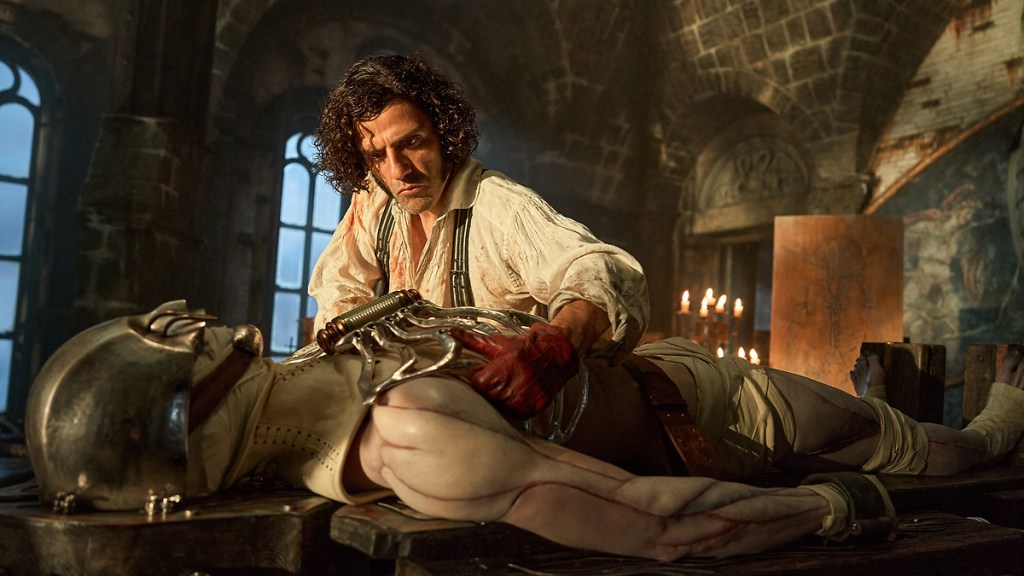
The central story follows Victor Frankenstein (Oscar Isaac), a brilliant yet arrogant young surgeon. As a boy (Christian Convery), his domineering father (Charles Dance) trains his son in the ways of medicine and beats him for his mistakes. After the death of his mother (Mia Goth), the young doctor becomes consumed by the idea of conquering mortality. Years later, Henrich Harlander (Christoph Waltz), a ruthless arms merchant, provides him with the means to pursue his forbidden experiments. Victor enlists his younger brother, William (Felix Kammerer), and becomes infatuated with William’s fiancée. Elizabeth (also played by Mia Goth), who also happens to be Henrich’s niece, is a compassionate soul whose disposition stands in stark contrast to Victor’s emotional void. The scientist begins harvesting body parts from executed criminals and fallen soldiers of the Crimean War. Using these parts, Victor assembles a new body and harnesses lightning to reanimate it. He gives life to a being of immense strength and fragile innocence. The Creature (Jacob Elordi) grows to understand love, as well as pain and betrayal. What begins as a scientific triumph turns into a violent reckoning between creator and creation.
Del Toro presents Frankenstein as a grand, bombastic work that feels like a culmination of the auteur’s recurring obsessions. From Crimson Peak to The Shape of Water to Pinocchio, the echoes of his earlier work are unmistakable in both theme and style. It opens with an Arctic prologue taken from Shelley’s novel but wisely excised from most adaptations. Del Toro restores it here, stretching the production to two and a half hours. Yet the heart is a straightforward tale of the maker versus his unholy marvel. Victor Frankenstein is a man obsessed with creating life. That’s an admirable goal, but the Baron has no capacity for love. He only longs to wield mastery over nature. Raised by a cold and demanding father, Victor predictably grows into a cold “father” himself. The suffering begins the moment the reanimated man opens his eyes. Victor shows no compassion for what he has brought into existence, immediately dismissing his achievement as a mistake rather than a miracle. A growing impatience feeds an urge to destroy it. His refusal to understand the being he created leaves him without a single redeeming feature. Issac’s wildly histrionic performance doesn’t help.
Meanwhile, Jacob Elordi’s portrayal of the Creature is unlike any previous depiction. This is not your father’s Frankenstein, a bumbling brute who speaks in grunts. He’s tall, sinewy, and almost ethereal were it not for the patchwork of scars stitched across his skin. His ability to speak with clarity and grace emerges far faster than in other versions. Guillermo del Toro streamlines this evolution, suggesting that the Creature absorbs knowledge not just through books but also through art, music, and memory. His fluency occurs in poetic montage, as if language itself awakens within him. Supernatural forces seem to guide his existence. The resurrected one is shot, stabbed, and even blown apart with dynamite. Nevertheless, he continues to endure, his wounds closing and healing before our eyes. His near-immortality underscores the tragedy at the heart of the story: while the Creature cannot die easily, he cannot escape his pain either.
All of this unfolds within a sumptuous production design steeped in gothic grandeur. From the candlelit corridors of the Frankenstein estate to the tower by the sea, we gorge on the handcrafted artistry. Production designer Tamara Deverell, a longtime del Toro collaborator, fills the film with ornate woodwork, flickering gaslight, and the decaying opulence of 19th-century Europe. Dan Laustsen’s cinematography captures these spaces in blues and golds, contrasting the warmth of life with the chill of scientific obsession. Although the fire sequences, when Victor attempts to destroy his ancestral home along with his creation, betray an artificial sheen. The CGI flames lack the tactile menace of the real thing. Luis Sequeira’s exquisite costumes, from stiff military coats to flowing silks and even bloodstained surgeons’ aprons, evoke both high society and moral decay. Alexandre Desplat’s score deepens the mood, his mournful strings forming a dirge of emotion. Even when the grotesquerie plunges into Grand Guignol excess, with flesh torn, stitched, and soaked in blood, the visual and sonic textures keep us enrapt in the elegance of horror.
In 1931, Universal Studios used the tagline “The Man Who Made a Monster” to promote their Frankenstein. In del Toro’s reimagining, the line might better read, “The Monster Who Made a Man.” Baron Victor Frankenstein is a thoroughly unlikeable figure, revealing only some flickers of humanity as a child. The screenplay rarely allows for humor. One memorable scene finds Victor smitten with Elizabeth, his brother’s fiancée. He follows her to church, slips into the confessional on the priest’s side, and listens as she whispers, “I’ve sinned in thought regarding my husband’s older brother, Victor.” Hopeful, he asks, “Was it lust?” “No, hate” is her dagger of a reply. At that moment, I understood (and sided with) this woman. I did not hate Frankenstein the movie, but I certainly hated Victor. Perhaps unambiguity is del Toro’s contribution. He makes us reserve all pity for the creature and only see his architect as an unlovable beast.
11-07-25
4 Responses
I liked this a little more. I expected the style, score and production design to be awesome. That did not disappoint. I don’t understand why he made Victor so awful. No sympathy, no patience. That didn’t make sense. It made us root for Frankenstein throughout. Jacob did a great job emotionally as the “monster”, I actually teared up at the end. 3 1/2 🌟
We rooted for the Creature throughout. Frankenstein was the Baron as in Victor. But I know what you meant. 😉
Hey Mark, nice Frankenstein review. I haven’t seen it yet, and for a while I questioned as to whether we really need a Frankenstein remake, even though Del Toro clearly has the right love and sympathy for monsters to earn the right to remake this film. Then I saw what Robert Eggers did with Nosferatu and it got me more intrigued about this. The good thing about the Frankenstein story is that it is always a metaphor for whether the monster or the creator is more dangerous. I see some parallels with the Frankenstein story and what is happening currently with AI. I’m note sure if Del Toro plays with this in the subtext. You mention in your review that the Frankenstein character has a little more eloquence. Often, people malign Frankenstein having an actual voice, but if you read Mary Shelly’s novel, he actually gets a monologue that poetically pinpoints the moment his attitude towards humanity changes. have you ever read the novel? It is to do with isolation and loneliness, so another parallel there with the modern world. It has been a great year for horror though I think. Check out my list of the best horror films of 2025.https://darrenmoverley81.wordpress.com/2025/10/25/horror-films-of-the-year-15-frighteners-from-2025/
Also congratulations on landing the talk sport film critic role. I used to listen to talksport when I lived in the UK.
You’re right. Frankenstein is such an oft-told story that remaking it is always a bit of a risk. Del Toro clearly has a deep love for the material, and he brings his own unique take, so this one absolutely deserves to exist. I may not be as completely over the moon about it as some, but Jacob Elordi was exceptional.
It’s funny you mention the Frankenstein story in relation to AI. The idea that Oscar Isaac is playing a kind of “tech bro” really isn’t far off.
It has been a great year for horror. I especially loved Weapons. I’ll definitely check out your list, and thanks so much for such an insightful comment.