
 Rating 6/10
Some experiences thrive on the joy of discovery. But when that fades, we must rely on what lies beneath. I remember when Star Wars: Rise of the Resistance opened at Disneyland in 2020. It was a genuine breakthrough in theme park design: Trackless vehicles, practical sets, and live performers combined in ways we hadn’t seen before. The engineering is still extraordinary, but what’s diminished over time is the shock of the new.
Avatar: Fire and Ash operates in much the same way.
Sixteen years after the original Avatar, the technical achievement continues to wow me. Director James Cameron is a supreme architect. This absolutely demands to be seen in 3D on a massive screen. Pandora is as richly realized as ever. In particular, the water effects are stunning, and the mid-battle sequence involving the tulkun (the whale-like creatures) is a highlight. But while the visuals astonish, the element of surprise is gone. Without that novelty, the storytelling is left. The narrative unfolds with the naïve enthusiasm of a child just learning how to write.
Set on the alien moon Pandora, the saga follows former human Marine Jake Sully (Sam Worthington) and his Na’vi wife Neytiri (Zoe Saldaña) as they struggle to protect their family after the death of their eldest son. Living in exile among the ocean-dwelling Metkayina people, Jake attempts to preserve peace. At the same time, Neytiri’s grief hardens into rage toward the humans whose continued presence brings violence to their world. That fragile calm collapses with the rise of a ruthless new Na’vi faction.
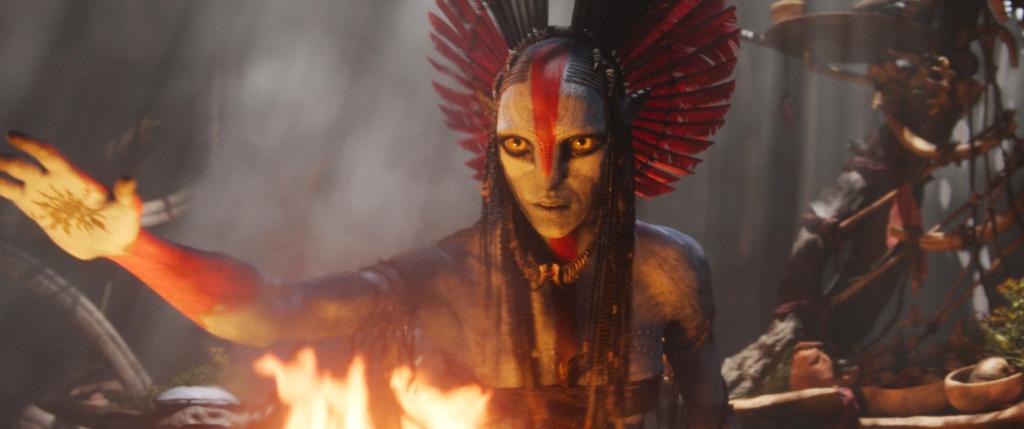
The Ash People are ideological extremists who believe in purification through destruction. They see humans and their rival clans as corrupting forces. In theory, they are an interesting escalation: Na’vi turned against Na’vi. Oona Chaplin makes a vivid impression as Varang, the formidable leader of the volcano-dwelling Mangkwan clan. But the account never develops them beyond their disruptive function. They simply exist as just another obstacle in the serenity of this realm.
Meanwhile, Colonel Quaritch (Stephen Lang), once presumed dead, returns in a Na’vi body. The broader conflict becomes increasingly centered on Spider (Jack Champion), the human boy raised among the Na’vi and Quaritch’s biological son. The film centers on Jake’s attempt to watch over his family while uniting Pandora’s clans as human forces and militant Na’vi factions push toward an all-out war.
Although Fire and Ash is technically the third entry in the Avatar series, it is, in all honesty, Avatar: The Way of Water – Part Two. It functions as a direct continuation of that picture, carrying over plot threads and even dialogue from the previous installment.
The actors do what they can with the material. Zoe Saldaña is a ferocious presence; her grief-fueled fury gives Neytiri an edge, while Stephen Lang continues to inject Quaritch with an unpredictable personality. Even when the dialogue feels repetitive, the cast sells the emotion that the basic script cannot.
That makes the spectacle highly dependent on how and where you watch it. I saw the film in XD 3D, Cinemark’s premium large-format presentation with brighter projection and enhanced sound. I can unreservedly endorse that version because it compensates for its narrative shortcomings. At home, this will feel more like a prestige miniseries, best enjoyed in five 40-minute episodes.
Yet again, I find myself lamenting the absence of a strong editorial hand. At three hours and eighteen minutes, this account is ridiculously long. James Cameron indulges his imagination with Tulkun rituals, spiritual mysticism, and hints of eco-religious reverence. They add texture, but these moments are more curiosities than necessities that drive a compelling story. This effort could easily lose 80 minutes and be a more enjoyable experience. A good editor doesn’t diminish a filmmaker’s vision; they sharpen it.
Once the novelty wears off, even remarkable craft can only carry a film so far. As a technical showcase, Avatar: Fire and Ash is formidable, but stretched to epic length, the storytelling reveals a weak foundation. The production is at its best when it celebrates scale. Epic battles, creatures, and environments carry the experience. That style is what kept me engaged. This is where James Cameron wholeheartedly delivers. Despite my misgivings, a third visit to Pandora remains a majestic spectacle. Its beauty stands as the film’s most enduring truth.
12-18-25
2 Responses
I completely agree. I was blown away by the spectacle in the first hour. After that, I had to rely on the story. It was ok, but not mind blowing. I still suffer as I did with the last two, because I can’t always remember who’s who. 7-10
I agree. For all its visual splendor, the Avatar struggles with character distinction. Many of the blue figures share such similar designs. They can be difficult to tell apart.