

Rating 6/10
Few contemporary filmmakers work under the personal risk faced by Jafar Panahi. Long banned by the Iranian government from making movies, Panahi has nevertheless continued to work in defiance of those restrictions. His career (The White Balloon, Offside, No Bears) has often focused on marginalized figures under bureaucratic systems. Iranian cinema on the world stage is often represented by the moral dramas of Asghar Farhadi, whose international success has made him a more protected figure. Panahi operates from a more precarious position, aggressively challenging the government. That context gives It Was Just an Accident a unique force.
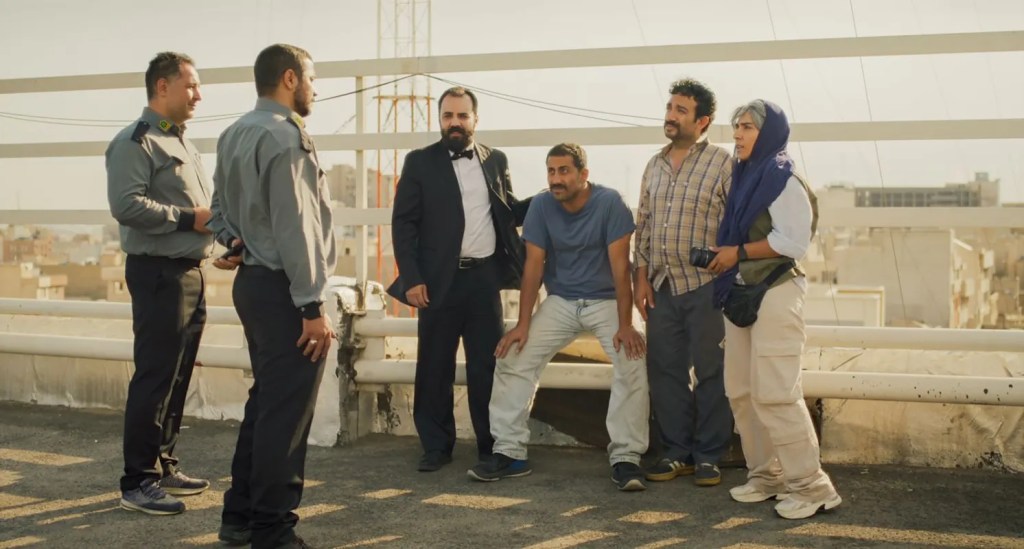
The account unfolds over lengthy conversations among a small group of people debating whether the man they have captured is, in fact, the person who wronged them in the past. Vahid (Vahid Mobasseri) drives the confrontation, but he is influenced by those around him. There’s photographer Shiva (Mariam Afshari), an engaged couple, Goli (Hadis Pakbaten) and Ali (Majid Panahi), and the more volatile Hamid (Mohammad Ali Elyasmehr).
Vahid believes the man in their custody was complicit in abuses tied to state power. The encounter is a reckoning with someone who once held authority over his life. Each character offers a different perspective. The film shifts from the question of whether he is the right man to a deeper consideration of whether a forceful act can offer any real resolution. The hostage’s family, including his wife (Afssaneh Najmabadi) and daughter (Delnaz Najafi), complicates matters considerably.
I appreciated the setup, and the ideas Panahi is engaging with are genuinely compelling. I’m always drawn to films that offer a window into another culture, even when that view is filtered through the clouded lens of unresolved anger. However, these talk-heavy ethical scenarios are notoriously difficult to conclude in a satisfying way. Panahi falters in finding an ending that matches the strength of his premise.
The final stretch features a static shot of the restrained man and his accusers. At one point, the camera doesn’t move for nearly fifteen minutes. That cinematic choice is audacious to be sure, but it saps the energy and halts the momentum. The saga furthermore closes on deliberate ambiguity meant to invite a dialogue. I welcome debate, but c’mon! The entire movie is one extended argument. This narrative demands a conclusion after so much conversation, not a prompt for another discussion.
11-11-25
2 Responses
I didn’t love this the way the critics are eating it up. It was fine. A little too long, but then ending shot was really good. 6/10
The circumstances surrounding the making of the film film are far more compelling than the film itself: made in secret in Iran despite Panahi’s ban, financed by France, and ultimately submitted to the Oscars by France—not Iran, which banned the film entirely.