
 Rating 8/10
I have a complicated relationship with director Yorgos Lanthimos. I don’t share his pessimistic worldview, but I admire his craft. I appreciated The Favourite for its wit, but I disliked Poor Things, which was more shock than substance. So when Bugonia came out last October, I heard that Emma Stone’s character was subjected to intense abuse. On that basis, I skipped it.
Awards season changed my mind. After hearing overwhelming praise, I decided to give Bugonia a chance. I’m glad I did.
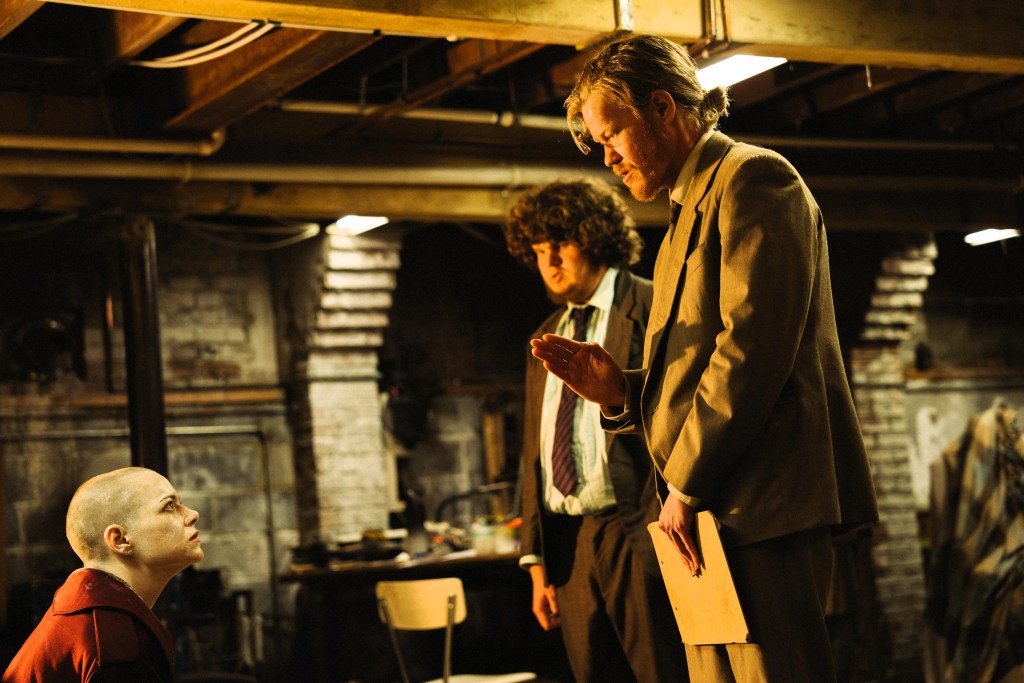
Jesse Plemons plays Teddy Gatz, a deeply unstable man. His paranoia convinces him of a supremely dark outlook. Michelle Fuller (Emma Stone) is a high-profile pharmaceutical CEO. She is also head of the company whose clinical trial left his mother, Sandy (Alicia Silverstone), comatose. In his mind, that isn’t even the worst of it. He believes she is an alien forcing humans into a state of numb subservience. He abducts Michelle with the help of his autistic cousin, Don (Aidan Delbis), believing he’s performing a moral duty.
What follows evolves beyond a standard captivity thriller into a mental standoff. Teddy gives Michelle four days to negotiate a meeting with the Andromedan emperor before an upcoming lunar eclipse. The conflict is psychological: Teddy seeks proof that his conspiracy theory is true, while Michelle strategically utilizes that belief system to gain leverage over him.
Bugonia is adapted by Will Tracy as an English-language remake of the 2003 South Korean picture Save the Green Planet! It’s elevated by a pair of brilliant performances. Plemons is terrific as Teddy Gatz. This could have been a cartoon fool, but he’s more frighteningly complex. Teddy is so convinced of his own righteousness that his delusions feel disturbingly plausible.
Emma Stone’s Michelle Fuller is a fascinating creation. She’s a thoroughly unlikable individual, but she has a distinct point of view. Michelle is never passive. Her ruthless tendencies verge into the amusing. As the CEO of a pharmaceutical giant, she embodies corporate hypocrisy with comic meticulousness. Michelle is superficially humane, while subtly reinforcing systems that benefit her own self-interest. An early workplace moment has her cheerfully reminding employees to absolutely leave when their shift ends… so long as they finish all their work first. It’s a pronouncement that encapsulates her philosophy: kindness is her brand, but the goal is control over the worker.
Michelle is not a victim. Once captured, she resists, adapts, and manipulates. She studies Teddy, identifies his vulnerabilities, and uses them to her advantage. The story grants her agency without freeing Michelle from guilt. She’s far more captivating than a traditional damsel in distress. At other times, she seems like an outright villain. You’re never quite sure whether to root for her escape or her reckoning. That tension is one of the saga’s great strengths.
Despite its premise, it’s not as punishing to watch as I feared. Lanthimos maintains control over tone and pacing, allowing the characters room to explain themselves. The ideas develop without tipping into gratuitous cruelty. And then there’s that ending: unusually decisive in an age where filmmakers too often lazily rest on ambiguity. It lands with a sense of completion. That matters. The film’s power ultimately lies in its conclusion.
Bugonia didn’t convert me to Lanthimos’s negative philosophy, but it reminded me why I keep returning to his work. When his provocations are rooted in fascinating characters and outstanding performances, he can be compelling. This is one of those times.
12-04-25