
 Rating 6/10
The 28 movies have become a franchise of footpaths branching off in strange, occasionally inspired directions. 28 Years Later: The Bone Temple is the fourth installment overall, but the second chapter in the 28 Years Later trilogy, penned by Alex Garland. Survival in this world is no longer about rebuilding. It’s about learning how to live within a fallen society. Belief systems are the next thing to mutate. The Bone Temple takes that idea and runs it straight into madness. Director Nia DaCosta, who helmed the 2021 Candyman sequel, takes over for Danny Boyle. This chapter is more focused on people than the infected, and the line between television and cinema continues to blur. It unfolds like another episode of a TV series, concerned with intersecting storylines and setting pieces in motion rather than offering resolution.
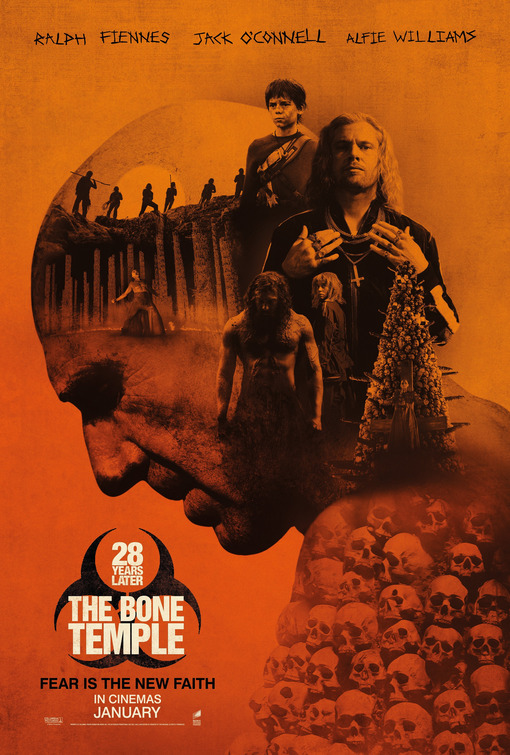
In the aftermath of the outbreak, Spike (Alfie Williams) is a teenage survivor who is forcibly inducted into a deranged Satanist cult. The Fingers are led by the sadistic Sir Lord Jimmy Crystal (Jack O’Connell). As Spike struggles to survive the group’s violent initiation rituals, the narrative reveals parallel threads of desperation. Jimmy Ink (Erin Kellyman) emerges as a quieter presence. She is more committed to her own survival than Sir Jimmy’s dogma. She forms a tentative bond with Spike because she shares his growing revulsion. Dr. Ian Kelson (Ralph Fiennes) exists on the outskirts of this chaos, an isolated doctor preserving an ossuary of skulls and skeletal remains in his macabre “Bone Temple” while chemically pacifying a terrifying, diseased Alpha nicknamed “Samson.”
The Fingers overtake the farm of a small band of survivors that includes Tom (Louis Ashbourne Serkis), his pregnant wife, Cathy (Mirren Mack), and their companions George (David Sterne), Matthew (Elliot Benn), and Jane (Lynne Anne Rodgers). Sir Jimmy’s hunger for sacrifice pushes the physical cruelty into especially punishing territory. Spike’s disgust adds to Ink’s unease. When the boy runs outside to vomit, Ink follows to comfort him. From a distance, she witnesses Dr. Kelson dancing by the fires with Samson. His ability to tame an infected Alpha plants an idea, one that will draw these seemingly disparate individuals together.
The saga really ups the bloodletting this time around, to the point where I had to look away from the screen several times. I am reminded of that Simpsons episode when Bart admonished Lisa as she covered her eyes while watching a particularly gruesome movie called Space Mutants IV. “If you don’t watch the violence, you’ll never get desensitized to it.” I can attest that I have not been desensitized to ritualized sadistic gore. There is the skinning of victims, a decapitation, the eating of human brains, and even a crucifixion.
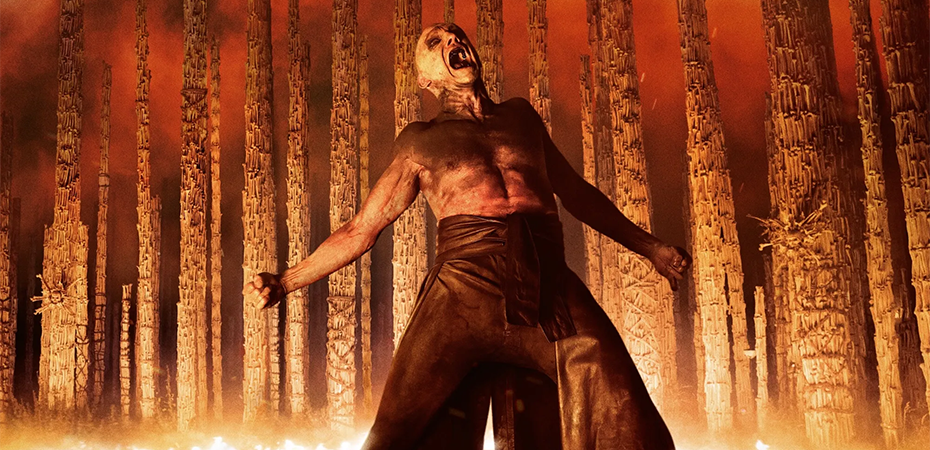
This is the Ralph Fiennes / Jack O’Connell show. Actor Alfie Williams, who was so memorable in the previous film, is largely sidelined here as Spike. Fiennes gives a truly odd performance. The character oscillates between mad scientist and caretaker. Kelson tranquilizes the afflicted Alpha with morphine to keep him subdued. After a while, Samson deliberately visits the physician to get drugs, putting him in a peaceful state. As their bond grows, Dr Kelson slow-dances with the docile giant to “Ordinary World” by Duran Duran. The moment is so ridiculous that it made me chuckle. Later, the accidental prophet stages an aggressively theatrical spectacle, surrounding himself with flames and hallucinogens as he plays the part of the devil, blasting “The Number of the Beast” by Iron Maiden. The set piece is wildly entertaining, pushing a rock-god persona into near-camp excess.
The picture is well-acted, and it offers a compelling story. That an ideology can regress from being spiritual into a practical tool that people exploit to maintain control is a compelling premise. Far more interesting than the reliance on transgressive horror. But there’s also a surprising amount of silliness woven throughout. That helps to momentarily cut the tension and imbues the atmosphere with an uneasy, almost mischievous tone. That said, the events lean too heavily on performative violence. The inner workings of these personalties and the way their motives intersect are far more interesting than the film’s reliance on bodily mutilation. The gore isn’t necessary to make the point, and it isn’t illuminating. The central thesis is strong enough on its own.
01-15-26