

Rating 4/10
Coming-of-age movies are a dime a dozen. So, when a film can offer a truly unique perspective on adolescence, it’s a breath of fresh air. Liquid Sky (1982), The Virgin Suicides (1999), Donnie Darko (2001), and Mysterious Skin (2004) introduced us to eccentric characters, bizarre artistic flourishes, and idiosyncratic soundtracks. I Saw the TV Glow would like to join the same quirky pantheon of films. Sorry, but thanks for trying.
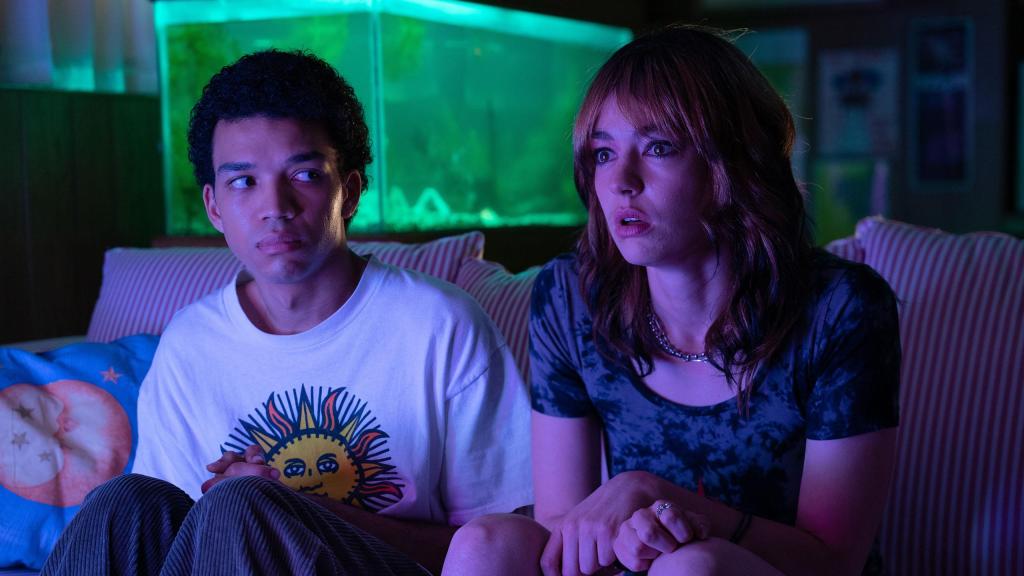
The drama is an eerie journey of self-discovery. Most of the listings in print have labeled it as a horror picture, but it isn’t scary in the traditional sense. Our tale begins in 1996 when isolated seventh-grader Owen (Justice Smith) befriends ninth-grader Maddy (Brigette Lundy-Paine). The fact they both have oppressive fathers is a troubling connection. However, their real bond is based on their love for a young adult TV show called The Pink Opaque. It’s kind of similar to the late 90s program Buffy the Vampire Slayer. The Pink Opaque is also the name of a 1986 album by the Scottish rock band Cocteau Twins. As a child of the 80s, I was pleased by the reference.
The supernatural TV series follows teenage girls battling monsters using their psychic connections. Owen and Maddy develop a near obsession with the program and imagine themselves as the main characters: Isabel (Helena Howard) and Tara (Lindsey Jordan), respectively. The show has a complex mythology. It becomes a portal to another dimension that allows them to seek a more authentic self. Maddy is particularly affected: “Sometimes The Pink Opaque feels more real than real life,” she asserts. Maddy rejects her current situation and proposes they run away together.
The account fails to deliver a satisfying exploration of the bizarre. At the very least, a movie should engage by delivering a compelling story. When woven into an intriguing tale, unconventional elements can enhance a cinematic experience but they shouldn’t replace it. What I gleaned from this story was that entertainment has the power to foster a sense of community. A significant part of the saga is Owen’s attempts to see a broadcast that airs at 10:30 pm when his bedtime is 10:15 pm. Lying about sleepovers and getting recordings from Maddy via VHS tape are ways he can see the drama. Unfortunately, despite the attempts at weirdness, this chronicle fell flat. As personalities, Owen and Maddy are vague and unengaging. The slow, halting cadence of their conversations stretch a sentence that should take a couple seconds into a full minute. Owen is so passive he barely registers as human.
I tend to walk into a movie blind with no knowledge or preconceived notions. Oops! Big mistake. I should have done some research first. Afterward, I scoured the internet for explanations. Director Jane Schoenbrun (We’re All Going to the World’s Fair) is a trans filmmaker who identifies as nonbinary and uses they/them pronouns. They wrote the screenplay in late 2020, just a few months into their transition. In one interview I read, they sought to highlight how themes of gender, transformation, and self-acceptance are intertwined. I Saw the TV Glow is an allegory for the trans experience. Schoenbrun crafted a piece intended to draw parallels to their own life. The account would have made more sense had I known this. It wasn’t clear from the presentation.
I can appreciate Schoenbrun’s film as an objet d’art. It has undeniable visual and auditory appeal. I enjoyed the soundtrack. In particular, Caroline Polachek’s “Starburned and Unkissed” is a catchy Fiona Apple-esque guitar-driven tune. Yet the chronicle is so inert and lifeless. Paris Is Burning (1990), Boys Don’t Cry (1999), and Tangerine (2015) explored similar themes with so much more passion. The chronicle lacks a cohesive narrative, character development, and emotional resonance. As such, the movie fails to meet the basics of entertainment. This is just a muddled tribute to ambivalence.
05-20-24