

 Rating 8/10
I’ll concede that Predator: Badlands sounds better than Predator 7, which, technically, is what this is for those counting (excluding the two Alien vs. Predator crossovers). Nevertheless, the title still sounds generic. However, in another sense, it fits. We’re venturing into unfamiliar territory for the franchise: fresh terrain, a different perspective, and a bold narrative structure. Director Dan Trachtenberg clearly loves this universe. This marks his third contribution to the Predator mythos, following Prey (2022) and the animated Predator: Killer of Killers, which debuted on Hulu earlier this year. Full disclosure, I couldn’t care less about this IP. I went in expecting a routine installment. I came out a convert to Trachtenberg’s vision of anthology-style storytelling. For me, this is not only his strongest entry yet, but arguably the finest Predator film to date.
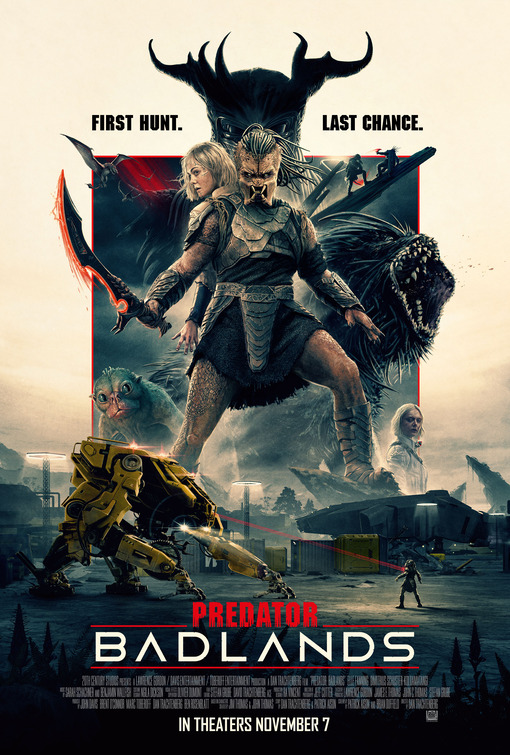
Dek (Dimitrius Schuster-Koloamatangi) is a young and undersized outcast of the alien race known as the Yautja. He’s desperate to prove himself worthy of his warrior clan. After defying the execution order of his brutal father, Njohrr (Reuben de Jong), he’s exiled to the hostile planet Genna, a treacherous “bad land” filled with lethal creatures and toxic terrain. There, he forms an uneasy alliance with Thia (Elle Fanning), a damaged android known as a synthetic, created by the Weyland-Yutani Corporation. Her team’s mission was to capture the Kalisk, a monstrous, regenerative lifeform deemed “unkillable.” They failed, and now she is stranded on the hostile planet. Thia becomes Dek’s unlikely companion and tool. Determined to return home not as a disgrace but a legend, Dek sets out to complete an impossible hunt that could restore his family’s honor.
Traditionally, this series has centered on humans fending off the Yautja species with deadly results. For the first time, Badlands flips the script: the story unfolds entirely from the alien’s point of view. This shift in perspective breathes new life into the franchise. Working from a screenplay by Patrick Aison, Trachtenberg doesn’t play it safe. He injects humor, heart, and bold choices that make this installment feel genuinely fresh.
Some purists may bristle at how different it is. The PG-13 rating will already frustrate shock-seekers who crave gore and profanity, but in their place comes style and inventiveness. The restraint makes sense. There are no humans here: Robots don’t swear, and aliens don’t bleed red blood (though there’s plenty of non-human goop to go around). The result is more polished than gritty, with a Disney-produced sheen that reflects its 20th Century Studios ownership. Adding to the accessibility is Bud (Rohinal Narayan), a cute creature who joins Dek and Thia. He’s the kind of endearing sidekick that wouldn’t be out of place in a James Gunn Marvel movie. Those seeking raw, R-rated realism may miss the grit, but we have six other films to scratch that itch. This one dares to evolve.
Dek’s pursuit of the invincible Kalisk is surprisingly compelling. As a runt among his tribe, his vulnerability adds a unique personality quirk to the hunt. Elle Fanning is terrific in a dual role: primarily as Thia, the damaged synthetic whose entire lower half is missing for much of the film. Dek carries her like a backpack as she delivers motor-mouthed commentary, offering humorous observations and quips. Fanning also plays Tessa, Thia’s identical “sister” and antagonist, accompanied by an army of drone synths (all played by Cameron Brown). She nails the tones of the clashing personalities, both comedic and chilling, with aplomb.
If there’s a drawback, it’s the heavy reliance on CGI. Though shot in New Zealand and occasionally featuring natural landscapes, much of it feels like it was shot on soundstages augmented by computer backgrounds. Despite that, the visual world remains captivating. The action sequences pop, and the humor arises naturally from character dynamics rather than pop-culture gags.
Setting the story on the predators’ home world gives us a rare glimpse into their society, revealing the codes they live by, the brutal rituals that define them, and the rigid hierarchy that governs their kind. Even with that depth, Badlands remains self-contained and accessible, thanks to a simple and efficient plot. Trachtenberg finds time to slip in deeper ideas: the struggle for survival blurs the line between prey and protector, and Dek’s journey suggests that true strength isn’t found in the kill but in what, and whom, he’s willing to stand up for.
Predator: Badlands redefines a franchise. It trades bloodlust for imagination, brutality for character, and tired formula for reinvention. It’s a daring experiment that pays off, and proof that even a well-worn IP can still surprise when placed in the hands of a filmmaker with vision and heart.
11-06-25
2 Responses
I expected a completely different movie than what I got, and I liked this version, a lot! It was unlike the others and it was a welcoming change. I laughed and enjoyed the chemistry between the characters. A lot of fun and excitement. 4 🌟
That we got the best Predator movie since the first (maybe ever?) might be the biggest cinematic surprise of 2025.