

Rating 8/10
Historical fiction takes the bare bones of what we think we know about a time period and breathes new life into it. It invites us to engage with history as real people. The imagined conversations create a bridge between contemporary readers and distant eras.
Maggie O’Farrell’s 2020 novel takes a figure largely unknown to history. What survives is that William Shakespeare’s only son died at age 11 in 1596 and little else. O’Farrell uses that ambiguity to explore how the event affected the family. It conjectures that William was inspired to write Hamlet, but it more interestingly centers on how the loss affected his wife, Agnes Hathaway, a period-accurate form of the name later rendered as Anne. “Hamnet” and “Hamlet” were essentially interchangeable names in Elizabethan England. While no historical document states outright that Hamlet was written in response to his son’s death, the name and chronology of events make the idea believable.
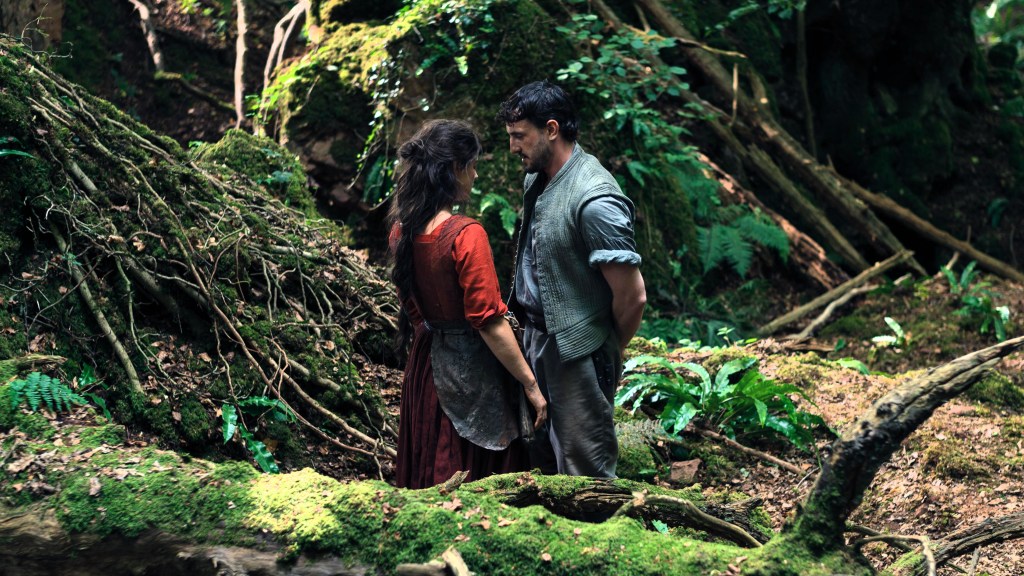
Agnes (Jessie Buckley) is a free-spirited healer in Renaissance Stratford. She’s into herbal healing, falconry, and other woodland-based wisdom. The villagers see her as a kind of witchy figure. William (Paul Mescal) is a shy Latin tutor, but he is instantly captivated by the enigmatic woman and keeps returning to her family’s barn. She initially holds him at arm’s length, but their bond deepens quickly.
William and Agnes’s relationship begins in secrecy, and they become intimate. The forest woman soon discovers she is pregnant. Agnes’s stepmother (Justine Mitchell) banishes her from the household for her out-of-wedlock pregnancy, while William’s domineering father (David Wilmot) also disapproves of the match. Despite resistance on both sides, the two marry, and Agnes gives birth to their first child, Susanna (Bodhi Rae Breathnach). Within a few years, Shakespeare’s wife welcomes fraternal twins: Hamnet (Jacobi Jupe) and Judith (Olivia Lynes). As the young playwright begins traveling to London to pursue a career in theater, Agnes remains in Stratford, raising their young family. This domestic divide becomes an issue.
Chloé Zhao has a gift with actors. The director can take the text of the page and shape performances that feel authentic. She clearly understands how the loss of a child could weaken a marriage and influence an artist’s life. She brings that insight much the same way she guided Frances McDormand. Her Oscar-winning turn in Nomadland was so authentic it bordered on documentary. That film showed Zhao’s sensitivity to human pain and resilience, and she delivers the same touch here, guiding Jessie Buckley in an achievement that truly galvanizes the viewer.
Jessie Buckley is the reason Hamnet works as well as it does. Sure, the cast around her is strong. Emily Watson carries herself with confidence as the future Bard’s mother. Jacobi Jupe is wonderfully natural as his son, young Hamnet, and his real-life older brother, Noah Jupe, is smartly cast as the actor portraying Hamlet onstage. Paul Mescal is a compelling Shakespeare. Yet all of these roles orbit around Buckley, whose portrayal of Agnes is the focus. She conveys raw feeling with such clarity in several key scenes. There are many, but the frustration over her husband’s long absences in London and the mesmerizing dramatization at the playhouse in London stand out.
I have always struggled with the language of the Elizabethan stage. It demands study and patience. I even took Masterpieces of English Literature in college, and I still find it challenging. The film’s soulful peak rests on a theater production of Hamlet, and seeing that play through Buckley’s eyes makes the moment all the more powerful. The portrait unfolds at a deliberate pace to get to that final emotional surge. I wasn’t entirely convinced until the ending gave everything a sense of purpose. They say it’s not the destination but the journey. Here, the climax pulls everything together, and I was genuinely moved. Buckley has been nominated for an Oscar before (The Lost Daughter), and she will undoubtedly be nominated again. I dare say she may get the award this time, and it would be well earned.
12-02-25
2 Responses
“They say it’s not the destination, but the journey”. That line is exactly what made it so emotional at the end for me. I’d like to see this again just to revisit everything that led me to that awesome conclusion. 9-10
Agreed. It was a powerful conclusion.