
 Rating 7/10
Brazilian filmmaker Kleber Mendonça Filho has spent the last decade making movies rooted in everyday life, but tinged with strangeness. American audiences know him for Aquarius and Bacurau. These films have small but passionate followings. The Secret Agent, buoyed by four Oscar nominations, including Best Picture, is his most accessible work yet. At 158 minutes, however, it requires patience.
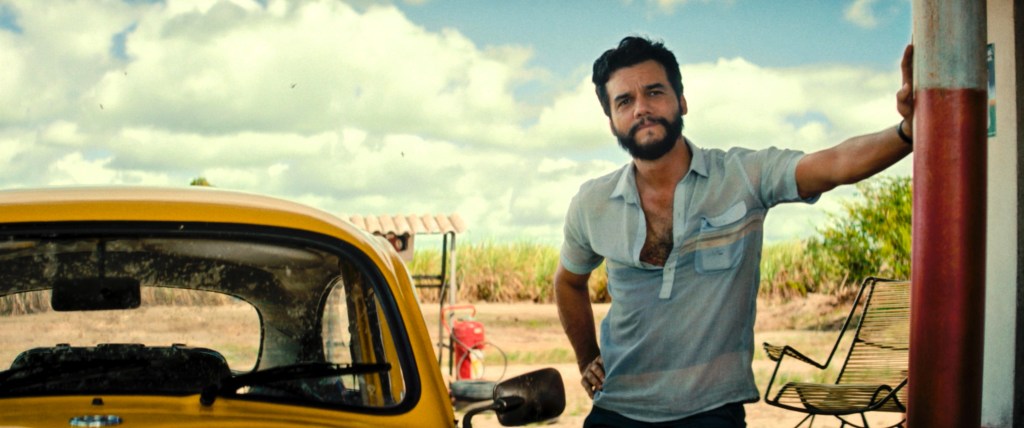
The account follows Armando Solimões (Wagner Moura), a former professor and recent widower. He returns home to Recife during Carnival in 1977, hoping to reunite with his young son (Enzo Nunes). It’s the tail end of Brazil’s military dictatorship, and Armando lives publicly under an assumed name, Marcelo Alves, working quietly at the state identity card office. Privately, he is connected to a network of political dissidents. He exists within a system of surveillance that seems benign on the surface, yet is anything but. Corrupt police smile and joke while exerting control through unspoken threats. Even the most bizarre subplot, the discovery of a severed human leg inside a shark, verges on the surreal. When the limb reappears at Carnival, it becomes another frightening reminder of a regime that erases people.
Armando is not a “secret agent” in the conventional sense. He is watched by forces he never fully sees. One of the most challenging aspects is how long it takes to understand what the movie is really about. For well over an hour, Mendonça Filho allows the tale to drift between incidents and characters without a clear narrative destination. Only gradually does it become apparent that this is not a traditional conspiracy thriller. It is a portrait of a state that weaponizes its ability to make people disappear and treats it as a fact of life.
By keeping the story deliberately vague, there is an enormous emphasis on performance. Wagner Moura carries the film. Armando is defined by restraint. He understands that visibility is dangerous, and Moura builds the character around that knowledge. He navigates conversations without ever offering more than necessary. Fear registers in how rarely Armando pushes back. His alias is more than a disguise. It is a survival technique. Moura also plays Armando’s adult son years later. The choice allows the accumulated weight of that life to speak volumes.
The supporting cast reinforces the sense of systemic pressure closing in. Udo Kier, in his final screen appearance, plays a weary German refugee whose interrogation draws a direct line between historical atrocities of the past and the present machine of state violence. Gabriel Leone and Roney Villela appear as Bobbi and Augusto, hired assassins whose calm professionalism turns murder into routine work. Carlos Francisco lends warmth as Armando’s father-in-law, Sr. Alexandre, who manages an aging movie theater that doubles as a refuge and meeting ground. The film’s love of cinema uses a recurring Jaws motif. Presiding over it all is Tânia Maria as Dona Sebastiana, a 70-something woman who shelters political dissidents in her home. Her importance lies in the simple, daily care she offers.
The Secret Agent is not in a hurry to tell you what it’s about, but when it does, it demands to be remembered. For long stretches, the saga withholds clarity. The first 70 minutes require patience. The viewer must sit in uncertainty, much as its characters do. But when the plot reveals itself, those fragments lock into place. What once felt diffuse becomes a specific accumulation. The performances carry that transition, and Moura, in particular, makes the ending resonate.
11-27-25
2 Responses
The Secret Agent is not in a hurry to tell you what it’s about, but when it does, it demands to be remembered. My thoughts precisely great review
I can’t tell if it will be this or “it was just an accident”
For best forgien but thanks for your insight
You need a great job explaining and showing us your unique perspective on this interesting film.
Thank you. In a separate text, you made a great observation comparing the film’s use of a larger historical backdrop to movies like Summer of Sam, where intimate, personal stories unfold beneath bigger cultural moments.
Appreciate your insight. One day you’re going to start sharing your film thoughts in a vlog. Your perspective deserves a wider audience.