
 Rating 7/10
The emotional swell of French composer Maurice Ravel’s Boléro announces the opening moments. That slow, insistent build has scored seduction to spectacle in films 10 and Allegro non troppo. For a moment, it feels grand. Then the illusion falls apart when we realize that’s just what our protagonist is listening to on his headphones in a crowded subway, drowning out the world around him. It’s an auspicious beginning for a movie that unfolds as a meditation on the ways we tune out discomfort and sidestep responsibility.
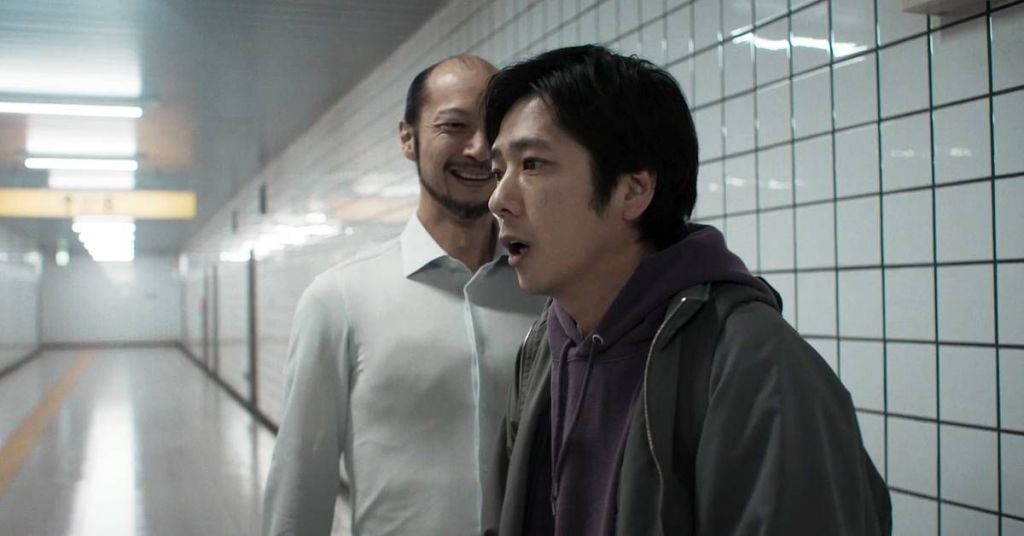
A man (Kazunari Ninomiya) riding the metro observes a tense encounter between an angry passenger and a distressed mother with a crying baby. Then he receives a life-altering call from his ex-girlfriend (Nana Komatsu), who reveals she is pregnant. Upon leaving the train, it takes him a while to realize he has been walking in circles, trapped in a surreal, looping corridor. He desperately wants to find a way out, and this experience is just as emotional as it is physical.
The whole point is to uncover irregularities and react accordingly. A cryptic sign on the wall lays out the rules: “Do not overlook any anomalies. If you find an anomaly, turn back immediately. If you do not find any anomalies, do not turn back.” He slowly realizes that if he doesn’t follow these rules, he is reset to the beginning, Exit 0. The man is trying to reach Exit 8, and he does make progress, Exit 1, Exit 2, and so on, but each mistake sends him back to Exit 0, and it happens over and over. The problem is, it isn’t always clear to the audience what he missed. It can get a bit exasperating, but I suppose that’s the point, and in that sense, it’s effective at producing dread.
Three other characters are introduced: a walking commuter (Yamato Kochi), a little boy (Naru Asanuma), and a high school girl (Kotone Hanase). Are these people also trapped in the same space, or perhaps figments of his imagination? Additionally, the monotony is punctuated by strange, intrusive details such as rats with human parts and walls that drip blood, a la The Shining. Also recalling Stanley Kubrick’s classic, when the little boy first appears, standing alone in the center of the corridor, that image takes on an eerie charge. I half-expected him to whisper “Hello, Danny,” even though our star remains unnamed.
Veteran anime producer Genki Kawamura directs his second feature, following A Hundred Flowers. The film is based on the 2023 indie video game The Exit 8. Kawamura ratchets up the anxiety as his protagonist wanders through a kind of cosmic purgatory. The movie is more of a surreal dream than a traditional narrative, and as an eerie mood piece, it’s quite effective. The sterile production design of the endless subway tunnel is vivid and deeply unsettling.
Exit 8‘s place within Japanese horror is an abstract, existential cousin to Ringu, Ju-On: The Grudge, and other works. The narrative is not about traditional scares but exploiting the building dread of repetition. Even at a brisk 95 minutes, it still tests the viewer’s patience with the endlessly looping motif of a white-tiled hall. Thankfully, the ending offers some explanation for why he’s been put through this ordeal. It trades ghosts for guilt, and the effect is a creeping horror that lingers. In that sense, I welcomed the finish. It finally ends with a sense of clarity that this meandering and seemingly pointless journey often lacks.
04-16-26