
 Rating 5/10
There’s a nagging emptiness at the center of Michael. For all its spectacle and reverence, it never answers the most basic question a biopic should pose: Who was this person?
The narrative follows a familiar arc, beginning with the Jackson 5 grinding through small-club performances before rising to fame, then charting Michael‘s solo ascent through Off the Wall and Thriller, and culminating with the Bad era. Structurally, it’s a greatest hits reel acting as a narrative. Director Antoine Fuqua (The Equalizer) dutifully checks off milestones without pausing for a moment to probe any of them. Blame the screenplay by John Logan (Skyfall, Spectre). He’s utterly content to stage famous moments without exploring the evolution of a personality shaped by those experiences. Each airbrushed vignette remains frustratingly thin. A great cinematic saga can show how one moment shapes the next. Michael largely sidesteps that work, presenting each development as an isolated tableau.
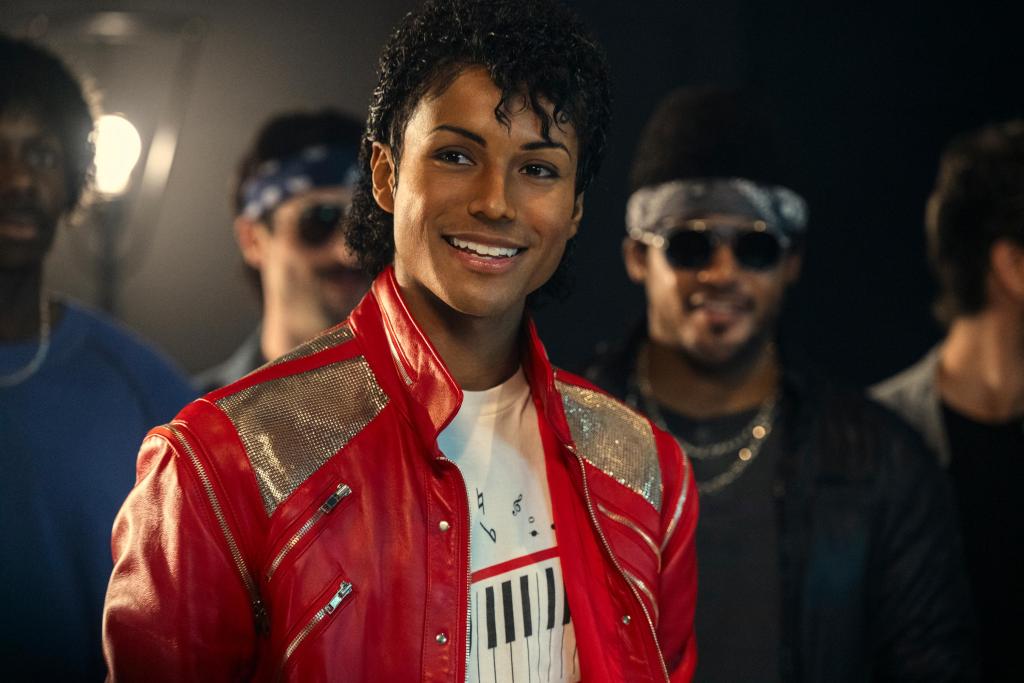
To the film’s credit, the portrayals are often compelling. Young actor Juliano Krue Valdi captures the precocious intensity of a child performer thrust into adulthood far too soon. At the same time, Jaafar Jackson, Michael’s real-life nephew, delivers an eerily precise physical and vocal embodiment of the pop icon at his peak. His impersonation is less an interpretation than a channeling, and for stretches, it is enough to carry the study on sheer mimicry. If you are content to watch a near-perfect illusion of the King of Pop in all his dancing and singing glory, this may be enough.
But mimicry, no matter how technically impressive, is not insight. And insight is precisely what Michael lacks.
The account gestures toward the complexities of Jackson’s existence, his fraught relationship with his appearance, his loneliness, and his eccentricities. But it treats them in passing rather than as subjects worthy of exploration. His vitiligo is acknowledged in a single, almost perfunctory exchange. His discomfort with his own face is addressed with a single nose job. His well-documented tendency to spend time with children is reduced to hospital visits, paraded as acts of charity, while his whimsical shopping sprees for toys are depicted as a personal indulgence. He brings home a Twister game to the disinterest of his adult brothers, and one of them jokes that they have a date and will play Twister for real. I laughed at that.
Even the creative process, which is arguably the most fertile ground for a showcase about an artist of Jackson’s magnitude, is rendered with baffling superficiality. I experienced the cultural dominance of Thriller firsthand and still consider it one of the greatest works ever recorded. I have read extensively about the making of that album. Virtually none of the fascinating details behind its creation find their way into this account. Inspiration is not framed with any of the struggle or experimentation that we should expect. We just get a larger-than-life shorthand. So a mere glance at a Vincent Price film leads, almost magically, to the title song; a news segment about gang violence becomes the seed for the music video “Beat It.” There is no trial and error or any indication as to why these ideas mattered so deeply to him.
The same lack of depth defines the supporting characters. Colman Domingo plays Michael’s father as a complete caricature of cruelty. An early scene introduces him, memorably, by beating his son with a belt during a rehearsal. Nia Long brings a gentler and more beatific presence as his mother. Yet even she is reduced to platitudes, dispensing warmth and encouragement like the pronouncements of a benevolent queen rather than a human mother. This moral universe is stark and uncomplicated. People are either saints or monsters, and there is no room for anything in between.
The biopic’s endpoint is equally telling. It culminates with the artist’s triumphant 1988 Bad Tour performance at Wembley Stadium, a rousing finale that conveniently draws the curtain before the far more troubling chapters of his personal history. That cutoff underscores the broader evasiveness of this showcase. Even within the period it does cover, the portrait remains agonizingly shallow. The priority is to preserve the legend, not probe the eccentricities.
That is the ultimate failure of this dramatization. Michael offers us no understanding of the man. It is a shrine, a hagiography that canonizes its subject as a pop deity and dodges the messier details that made him human. This is an icon in full regalia, with the electrifying discography to match, but it does not examine how that fame affected his inner psyche.
There is undeniable pleasure in the music, of course. The songs remain transcendent, the performances exhilarating. And in Jaafar Jackson, the chronicle finds a performer capable of conjuring the ghost of Michael with uncanny precision. But when the tunes are not playing, what persists is the lingering sense that we are kept at a distance, invited only to view a curated exhibit in a museum behind glass in a sanitized display. For a figure as endlessly dissected and mythologized as this global phenomenon, distance is the one thing a dramatization cannot afford. Michael may satisfy as pageantry and tribute, but as a critical examination, it barely scratches the surface.
04-23-26
2 Responses
It was exactly what I expected. A puff piece with great mimicry. I too, learned nothing about this strange guy. You can go on YouTube and see the real performances. It was just a greatest hits movie. 5/10
Yup. Great show, no substance.