
 Rating 6/10
“When I find myself in times of trouble, Mother Mary comes to me.”
I can’t look upon this movie’s title without immediately singing the appropriate lyric from “Let It Be” by the Beatles. In a weird way, it makes sense. That misplaced connection is pretty common when it comes to director David Lowery and me. He’s capable of everything from the mesmerizing The Green Knight to the lifeless Peter Pan & Wendy. So going into his latest opus, I was prepared for transcendence… or frustration. It’s a bit of both.
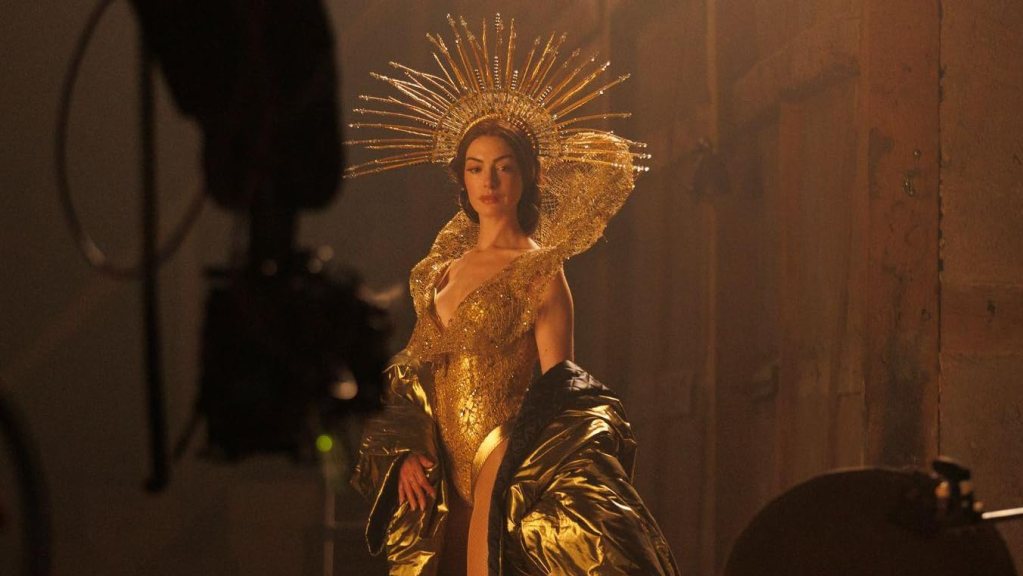
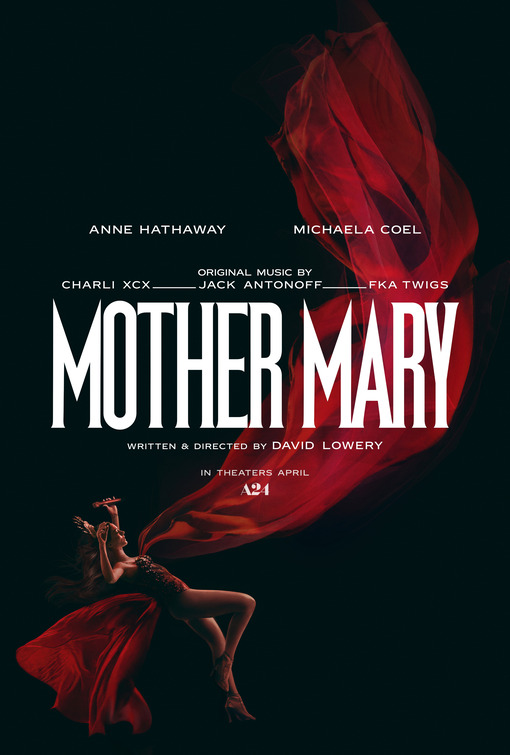
Mother Mary follows a global pop superstar on the brink of a high-stakes comeback. Mother Mary (Anne Hathaway), the performer, evokes a lineage of pop stars, combining the religious imagery of Madonna’s “Like a Prayer” and the theatricality of Lady Gaga with the anthemic bangers of Taylor Swift. An onstage accident triggers a crisis of conscience. She retreats to the English countryside, seeking out her estranged former collaborator, fashion designer Sam Anselm (Michaela Coel). Their association is professional, sure, but perhaps something more. This is never clearly explained. That ambiguity defines the entire production.
With only days before a major performance, Sam reluctantly agrees to design Mary’s signature look in her barn-sized workshop. Their partnership launched Mary’s career, and left Sam largely erased from its legacy. What unfolds initially is a riveting, extended dialogue between the two women. Their back-and-forth is sharp, emotionally charged, and deeply revealing. The screenplay unpacks the history of their relationship and the reasons behind their estrangement. Michaela Coel is especially magnetic. Her commanding presence, accentuated by her striking features and penetrating gaze, makes every line feel so precise. These scenes are, without question, the strongest.
However, what begins as a grounded and compelling character study gradually wanders into more surreal, less coherent territory. The account introduces a shared haunting, a literal spectral entity that seems to represent their unresolved tensions. It’s a crazy shift that I might have embraced. Unfortunately, it devolves into something that muddies the clarity established in the beginning.
Also, for a movie about a singer, it promises a richer musical experience than we actually get. Through fragmented flashbacks, we glimpse Mother Mary at the height of fame. She commands the stage, surrounded by dancers, before adoring crowds. These sequences are hypnotic, fueled by original tunes from Charli XCX, Jack Antonoff, and FKA Twigs. Twigs also appears onscreen as a mysterious medium who can contact otherworldly spirits. She contributes what is arguably the standout track, “My Mouth Is Lonely For You.” It offers a taste of what could have been.
This disappointment extends to an intriguing setup. Mary repeatedly hypes a composition titled “Spooky Action.” She contends it’s “the best song ever written in the history of songs.” Yet, in a cheeky narrative choice, we never actually hear it. Sam, having chosen to stop engaging with Mary’s music altogether, refuses to let her perform it. Instead, we watch Mary rehearse elaborate choreography in silence, thrashing through avant-garde movements without accompaniment. This elicits Sam’s perfectly timed question: “How are you going to sing while doing all that?” It’s a witty observation, but it builds anticipation for a payoff that doesn’t arrive.
Even the central visual motif, the dress Sam designs for Mary’s return to the stage, remains unfulfilled. We see the garment, but not worn by Mary in concert. The narrative positions this collaboration as the emotional and artistic culmination of their shared experience. Nevertheless, it stops short of delivering that catharsis.
We get a drama drenched in buried trauma and the possibility of exorcising it both literally and figuratively. David Lowery’s screenplay constructs a tale counting down to a defining performance, one that will crystallize who Mother Mary is and what she represents. Instead, the climax offers a subdued musical moment that is far from a declaration and more like a shrug. The absence of a true spectacle leaves a noticeable void.
By the end, we understand the cost of Mary’s ascent and the fractures it left behind. However, we’re still searching for a clear sense of who she becomes when she steps back into the spotlight. It’s an elusive conclusion. For a stylish exercise so steeped in iconography, it ultimately withholds the very revelation it seems to be building toward. As far as this story is concerned, I was unconverted.
04-28-26