

 Rating 6/10
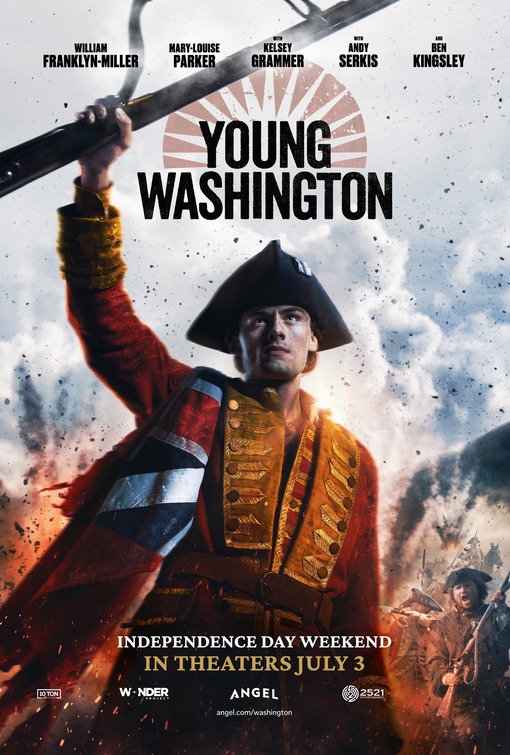
Young Washington is a goofy but sincere historical epic, the kind of movie that has its heart in the right place even as it turns George Washington into an 18th-century superhero. I hesitate to call it a biography, as it focuses only on Washington’s experiences during the French and Indian War. We’re talking about the years 1753 through 1755, a remarkably narrow slice of his life. The picture was released in the United States by Angel Studios on July 3, 2026, not coincidentally just ahead of the Fourth of July holiday. It presents a wholly reverential portrait of a future Founding Father and embraces many of the legends that have grown up around him.
The ideals associated with the nation’s early history are well worth studying. With that said, this film is better enjoyed as a riveting war drama than as a historical primer. It incorporates some documented events but often favors dramatic embellishment over documented certainty. Apparently, a sequel is already in development, so I can only assume Angel Studios has decided American history needs its own cinematic universe.
Who knew that George Washington was the Founding Avenger?
America’s first president is transformed from an untested Virginia surveyor into the military leader history remembers. After his father’s death, Washington (William Franklyn-Miller) learns surveying from his older half-brother Lawrence (John Foss). However, his dreams of becoming an officer are thwarted when he is unable to earn a commission in the British Army. Washington visits the plantation of Thomas Fairfax (Kelsey Grammer). There, he is introduced to the colonial elite and to Sally Cary (Mia Rodgers), the woman he hopes to marry.
His opportunity for military advancement arrives when Virginia lieutenant governor Robert Dinwiddie (Ben Kingsley) sends him on a dangerous diplomatic mission to the Ohio Country, where he is ordered to demand that the French leave the territory. The expedition brings him into an alliance with the Native leader known as the Half-King (Ryan Begay), but diplomacy soon gives way to bloodshed, drawing the colonies into the opening days of the French and Indian War. Washington is blamed for escalating the conflict. He later suffers a defeat at Fort Necessity and finds little comfort at home when the woman he loves becomes engaged to George William Fairfax (Joel Smallbone).
Encouraged by his mother, Mary Ball Washington (Mary-Louise Parker), he resolves to return to service, joining General Edward Braddock’s (Andy Serkis) campaign against the French, setting the stage for the battle that would define his legacy.
While the broad historical events are real, Young Washington leans heavily on American folklore. The screenplay promotes the old “Bulletproof President” myth, in which Native warriors supposedly fired at Washington during Braddock’s disastrous expedition, only to conclude that the Great Spirit had spared him because he was destined for greatness.
The real Washington did survive the Battle of the Monongahela with two horses shot from under him and bullets through his coat. The raw material is there, but the movie takes a remarkable survival story and decides God must have been doing the work. It does the same with the rest of his early life, treating every close call and mistake as evidence that he was destined for greatness. Crossing the icy Allegheny River on a makeshift raft is a test of character. The humiliation at Fort Necessity is treated as a necessary fall before the rise. His mother’s belief that God is protecting him is another sign that Washington was a man being guided toward a larger purpose. In this telling, every failure is a stepping stone on the road to becoming a predestined legend.
Sure, mythology can be stirring. Much of the film’s most miraculous material comes from stories that surfaced decades after the events and remain impossible to verify. The saga often feels like Captain America transplanted to the colonies. Superhero movies are fun, and this is engaging to a point. I liked the first half more than the second. The climactic conflict dragged on as it marched toward an obvious outcome. By that point, I realized the chronicle wasn’t concerned with the facts so much as the legend. As a war drama, it’s interesting enough. Young Washington doesn’t invent the lore. It simply polishes it into an entertaining bit of patriotic hokum and sends it galloping into the fray. Just don’t use it to study for your AP U.S. History exam.
07-07-26