

From its origins as a powerful Pulitzer Prize-winning novel by Alice Walker, it became a critically acclaimed 1985 film directed by Steven Spielberg, garnering 11 Oscar nominations. The drama then found its way to the stage as a Broadway musical in 2005, which inspired this cinematic adaptation of that show. Blitz Bazawule (Black is King) directs, while Steven Spielberg serves as a producer alongside Oprah Winfrey, who played the role of Sofia in the 1985 movie he directed. The many artistic forms of this enduring story confirm how it resonates with audiences across generations.
Given the disturbing developments, a bright, splashy musical with joyful numbers is an odd choice for a story that calls for a more somber tone. Our chronicle follows the personal odyssey of Celie (Fantasia Barrino), a Southern black woman from 1909 to 1947. Teen Celie (Phylicia Pearl Mpasi) is close with younger sister, Nettie (Halle Bailey). However, her life is scarred by harrowing experiences with evil men. Raised in rural isolation in Georgia, she is subjected to physical and emotional cruelty by stepfather Alfonso (Deon Cole), who sexually abuses her. Celie will give birth to two children, who are then taken away. Celie is then forced into marrying a man she calls “Mister” (Colman Domingo). He continues this cycle of violence in an oppressive marriage. When sister Nettie visits, she refuses Mister’s advances who then kicks Nettie out of the house. The support from this sisterly bond is now shattered. Celie’s self-worth will be tested, and her voice will be further suppressed. However, there are bright spots.
It’s the performances that genuinely make this saga sing. American Idol winner Fantasia Barrino is a gifted vocalist who can belt a tune like nobody’s business. Barrino played the part of Celie in the 2010 National tour after taking over for LaChanze, who won a Tony for launching the role during its original Broadway run. Barrino seems confident and empowered even when bad things happen to her. It’s in the dramatic, non-singing moments that we have some understanding of her pain.
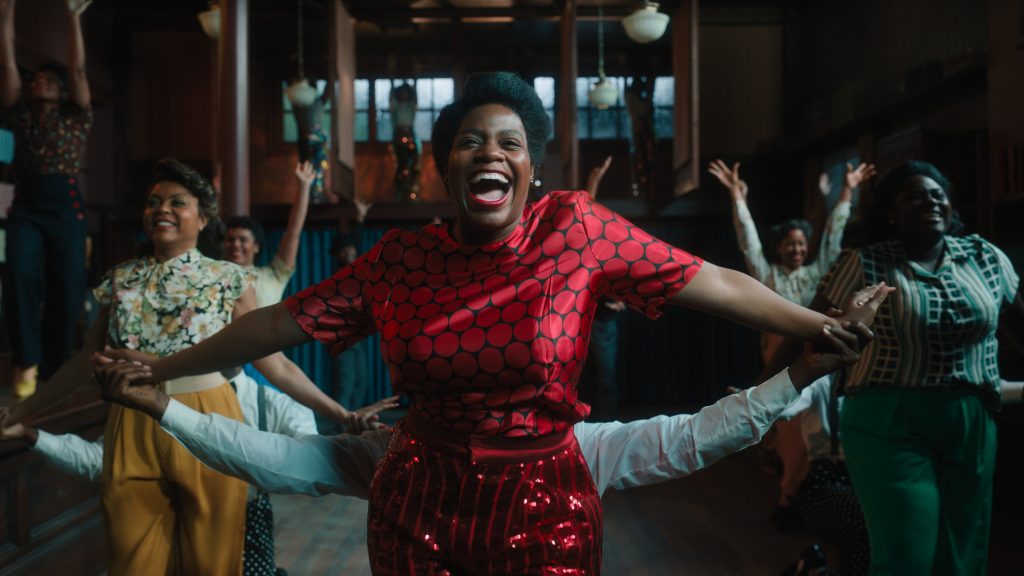
Celie’s meaningful connections with women are the key to her healing and liberation. Celie’s stepson, Harpo (Corey Hawkins), is married to a strong-willed woman named Sofia, embodied by scene-stealer Danielle Brooks. She is the most charismatic individual in the entire piece. Sofia’s refusal to be bullied will inspire Celie to discover her own sense of dignity. Brooks’s main number, “Hell No!,” is assisted by a rousing group of backup dancers that bring a brigade of badassery to her defiance.
Celie’s friendship with a glamorous blues singer, Shug Avery, will have a transformative effect. Shug is portrayed by the picture’s biggest celebrity, Taraji P. Henson. Shug will further uplift Celie’s subjugated character. The free-spirited woman is Mister’s sometime mistress, but Shug will also open Celie’s eyes to her own sexuality. The depiction of their love included a kiss in Spielberg’s 1985 reworking but their friendship remained chaste. This version embraces the more intimate aspects of Celie and Shug’s relationship that were present in the book.
This musical account presents a decidedly more upbeat tone than the original novel or even Spielberg’s adaptation. With music and lyrics by Brenda Russell, Allee Willis, and Stephen Bray, the play introduces uplifting melodies that contribute to a generally more hopeful mood. “What About Love?” “I’m Here” and “The Color Purple” are among those transferred from the Broadway show, along with vibrant new additions “Keep It Movin” and “Superpower, written for the Oscar…er uh…I mean the movie.
The production numbers pulsate as impressive feats of choreography and song. Yet they are more effective as separate pieces that highlight talent. They make Celie’s hardships seem not so hard. Even when Celie’s children are ripped away from her at the beginning, she sings “She Be Mine,” a tune that is strangely more buoyant than sorrowful. That ditty was written for but ultimately cut from the Broadway musical. Her confidence and self-actualization already seem in place from the start, so her willingness to be pushed around is somewhat puzzling. The soulful performances add a layer of positivity to the narrative, creating a more celebratory and resilient atmosphere. That works far better in the climax but not in Celie’s journey to get there. Alice Walker’s portrait of an oppressed woman who ultimately finds herself doesn’t seem like such a massive leap in this interpretation.
12-07-23
4 Responses
After rewatching the original. I quickly noticed the direction the musical was taking. It was less depressing and Celie was more confident in this version. It almost felt like an uplifting movie. The original took quite a while of suffering before you reached the satisfying powerful ending. This missed that completely. 3 ⭐️
This was surprisingly overlooked at the Oscars, save for Danielle Brooks’ lone nomination for Best Supporting Actress. Also, I can’t remember the last time a movie made one-third of its entire box office gross on opening day.
Fantastic Review! I really enjoyed it as well. I do prefer Spielberg’s version because it had a greater emotional impact. That being said, I thought it was great. Here’s my review: https://huilahimovie.reviews/2024/02/07/the-color-purple-2023-movie-review/
I Think Ciara would be great choice as Julie LaVerne In a Show Boat Remake