

Rating 8/10
Pixar is back! Only four of the studio’s films have reached a billion dollars at the box office worldwide to date. Whether it be because of themes that didn’t click with audiences or merely the simple fact that some pictures bypassed theaters and went direct to steaming, nothing has achieved the feat since Toy Story 4 in 2019. Given the opening weekend numbers, it’s safe to say that Inside Out 2 will also achieve that distinction. News flash: sequels sell.
Hard to believe, but it’s been nearly a decade since Inside Out came out. The 2015 film followed an 11-year-old girl named Riley and her core emotions: Joy (Amy Poehler), Sadness (Phyllis Smith), Anger (Lewis Black), Fear (Bill Hader now Tony Hale), and Disgust (Mindy Kaling now Liza Lapira). In the sequel, Riley (Kensington Tallman) has turned 13.
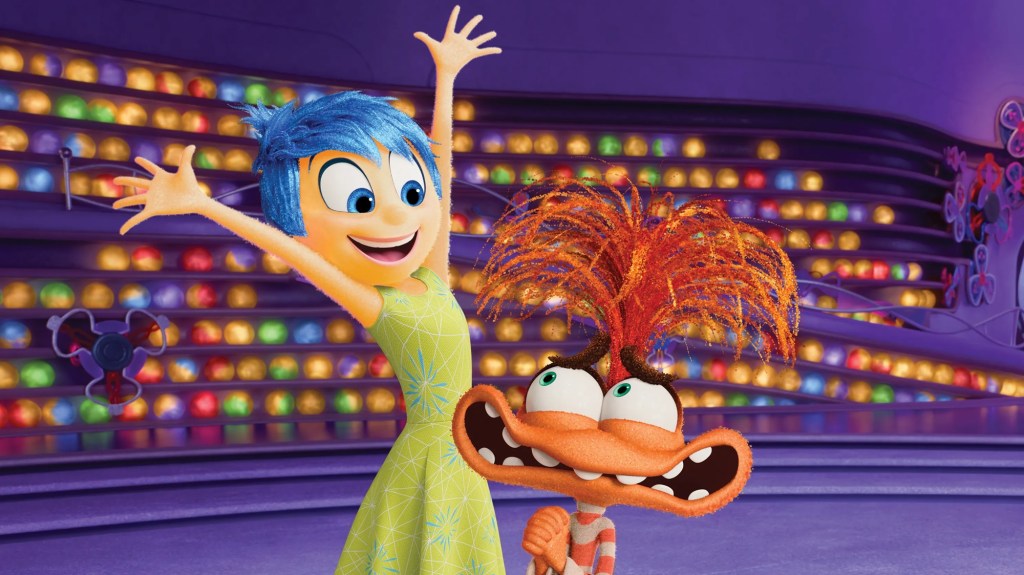
The account has her attending a hockey camp, and a new set of feelings rear their ugly head—Envy (Ayo Edebiri ), Ennui (Adèle Exarchopoulos), Embarrassment (Paul Walter Hauser), and Anxiety (Maya Hawke)—arrive. I’d argue that kids first encounter these attitudes far earlier in their life. However, I accepted the conceit because the conflict and chaos they cause are the very foundation of the entire story. Anxiety becomes the main character which is a dizzy orange creature that looks like a muppet Jim Henson might have created. The concept of panic and unease takes control, leading to a struggle between the past and present state of mind to restore balance. The current version of Riley’s brain includes a section called her Sense of Self.
Anxiety is the MVP of the production. The concept is innovatively portrayed. As voiced by Maya Hawke, she is initially depicted as a negative presence. However, Anxiety evolves to reveal her positive aspects, highlighting how she can be beneficial by helping individuals avoid failure and navigate challenges more effectively. This nuanced depiction underscores the complexity and value of all the temperaments in Riley’s personal development.
What made the original so innovative was how the screenwriters envisioned emotions being processed behind the scenes as little characters in the brain. The novelty is gone because it relies on the same perspective. However, there are enough unique ideas sprinkled in the narrative to offer some surprises. In the back of Riley’s psyche, while suppressed, the core feelings encounter a collection of similarly trapped entities from the past. One is a two-dimensional purple dog named Bloofy from a preschool show from her youth. Bloofy talks to the audience, much like Dora the Explorer, and is accompanied by a sentient fanny pack, Pouchy, who provides materials and solutions to problems like Dora’s Backpack.
Among the humor is another brief introduction of a fresh mindset. One of Riley’s newest personified feelings is Nostalgia (June Squibb), an elderly mood who loves to recall the good old days and better times. The other sensitivities insist that the young girl isn’t prepared for Nostalgia at this moment and still has several years before she can truly handle the abstraction. That’s incorrect. You can best believe a 13-year-old can yearn for that vacation she took when she was ten or that birthday party when she turned five. Sadly, Nostalgia’s role is severely limited to a few pop-up appearances. The screenplay claims we aren’t ready for her contributions just yet, but I beg to differ. The idea of Nostalgia in a teen is a funny one. , and whenever she appeared, I laughed.
Additionally, there is a smattering of gags that elevate the chronicle. Riley’s mind offers four boys she likes in a visual representation called “Mount Crushmore,” carved into a mountainous rock. Eagle-eyed (and fanatical) viewers will notice “Jordan,” her school friend from the 2015 Pixar short Riley’s First Date? Another bust includes Lance Slashblade, a videogame character who resembles Cloud Strife from the Final Fantasy series. His Playstation-style graphics and personality become a remarkable individual that will interact with other emotions. He is an amusing addition.
Inside Out 2 explores the sophisticated landscape of the teen years. The elaborate approach presented is too complex for very young people to understand. For example, though they try to differentiate them, the difference between Anxiety and Fear is pretty subtle. If you are prepared to roll with it, you’ll have a good time. It’s a thoughtful continuation of Riley’s life, capturing the intricacies of adolescence and psychological growth in an insightful way. While it doesn’t top the original, it is a worthy follow-up to its predecessor, offering mature audiences a deep and engaging experience. Given its unqualified success at the box office, one can imagine that we may get many sequels to depict each stage of Riley’s life. The thought of getting Inside Out 7: Midlife Crisis in the future doesn’t excite me, but for now, Pixar continues to explore the complexities of growing up with creativity and charm. Let’s cheer for that.
06-13-24
2 Responses
Great reviews as always. I look forward to watching this film soon. I was a massive fan of the first “Inside Out”, which is one of my favorite animated films of all-time. It proved that animation was a powerful medium which could portray complicated emotions. As someone with mental health issues, the film resonated deeply with me. I am curious to see how a sequel will turn out. Given how great the first film was, the sequel definitely has high expectations to live up to.
It’s fun to see how beloved characters and stories evolve in a follow-up. Hope the sequel lives up to your expectations.