
 Rating 9/10
The death of the Pope sends the College of Cardinals into seclusion to choose his successor. Each of the leading candidates has their own distinct worldview that will affect the future. The conclave grows into a high-stakes struggle for the soul of the Church as the cardinals uncover secrets, shifting alliances, and fierce philosophical divides.
The actual process of choosing a pope is shrouded in secrecy, with only the participating cardinals privy to its inner workings. This confidentiality requires a screenwriter to use dramatic license when depicting such an event. As a Catholic, this narrative recalls the ideological divisions that surfaced after Pope John Paul II’s death in 2005. That conclave highlighted factional tensions within the Church, ultimately electing Cardinal Joseph Ratzinger as Pope Benedict XVI over Jorge Mario Bergoglio, who later became Pope Francis after Benedict’s resignation in 2013. That real story likely inspired aspects of this fictional account.
The variety of personalities gives this drama its dramatic weight. The Greek word katholikos is the origin of the word “Catholic” and early on translated into Latin as ecclesia universalis, which means “universal” or “concerning the whole.” This term expressed the Holy See’s all-encompassing mission to unite believers across cultures and nations. Reflecting this universality, the conclave depicted here brings together cardinals from diverse backgrounds around the world, each with unique opinions shaped by their respective regions. Their assembly underscores the global vision of the Church, reconciling differences through a shared faith and purpose that transcends borders.
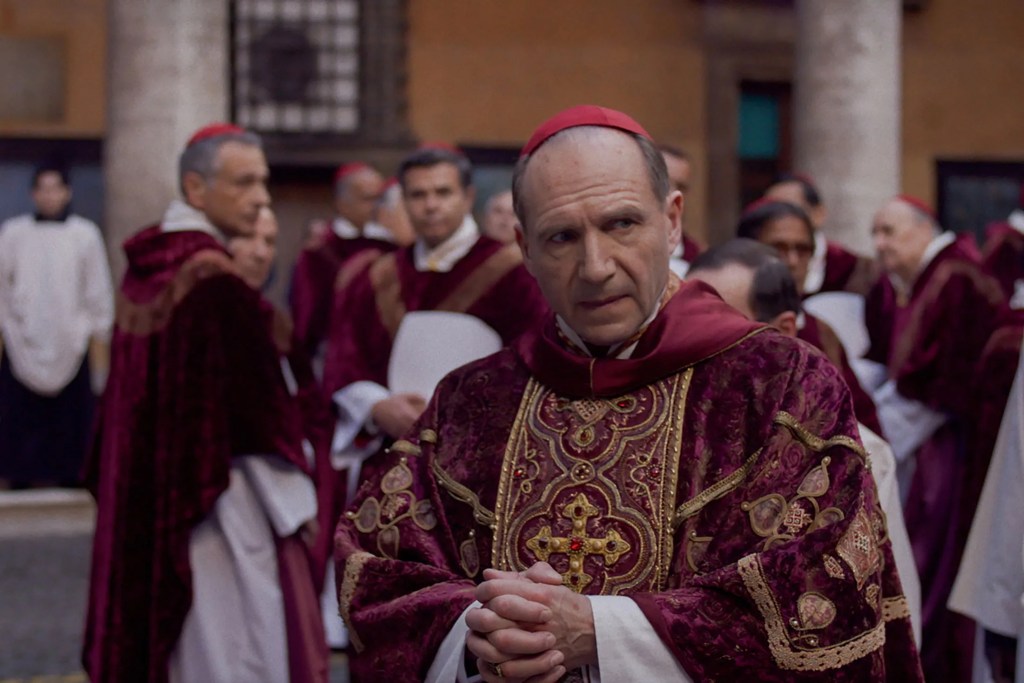
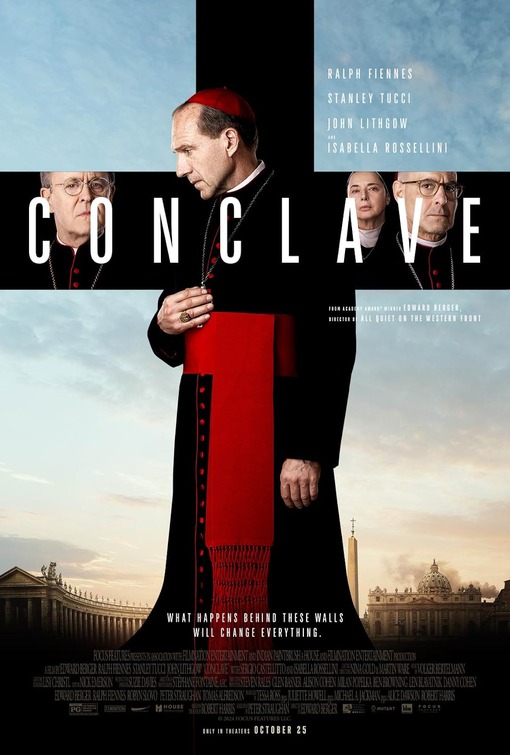
The meticulous Thomas Lawrence (Ralph Fiennes) leads the meeting. He is an introspective Dean who hesitates at the prospect of power but takes his responsibility seriously. His liberal ally, Aldo Bellini (Stanley Tucci), seems equally reluctant, though determined to block the ultra-traditionalist Goffredo Tedesco (Sergio Castellitto), who seeks to undo recent reforms. Meanwhile, Joseph Tremblay (John Lithgow) brings conservative pragmatism, while Joshua Adeyemi (Lucian Msamati) poses a unique mix of economic progressivism and social conservatism. The arrival of the enigmatic Vincent Benitez (Carlos Diehz), an unexpected appointee from Kabul, only adds to the tension. Meanwhile, Sister Agnes (Isabella Rossellini), a compassionate yet sharp observer, offers a steadying presence amidst the unfolding intrigue.
The account was directed by Edward Berger (All Quiet on the Western Front) and written by Peter Straughan (Tinker Tailor Soldier Spy). It’s based on the 2016 novel of the same name by Robert Harris (Pompeii, Fatherland). Although Harris is not a theologian, his experience as a journalist and historical novelist lends credibility to his portrayal of the intense pressures faced by those involved in choosing a new pope. Harris is not a Catholic, so those looking for his ability to accurately represent its religious doctrine will not find it here.
This tale is a pure soap opera that leans into the idea that this is a power play marked by scandal. In 1995, the Vatican issued a list of 45 films that complement faith and moral considerations, and no update would ever include this film. Still, the suggestion that these are human men that do sin is not blasphemous. I accepted this as pure fantasy from a secular opinion, not biblical truth sanctioned by the Vatican. Nevertheless, careful consideration is given to do the right thing. Thoughtful discussions surrounding the mission of the Church and the role of the papacy do bear significance, at least as embodied by the variety of individuals depicted here.
Conclave is a fascinating discussion about the conflict between men, God, and devotion within the Catholic Church. It’s beautifully staged as the grandeur and importance of the Vatican proceedings are affirmed to glorious effect in the details. Cinematography by Stéphane Fontaine plays a crucial role in elevating the film’s tense but reverent atmosphere. Fontaine highlights minimalist images with bursts of color that suggest the stark contrast between the austere setting and the dynamic forces at play. That suspense is further emphasized by the music by Oscar-winning composer Volker Bertelmann. With its spare use of plucked strings, his score helps evoke a gradually building mood of intensity.
All of this elevates a saga about an admirable and introspective Dean wrestling with a deep-seated crisis of faith. Actor Ralph Fiennes delivers an emphatic performance embodying Cardinal Lawrence’s blend of strength mixed with internal conflict. Managing the high-stakes election process and navigating complex interpersonal dynamics among the cardinals is a challenging task. Fiennes brings a compelling authority, portraying a leader capable of balancing conflicting political agendas. His reluctance to pursue power resonates with the Church’s values that spiritual leaders should not seek office.
As he leads his men through the papal machinations, the film thoughtfully explores beliefs, virtue, and divine testing. One of the concepts that comes up repeatedly is that true leadership within the Church should be marked by humility and a genuine sense of duty rather than ambition. That concept is nicely highlighted here. The fact that a mainstream Hollywood studio would make a movie about Catholicism in 2024 that doesn’t seek to discredit the institution is a refreshing surprise. The fact that it is one of the most entertaining films of the year is another.
10-27-24
4 Responses
I liked this movie a lot. Never saw the twist at the end coming.
You’re not alone. There was an audible gasp in my theater.
I’m interested in your opinion as to whether this is essentially a melodrama about political infighting that would have worked just as well in a context having nothing to do with religion and hence would potentially be just as interesting to Catholics, Protestants, atheists or whatever? Or is the competition of theologies represented by the different participants crucial to what goes on, in which case it might not be of much interest to non-Catholics?
Another way of putting the question is in reference to some old movies I remember that you may or may not: Is it more like “Advise and Consent” (1962) and “The Best Man” (1964) on the one hand, or like “Catholics” (1973) on the other?
It would work as a political thriller in a non-religious setting. It’s about rivalries, shifting alliances, and the suspense of choosing a leader. The narrative is about a power struggle and personal ambition. This speaks more to a broad audience of films like Advise and Consent and The Best Man. The competition of ideologies is not handled with the depth that someone looking for an exploration of Catholic dogma would find interesting.
I’m now curious about seeing Catholics, which is apparently a British TV play from 1973 starring Martin Sheen and Trevor Howard.