
 Rating 5/10
There’s something comforting about words of wisdom delivered in a calm voice, like a clear direction unencumbered by all the background noise. In The Life of Chuck, an unseen Nick Offerman lends his unmistakable tone to Stephen King’s rumination on the human experience. We are bestowed with various life lessons: existence is a fragile thing, grief is part of living, everyone leaves a mark, and when in doubt—dance. Scenes are introduced with a narration that indirectly serves to tell the audience, “Pay attention! This means something,” in lieu of actually showing why it should.
Nick Offerman’s warm, reflective enunciation oddly evokes the same cadence of Australian voice actor Lee Perry, who was featured on Baz Luhrmann’s 1999 spoken-word anthem “Everybody’s Free (To Wear Sunscreen).” That track was based on a Chicago Tribune column by Mary Schmich, which presented a hypothetical commencement speech and became a cultural touchstone for its gentle advice to a generation—both the movie and the song traffic in platitudes.
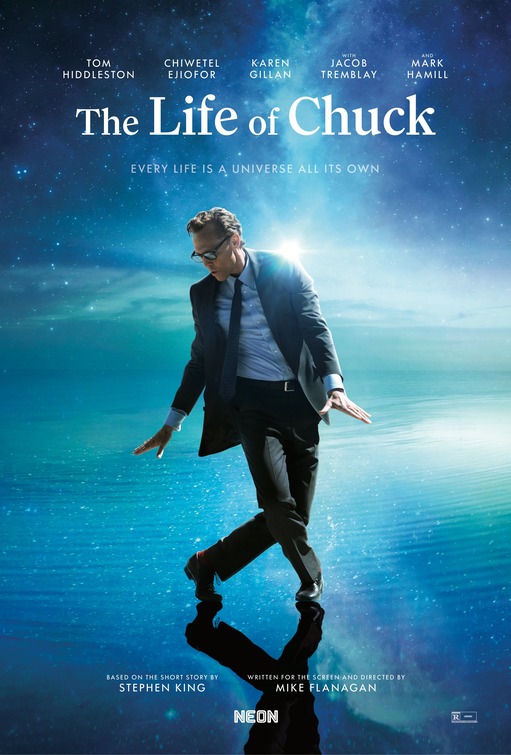
Our story begins in an apocalyptic world quietly unraveling—electrical grids failing, stars disappearing, and cryptic billboards thanking a man named Chuck for 39 great years. From this surreal premise, the narrative unfolds backward. We start at the end of Charles Krantz’s life (Tom Hiddleston), an unassuming financial officer with a mysterious inner world. From there, the film winds backward—first to a pivotal middle chapter, then further still to the earliest days of his time on Earth.
Through three interconnected acts, we glimpse Chuck’s path as a mosaic of moments: impromptu choreography in a public space, quiet days with his grandparents (Mark Hamill and Mia Sara) in a house that holds a room that is off-limits, a school dance with an adorable girl (Trinity Bliss) aided by his instructor (Samantha Sloyan), who nurtures his expressive spirit, and another teacher (Kate Siegel) who broadens his perspective with literary insights.
Walt Whitman’s oft-quoted line, “I contain multitudes,” from his poem Song of Myself, is repeated throughout. That holds the key to the emotional core. It’s meant to underscore the idea that even the most seemingly unremarkable lives are rich with complexity—a notion the screenplay adaptation by Mike Flanagan treats with the highest reverence. However, for all its poetic ambition, the sentiment is more akin to a self-help poster than a profound revelation. That people are complicated isn’t news, and the insistence on this point begins to feel like repetition in search of depth.
Figuring out the plot in all this is rather hard. This is just a collage of moments—told in reverse order. Through its backward structure and deliberate pacing, the picture offers twinkly reflections that form a sort of pseudo-religion that blends wonder, humanism, and the cosmic musings of Carl Sagan.
There’s beauty in the concept—but it’s the kind of allure that works better in print, where King’s introspective tone can live on the page instead of literally being articulated aloud. Director Mike Flanagan is clearly a fan of the author. He’s adapted Gerald’s Game and Doctor Sleep before. Ah, but sometimes blind love leads to overindulgence. What is delicate and thoughtful in a novella becomes cloying and overly literal on film. It leans too hard into sentimental sap and not enough into narrative depth—a dreamy scrapbook of fortune-cookie morals.
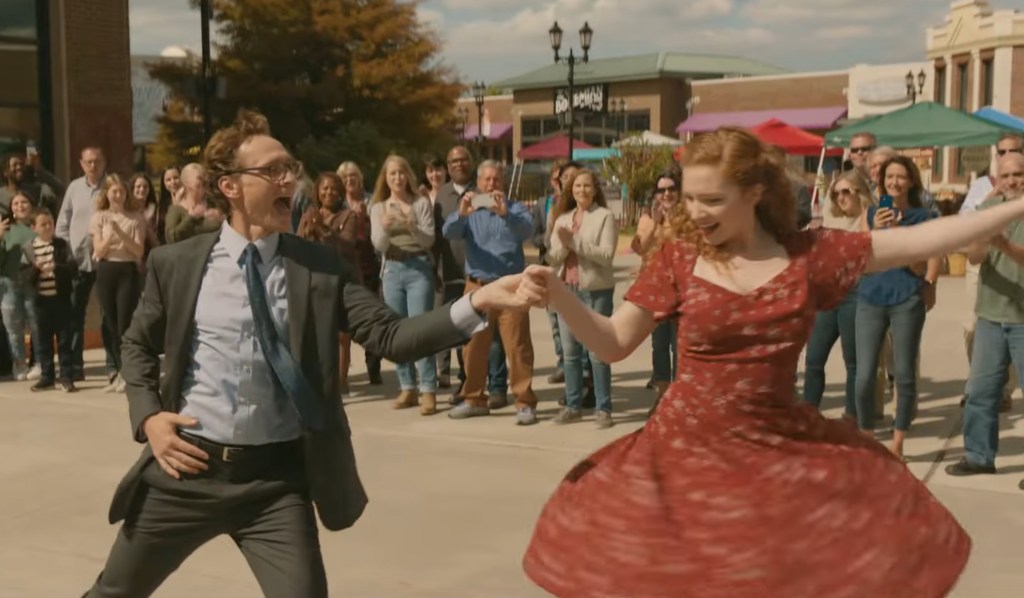
That said, The Life of Chuck does offer one truly great moment in its second act—a euphoric routine in the street featuring The Pocket Queen, the stage name of percussionist Taylor Gordon. Tom Hiddleston lets loose, pulled into a rhythm by a drummer and joined by a random woman (frequent Flanagan collaborator Annalise Basso) in the crowd. It’s light, unguarded, and spontaneous in a way the rest of the saga is not. The production has altruistic goals, so I take no pleasure in dismissing its charitable efforts. But that dance sequence packs more punch than everything else in this feature-length “meditation” combined.
06-02-25
”
“
2 Responses
I agree the dance sequence was the complete highlight of this film. Actually, there are two dance sequences. I really enjoyed both. I didn’t understand what was going on through most of the movie. I was left incomplete. 2 1/2 ⭐️
Yeah, it was a poorly assembled narrative.