
 Rating 7/10
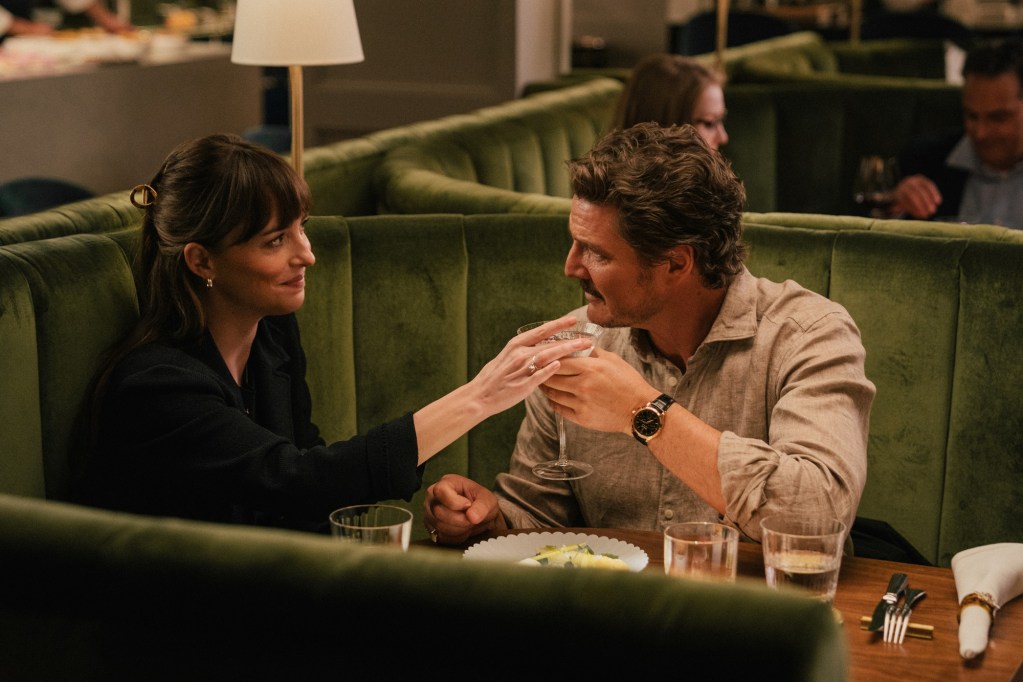
Writer-director Celine Song (Past Lives) returns with another sharp exploration of human connections, framing the story around a triangular relationship. This time, the modern dating world is the stage. Lucy (Dakota Johnson) is an accomplished high-end matchmaker in New York City whose job is to curate “perfect” couples. She begins to question long-held beliefs when she’s conflicted over two men: the wealthy Harry (Pedro Pascal) and her penniless ex-boyfriend, John (Chris Evans). What unfolds isn’t a sweeping romance but a character study about flawed people navigating a world where appearances are currency and love is just a transaction—until it isn’t.
Lucy excels at pairing her affluent singles based on a matrix of desirable traits. She believes that love is simply based on an algorithm—checking boxes by matching attributes with an eye towards marriage as the goal. One of her most challenging cases is Sophie (Zoë Winters), a demanding woman whose requirements have made finding a mate nearly impossible. When Lucy sets Sophie up with a seemingly ideal man named Mark, it feels like a professional breakthrough.
Outside the office, Lucy’s own life resists such tidy logic. She is torn between two guys. Harry is a polished, highly successful bachelor who represents everything her clients aspire to, and John is the former flame whose vulnerability cuts through her defenses. The stage is set for an implosion of everything that she thinks is essential in a mate. The qualities she’s spent years prioritizing no longer hold up. Now, she must reevaluate how she conducts her job as well as her entire philosophy.
As with Past Lives, Celine Song constructs a narrative that initially appears to center on weighing two potential partners. But beneath the surface, it’s a story about confronting the illusion that compatibility can be reduced to quantifiable traits. In Dakota Johnson’s hands, Lucy is a compelling figure yet hollow in her approach to relationships. As a matchmaker, she prioritizes data over depth: height, hairlines, income brackets—all reduced to a formula. Courtship becomes a system as clinical as it is soulless. “And you are not a catch,” she deadpans to one self-important client, “because you are not a fish.” It’s a system that treats dating less like romance and more like customizing a luxury car—searching for ideal specs instead of genuine connection. Song skewers this culture, especially when an outwardly impeccable match amongst two applicants leads to disturbing consequences.
At times, I found myself frustrated by the sheer superficiality of the characters, more invested in aesthetics than substance. And yet, by the end, Lucy had unexpectedly won me over. Though shallow and, at times, even unlikable—she evolves. Her transformation for the better is hard-earned. Chris Evans brings a raw sincerity to John, a struggling actor whose earnestness is undercut by emotional immaturity and financial insecurity. Pedro Pascal’s Harry Castillo is his own brand of contradiction: charming and financially impressive, yet emotionally vacant and surprisingly insecure—even surgically enhanced to better “succeed” at love. None of these characters are particularly admirable, but they feel achingly honest, and that’s the brilliance of Song’s screenplay. It doesn’t glorify or vilify—it just observes, giving these people room to talk, reveal, and contradict themselves.
Celine Song’s fascination with love triangles was evident in Past Lives. That obsession seems to run in the household—husband, Justin Kuritzkes, wrote Challengers, another trio tangled in ego and longing. Perhaps for them, a bond isn’t confined to two people. It’s often the presence of a third who exists to uncover who we truly are.
06-17-25
3 Responses
Your review explains everything perfectly. I was shown a world I did not know existed. Even though these are characters I would not care for in real life, somehow, I liked them. None of them were written to be villans like I expected. Great acting all around. 3 1/2 🌟
It’s a very complex screenplay. There’s a lot going on here.
I found myself trying to figure out what Celine Song was really saying. At first, it felt like she wanted us to admire these characters—but for much of the film, I didn’t. And ultimately, I think that’s intentional. By the end, that discomfort feels like the point, and it pays off.