

 Rating 6/10
The original Tron may have been a box-office disappointment in 1982, but over the years, it evolved into a cult classic that inspired two sequels. The latest, Tron: Ares, directed by Joachim Rønning (Pirates of the Caribbean: Dead Men Tell No Tales, Maleficent: Mistress of Evil), returns to that glowing digital frontier where the virtual realm known as the Grid collides once again with the physical world. Yet despite the four decades that have passed, the film rehashes the same old question that started this franchise: What if the computerized domain were more than data and algorithms but a tangible existence that pulsed with life?
Ares (Jared Leto) is a powerful code-born entity originally conceived as a weapon. Engineered within the Grid and brought into the natural world through a revolutionary “generative laser,” Ares can cross the boundary between data and flesh. His creator, Julian Dillinger (Evan Peters), is the ambitious grandson of ENCOM’s disgraced former CEO Ed Dillinger (David Warner). Julian sees the synthetic lifeform not as a person, but as a prototype, the first in a line of programmable soldiers he hopes to market to armed forces worldwide. Ares’ second-in-command, the formidable Athena (Jodie Turner-Smith), remains fiercely loyal to Julian’s mission.
Julian’s experiments unleash Ares and Athena into the physical world, and the story unfolds exactly as you might expect. Ares starts to develop feelings (shocker!) and begins to question his purpose. Julian, as it turns out, isn’t much of a humanitarian. The heart belongs to Eve Kim (Greta Lee), ENCOM’s current CEO and the moral counterpoint to Julian’s greed. Eve’s mission centers on finding and completing the Permanence Code, which her late sister (Selene Yun) once discovered in an isolated Arctic research station. For Eve, this software represents an opportunity to heal the planet, cure diseases, and create technology that promotes life. Her idealistic stance is in sharp contrast to Julian’s corporate ruthlessness. You go, girl!
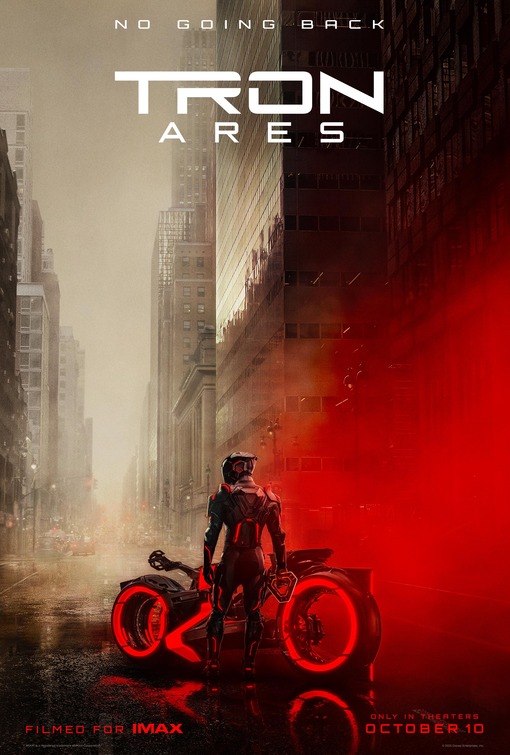
All of this is simply an excuse to present a dazzling visual and auditory spectacle. Tron: Ares imagines a reality where the border between cyber and organic has completely dissolved: light cycles race through earthly city streets, data takes concrete form, and everything hums to a zippy industrial score courtesy of Trent Reznor and Atticus Ross of Nine Inch Nails. Ares extols a fondness for Depeche Mode while “Just Can’t Get Enough” plays in the background. Gillian Anderson adds ersatz seriousness as Elisabeth Dillinger, Julian’s ethically conflicted mother and former ENCOM CEO. And Jeff Bridges returns as Kevin Flynn, appearing as an aged, semi-artificial version of himself who guides Eve in her search for the Permanence Code.
The screenplay, written by Jesse Wigutow from a story by Wigutow and David DiGilio, aspires to be a cerebral exploration of artificial intelligence and humanity’s drive to engineer consciousness. In truth, it’s a basic story of corporate greed versus utopian ideals. There’s some exposition about the ethics of godlike technology thrown in, but it’s a perfunctory effort to merely frame the next kinetic rush of imagery and sound.
Tron: Ares had the potential to be a futuristic parable about our quest to design sentient life. The moral reckoning that follows when our inventions begin to question the limits of their own design is an interesting concept to explore. Instead, it settles for being a neon-slick audiovisual experience. On that modest level, it wholeheartedly succeeds. The movie dazzles the eyes and rattles the ears. It leaves the intellect curiously untouched.
10-09-25
2 Responses
I like that the story was simple and easy to follow. Not brilliant, but good enough. What made it better was the music score and colorful visuals. 3 ⭐️
This movie was made great by the score.