
 Rating 7/10
Theater-writing legends Rodgers and Hammerstein loom so large that it’s easy to forget Richard Rodgers once had another muse. Before meeting Oscar Hammerstein II, he shared a brilliant partnership with lyricist Lorenz Hart. Together, Rodgers and Hart wrote 28 stage musicals and more than 500 songs, including “My Funny Valentine,” “The Lady Is a Tramp,” and, of course, “Blue Moon.” This film imagines Hart’s state of mind on the opening night of Oklahoma!, the musical that would redefine Broadway, and leave him behind.
During one fateful night in 1943, lyricist Lorenz “Larry” Hart (Ethan Hawke) slips away from the opening of Oklahoma!, the Broadway smash created by his former collaborator Richard Rodgers (Andrew Scott) and Oscar Hammerstein II (Simon Delaney). Hart, who had no part in the show, dismisses it as too sentimental. But beneath the cynicism lies envy and regret. Once half of Broadway’s most celebrated songwriting team (Babes in Arms, Pal Joey), Hart’s career unraveled due to his alcoholism, which strained Rodgers’s patience and ultimately drove them apart.
Now newly sober, he retreats across the street to Sardi’s, where preparations are underway for the afterparty. There, amid witty banter with his compassionate bartender friend Eddie (Bobby Cannavale), an eager young pianist Morty (Jonah Lees), and a quiet observer soon revealed to be Charlotte’s Web author E. B. White (Patrick Kennedy), Hart wrestles with the temptations of alcohol, nostalgia, and the faint hope that a young admirer named Elizabeth might give his life new purpose. As the night wears on, old tensions with Rodgers resurface and buried wishes emerge, forcing Hart to confront the fragile legacy he’ll leave behind.
Written by Robert Kaplow (Me and Orson Welles) and directed by frequent Hawke collaborator Richard Linklater, Blue Moon is an elegant, theatrical chamber piece anchored by a distinguished Ethan Hawke performance. He delivers a near-soliloquy of pathos and longing over a single night, compressing years of frustration, brilliance, and sorrow into a few charged hours. Kaplow’s screenplay draws from real accounts and whispered legend about one of Broadway’s most infamous evenings.
You don’t need to know much about Hart going in, but understanding what was at stake for him and what would happen later deepens the emotional power. Hart was a man of razor-sharp wit but with a sarcastic bite. “Any title that feels the need for an exclamation point, you want to steer clear of,” he quips about Oklahoma! His observations sting because they’re both incisive and steeped in jealousy.
Hart was diminutive in stature (sources say barely five feet tall), and Linklater cleverly conveys this through camera angles on the 5’10” Hawke. Small in frame but towering in intellect, he radiates eloquence and melancholy in equal measure. Hawke’s performance deserves an Oscar nomination. He seems to understand Hart from the inside out, turning a man who could have seemed snobbish and unlikable into someone painfully human and sympathetic. Every flash of wit, every flicker of desperation, feels like a matter of life and death.
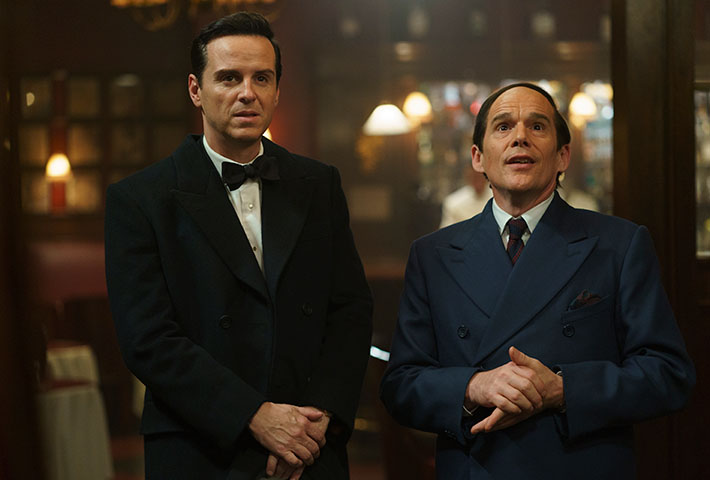
In the second half, as the theater empties, Hart encounters his former partner. He congratulates Rodgers warmly, but beneath the civility lies a challenge. He questions whether Rodgers is truly content creating what Hart sees as schmaltz. Their exchange reveals the fissures that ended their collaboration: Rodgers’s earnest romanticism versus Hart’s biting irony. Andrew Scott plays Rodgers as debonair and conflicted, a man who adores and resents Hart in the same breath. His appearance adds dimension to their complex bond.
Hart also welcomes the arrival of Elizabeth Weiland, an aspiring poet and Yale student (Margaret Qualley). She’s warm and affectionate, clearly admiring Hart, but perhaps more as a friend than a lover. He may call her his girlfriend, but their moments together suggest his desires may not be sexual either. He yearns for connection, not conquest.
Ultimately, Blue Moon is a finely crafted showcase for its lead. Ethan Hawke’s moving achievement makes Hart both admirable and pitiable, balancing reverence with his humanity. In lesser hands, it could have seemed mannered or affected, but Hawke makes every word feel sincere. He has delivered great performances before, often with Linklater at the helm in The Before Trilogy and Boyhood. This, however, may well be his crowning achievement. His ability to channel both exuberance and despair makes Blue Moon an unforgettable portrait of a man at a crossroads.
10-30-25
3 Responses
I love a movie with not only a great performance, but great dialogue. This had that. Great story too. 3 1/2 ⭐️
I hope Ethan Hawke gets rewarded with an Oscar nomination.