

 Rating 6/10
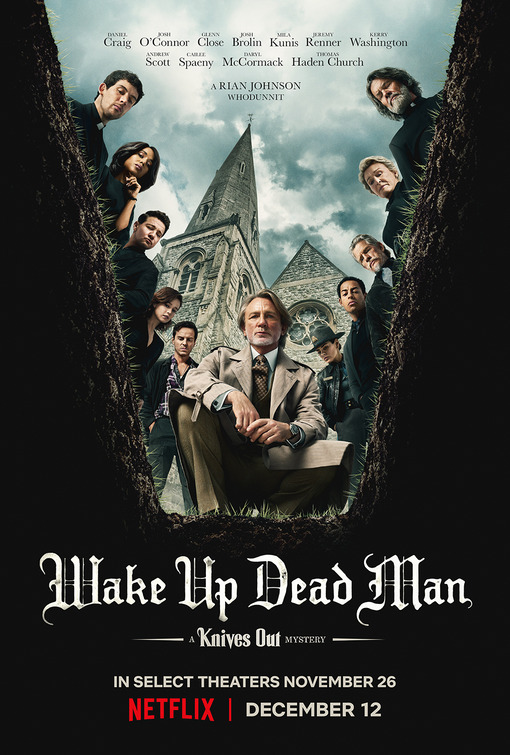
For once, detective Benoit Blanc isn’t the one commanding the room. Wake Up Dead Man may feature Daniel Craig playing the private investigator for a third time in the Knives Out series. Yet the most captivating presence belongs to Josh O’Connor’s Father Jud Duplenticy. What begins as another eccentric ensemble mystery gradually emerges as a picture more interested in exploring faith.
The setting is a troubled Catholic parish in upstate New York. Father Jud is a boxer-turned-priest sent there as a form of penance. There, Monsignor Jefferson Wicks (Josh Brolin) rules his congregation with total contempt. He actually considers one of his Sunday sermons a success if someone abruptly leaves in disgust. Wicks is a deeply alienating figure. So it’s not surprising when he is murdered. His stabbing involves a devil-headed dagger in a locked room. Nearly everyone in the parish has a reason to hate him. There’s a former sci-fi novelist turned right-wing ideologue (Andrew Scott), a failed political aspirant (Daryl McCormack), his tightly wound adoptive mother (Kerry Washington), a disabled former concert cellist and major donor (Cailee Spaeny), an alcoholic doctor (Jeremy Renner), an emotionally muted groundskeeper (Thomas Haden Church), and Wicks’ fiercely loyal right-hand woman Martha Delacroix (Glenn Close). It’s a classic setup, but it takes far too long to arrange all the parts.
Spoiler alert (but not really): Benoit Blanc doesn’t appear until nearly 40 minutes in. However, the delay pays off in one of the movie’s most interesting exchanges. Blanc, proudly secular, declares, “I kneel at the altar of the rational.” He dismisses that the church is built upon “a child’s fairy tale, filled with malevolence and misogyny and homophobia.” Father Jud concedes, “It is storytelling,” but responds thoughtfully, not defensively. “Do these stories convince us of a lie? Or do they resonate with something in us that’s profoundly true? That we can’t express any other way except storytelling.” As he speaks, a halo of sunlight briefly frames his head. Sure, it’s a bit corny, but it’s an effective visual. A moment where sincere belief is allowed to speak for itself without being immediately undermined.
The most compelling scene arrives with a phone call. While Jud is trying to clear his name as the prime suspect, he contacts a construction company to find out who ordered the forklift used to open a crypt. The conversation begins as procedural business with Louise (Bridget Everett), but then shifts when she discloses a personally distressing problem. Without hesitation, Jud slips fully into priestly mode, listening and comforting her. For a brief stretch, the investigation recedes: faith is more than mere ideology; it is about service. It’s in these spirited acts of care that the film comes alive. Wake up, dead man indeed.
The surrounding portrayals of Catholicism never reach that level of depth. Glenn Close’s Martha Delacroix is frequently amusing, popping into scenes with her jump scares. Sure, I laughed. Her comic stiffness recalls Cloris Leachman’s Frau Blücher in Young Frankenstein. But she, like all of the parishioners, is drawn broadly. The congregants tend to function more as symbols of repression or hypocrisy than real people. Writer and director Rian Johnson is gleefully eager to tear down Christian iconography without examining it. This most literally occurs in a flashback where Grace Wicks (Annie Hamilton), branded the “harlot whore” by the community, destroys the interior of the chapel in a rage. I assume the smashing of religious statues is meant to provoke, but for the faithful, it’s profane. This is an insult, not insight.
As the drama meanders toward who killed Monsignor Wicks, the narrative becomes overlong and overcomplicated. The final explanation stretches on, piling motives on top of people until Benoit Blanc, the supposed engine of the series, is oddly sidelined. He is reduced to merely listening as others confess their roles, while he awkwardly pieces it together from their testimony. There is a definite end to the picture. So it technically offers a reveal, but it’s a shrug. The experience is dramatically inert.
Wake Up Dead Man is entertaining and intermittently thoughtful, but it’s far too long. It attempts to do a lot: a detective story, a satire of Christianity, and a theological debate about faith. Rather than engage with those ideas meaningfully, the screenplay reduces them to superficial talking points. The central mystery is serviceable, and the ideas themselves are provocative. Yet the execution is shallow. This remains a watchable whodunit, but its punishing length and lack of depth dilute its impact. What ultimately lingers is O’Connor’s performance. He is genuine humanity in a story that doesn’t extend the same generosity to anyone else.
12-12-25
2 Responses
Knives Out was great but the last two movies in this series have really been meh to me. I actually prefer this to Glass Onion but definitely can admit Glass Onion had more crackling characters and better pacing.
Knives Out is my favorite too. Each one gets a little less wonderful for me.