

 Rating 5/10
Quotation marks can imply a distance from the source. Director Emerald Fennell has been quite candid about the punctuation around the title of “Wuthering Heights.” In interviews, she has stated, “You can’t adapt a book as dense and complicated and difficult as this book.” This adaptation does not purport to be faithful to Emily Brontë’s 1847 novel, but an alternate version fabricated by the filmmaker’s own sensibilities. While the account borrows Brontë’s names and outline, what unfolds on screen is a decorative reimagining. It favors contemporary taste over the fierce, unvarnished spirit of the original. There are so many adaptations, so in theory, that isn’t necessarily a bad thing.
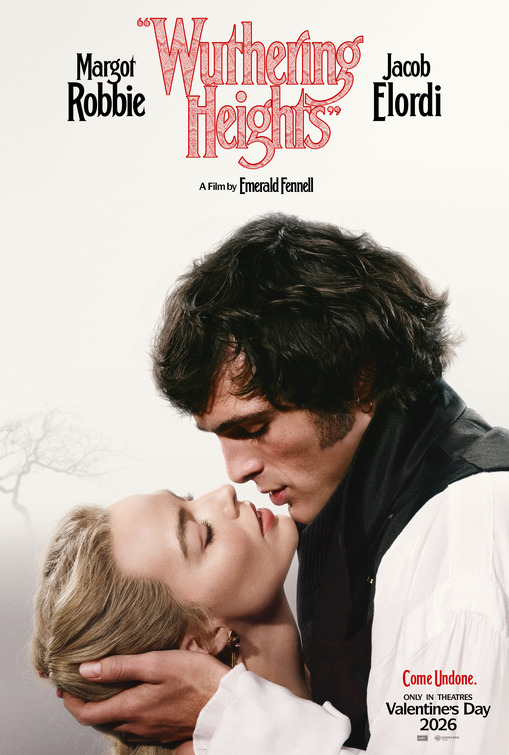
Emerald Fennell’s reworking does retain the basic outline of Brontë’s novel. The saga is set on the 18th-century Yorkshire moors. Windswept landscapes and gloomy visuals preserve the bleak backdrop. This classic tale revisits the enduring and tempestuous bond between Heathcliff and Catherine “Cathy” Earnshaw, portrayed here by Jacob Elordi and Margot Robbie, respectively. Their evolution from wild childhood companions roaming the moors to adults has always been more tragedy than romance. Heathcliff is taken in as an outsider by Mr. Earnshaw (Martin Clunes). He and Cathy immediately bond as children. Years later, he is devastated when she chooses social advancement through a marriage to Edgar Linton (Shazad Latif). Class, pride, and romantic fixation continue to propel the story.
Where the adaptation diverges sharply is in tone. Brontë’s drama is built on a love that often goes unfulfilled. Fennell’s reconstruction abandons restraint, depending heavily on physical expression. The central relationship is overtly sensual. Forget the pains of haunted longing. This version leaves nothing to the imagination. Heathcliff and Cathy’s passion is plainly physical, and the audience is shown repeatedly just how physical it is. A Gothic tragedy about a love so obsessive it destroys the people involved is reduced to a modern romance dressed up in period costume. It is emotionally accessible, but not spiritually deep.
The screenplay is tenative in its aims. Does it want to honor the dark severity of Brontë’s original, or does it prefer to completely indulge in a bonkers, maximalist spectacle? In the end, it does not satisfactorily commit to either impulse, and so it satisfies neither.
In Fennell’s interpretation, the supporting cast are the intriguing characters. The Earnshaws’ housekeeper, Nelly Dean (Hong Chau), emerges as the most layered presence. The keen-eyed servant’s growing disillusionment with Cathy curdles into subtle undermining. Hong Chau plays her with quiet calculation, turning a narrative conduit in the novel into a figure of agency and moral ambiguity. Isabella Linton (Alison Oliver), Edgar’s naïve sister, leaves the strongest impression. She is a romantically impressionable ingénue whose dramatic displays of devotion become self-destructive. Isabella is portrayed as an eager participant in a submissive relationship with Heathcliff. Her consent to a relationship built on cruelty is clearly a misguided craving for passion. Her desires are decidedly more provocative here.
Where the film succeeds is style. The picture is lavishly committed to a bizarrely heightened vision. It sets its two manors in visual opposition. Wuthering Heights broods in darkness and shadow. Thrushcross Grange, by contrast, glows with lurid, technicolor excess. At the Grange, the production design veers into body horror. Edgar Linton has painted the walls of Catherine’s bedroom to resemble her own skin, complete with faint veins and even a birthmark. In other rooms, the partitions glisten as if perspiring. A metaphor for heated desire, no doubt. The fireplace is a sculpture of white plaster hands, with disembodied palms rising from the hearth and fingers grasping upward. Hand-shaped candleholders line the library interiors. In contrast, Wuthering Heights presents severity: a checkerboard parlor floor, a doom-laden painting of the seven deadly sins, and a kitchen ceiling so oppressively low that the six-foot-five Jacob Elordi must physically stoop beneath it.
The costumes further the camp aesthetic. Catherine’s gowns grow increasingly theatrical, with corsets laced so tightly she might suffocate. Heathcliff’s dark tailoring resembles something from a Paris runway more than the rough provincial wear of the period. They’re two models trapped in a gorgeous jail of lacquered floors and velvet drapes, where they can emote anger and sadness. The rooms are staged as theatrical scenes, not lived-in spaces. The production design is undeniably evocative but conspicuously aware of its own artifice. The result eschews austerity for something far more stylized. It is a bold fever dream of velvet, candlelight, and living walls.
Emerald Fennell’s “Wuthering Heights” is fan fiction, fueled by a crude intensity, unconcerned with a serious excavation of Brontë’s themes. It values sensation over introspection. Fennell has said she “wanted to make something that made me feel like I felt when I first read it” as a teenager. Precisely. That adolescent mentality runs throughout, right down to the Charli XCX songs on the soundtrack. They’re not bad, actually. The tunes fit this aesthetic: “The chains of love are cruel, I shouldn’t feel like a prisoner,” she sings. Brontë’s novel is about the blaze of love that refuses to die and the damage it can cause. “Wuthering Heights” is a superficial experience. It keeps throwing logs on the fire but confuses the smoke for the fire itself.
02-12-26
2 Responses
I completely agree with you on every point. I wasn’t a huge fan of the original, however, I was surprised at all the disappointing liberties taken here. I was relieved they didn’t bombard us with modern music, though I fully expected them to. They could’ve done better. It had its moments. But failed in the end. 5/10
I’ll always have a soft spot for the 1939 Olivier version. Those characters weren’t likable, but they felt human. There was weight behind their cruelty and longing. You could sense the history between them.
Here, the liberties don’t deepen the psychology. The emotions are louder, but their personalities feel thinner. They’re cliches out of a modern romance paperback novel.