

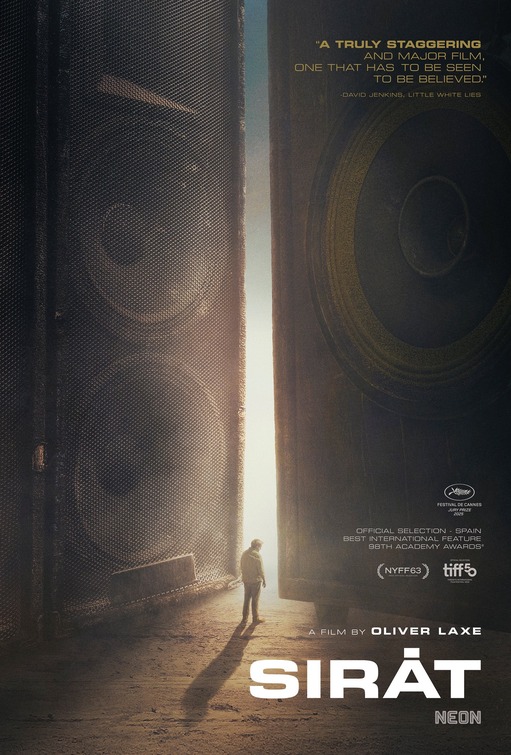
 Rating 7/10
Sirāt is unmoored from geographical borders. It drifts between Spanish, French, and Arabic languages more fluidly than its travelers drift across a vast desert terrain. Director Óliver Laxe is French-born but grew up in Spain, where his career has been nurtured and financed. He has worked for years within Spanish cinema. Meanwhile, this account is set in southern Morocco. That mix of European and North African cultures imbues the environment with a strange, otherworldly aura. You’re never grounded in one linguistic or national identity. The portrait exists in between.
Spain selected Sirāt as its submission for the Academy Award for Best International Feature Film, and it ultimately received one of the five nominations.
A Spanish father, Luis (Sergi López), travels into the Sahara Desert with his young son, Esteban (Bruno Núñez Arjona). Luis is searching for his missing daughter, who disappeared after attending a remote dance festival. As he ventures deeper into this isolated, almost mythic landscape, he encounters a nomadic group of ravers roaming from one underground gathering to another. The figures are a mix of Spanish and other European outsiders alongside Moroccan locals, including Arab and Amazigh (Berber) communities. That cultural mosaic heightens the sense that everyone is slightly displaced. The father is a foreigner in Morocco. The countercultural nonconformists are foreigners everywhere. Even the locals seem untethered from fixed identities.
I was drawn to the idea of a father and son, united, embarking on this odyssey together to find their missing family member. That paternal dynamic always resonates with me. There is something deeply poignant about a father searching for a child, his love now afflicted by the anguish of what might have become of her. What begins as a simple search gradually becomes an examination of generational distance. The wanderers he must rely on are the very kind of people his daughter gravitated toward. Their rhythms, their values, their freedoms are not his. He truly loves her, although he cannot fully inhabit the world she chose.
Luis and son Esteban join a ragtag group of festival-goers: Stef (Stefania Gadda), Jade (Jade Oukid), Tonin (Tonin Janvier), Bigui (Richard Bellamy), and Josh (Joshua Liam Henderson). These are non-professional actors, so you’re inhabiting a subculture from the inside. They share food and fuel, cross rivers together in their vehicles, and form a fragile makeshift family. We identify with Luis. This isn’t a group he would normally hang with. However, he needs them. Desperation overrides his discomfort, and we, the audience, understand that. The partygoers themselves are odd, even unsettling. Yet they are also generous and unexpectedly helpful. It’s a culture-clash road movie, propelled forward by necessity.
The soundtrack is essential. The pulsating techno and EDM score by Kangding Ray accompanies the action. The trance music propels the nomads’ search for transcendence, aligning with Luis’s obsessive drive to find his daughter. Sirāt also received an Oscar nod for Best Sound, which is no small feat considering it was nominated alongside major Hollywood productions like F1 and Sinners. The sound design is immersive, and you feel it in your body.
The saga builds to a devastating moment when one of the vans becomes stuck while crossing a mountain pass. In a single moment, something happens that permanently alters the group’s composition. I was gobsmacked. Later, another major developemnt compounds that devastation. And then another. By then, I was exasperated. What is the point of all this suffering? I asked. How much can these wounded people endure?
The word Sirāt refers to the narrow bridge over Hell in Islamic theology that souls must cross on the Day of Judgment. It’s “thinner than a hair and sharper than a sword.” A single misstep means catastrophe. The title is metaphorical, sure, but as the chronicle unfolds, that metaphor takes on a more tangible meaning. Laxe situates the journey near the long-disputed territory of Western Sahara. The region is still haunted by an unresolved sovereignty conflict dating back to Spain’s withdrawal in the 1970s. The film never turns to politics, but the land itself carries the weight of that history. Even carefree moments exist within boundaries marked by decades of conflict.
Sirāt is a picture that stayed with me. The experiences of these individuals are so visceral and immediate. It is a literal test whose full weight becomes clear by the end. The tale moves through highs and shocking lows. I was riveted throughout. Nevertheless, by the conclusion, I couldn’t shake the feeling that Laxe is more interested in delivering a series of emotional blows than in resolving the narrative he started. This treacherous test is never resolved. That punishing ambiguity left me conflicted. Still, I couldn’t stop thinking about how the story might continue. The characters are that compelling, and that lingering ache is a certain level of success.
02-20-26
2 Responses
Wow, that’s a fine review, Mark! This is probably not a movie I’ll choose to see, what you’ve written about it is a great read on its own merits. Thank you.
Totally understand it might not be everyone’s kind of movie, but I’m glad the review still made for a good read.