
 Rating 6/10
Oh, what Everything Everywhere All at Once hath wrought! Ever since that 2022 Best Picture winner, audiences have been primed for a new wave of radical genre mash-ups. Of course, filmmakers like Terry Gilliam were playing in this sandbox decades ago. I’m thinking of his seminal adventure, Time Bandits. But the Daniels’ movie presented this unhinged structure as something fresh for a new generation. Good Luck, Have Fun, Don’t Die, directed by Gore Verbinski, arrives as a descendant of that ilk. The result channels the same chaotic spirit, but charts its own path.
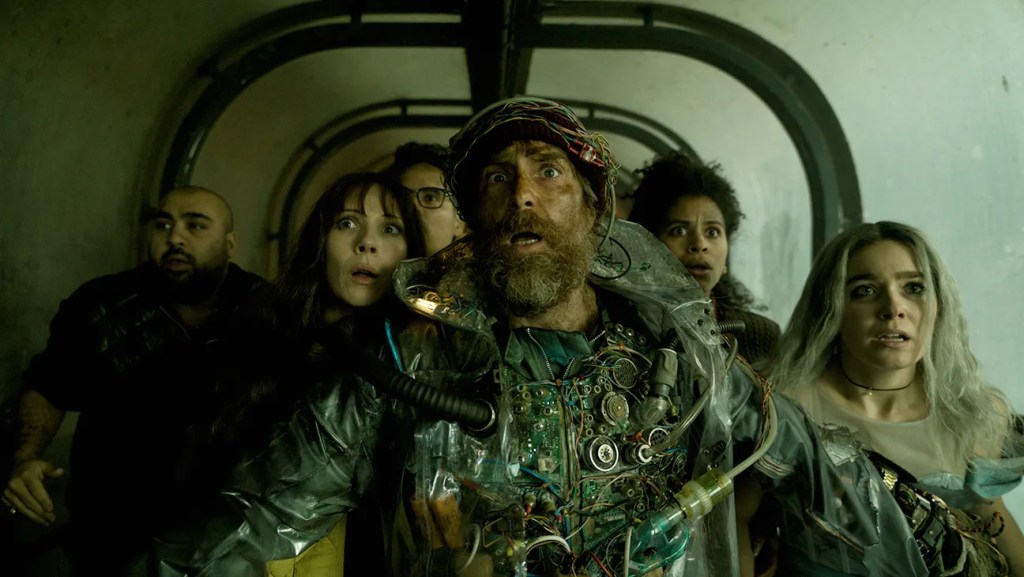
A time traveler, known only as “The Man from the Future” (Sam Rockwell), arrives at Norm’s Diner in Los Angeles at 10:10 pm wearing a plastic overcoat with a strange device strapped to his body. He claims a powerful artificial intelligence will soon destroy the world and that the only way to stop it is to assemble a very specific team of ordinary strangers. He explains that he has already traveled back to this diner 117 times before, trying different combinations of people, and every attempt has failed. His mission tonight is to recruit the right group and reach a nine-year-old boy (Artie Wilkinson-Hunt) who will eventually create the AI. Their objective is not to kill the young prodigy but to intervene before the technology spirals out of control.
The backstories of some of the patrons he selects are what make the account most captivating. Each is connected to the dangers of technology in different ways. Mark and Janet (Michael Peña and Zazie Beetz) are teachers with students hypnotized by a mysterious phone app. Susan (Juno Temple) is a grieving mother whose son (Riccardo Drayton) died in a school shooting. Current research promises to recreate lost children through scientific innovation. Ingrid (Haley Lu Richardson), whom the traveler reluctantly allows to join, has a rare allergy to electronics and Wi-Fi signals, making her naturally resistant to the AI’s influence. Each story plays like an episode of The Twilight Zone, or Black Mirror, if you prefer. They’re so funny and imaginative that I had hoped we would get stories for the rest: Uber driver Scott (Asim Chaudhry), Scout leader Bob (Daniel Branett), and a lonely woman named Marie (Georgia Goodman).
Alas, the story is far more interested in the group’s present-day objective of navigating the city to reach the young inventor before the future becomes irreversible. Unfortunately, that thread is the least interesting part. The flashbacks hint at deeper philosophical conversations about artificial intelligence and the strange directions it might take. It is in those moments that this zany satire comes alive. School shootings are so normalized that it’s comedy. Teenagers with the Gen Z stare drift through school like zombies, and kids can’t attend a birthday party without a tablet in hand. The ubiquitous dependence on starting at a phone screen is far closer to documentary truth than most of us would care to admit. Yet just as the premise begins to explore these fascinating observations, it snaps back to a guy racing a few blocks across town to locate a child.
Written by Matthew Robinson (Love and Monsters), the production is such a trippy creation that its creative flourishes carry it even when the storytelling falls short. The account so effectively thumbs its nose at our digital infrastructure that you can’t help but nod in agreement. The climactic scene with the AI boy perched atop a mountain of spinning cables is so bizarre that it entertains out of sheer weirdness. However, the narrative collapses into an incoherent mess. Sam Rockwell does much of the heavy lifting to hold these disparate elements together. He’s aided by an impressive ensemble cast that keeps things lively even when the narrative goes off the rails.
There’s a long cinematic tradition of decrying whatever new threat happens to dominate the cultural moment. Today, it’s artificial intelligence; in earlier eras, it was nuclear power, or television, and, more recently, the internet. This concept updates that style for the AI age: “Progress is only progress if it makes things better,” the Man from the Future yells at the diners. It’s a line that gets at the central tension: technology can absolutely improve our lives, but it has also made certain aspects of humanity worse. The frustrating part is that the film doesn’t deliver on a strong premise. The idea is brilliantly explored in those random asides, but the rest of the saga is too long. The overarching plot has severe pacing issues and a convoluted resolution. Rather than exploring possible solutions or imagining how we might reclaim control, the script is simply content to just complain about the problem. What remains is a disappointing finish to a promising satire. It’s entertaining, even wildly funny, but it never quite figures out what it really wants to say.
03-03-26