

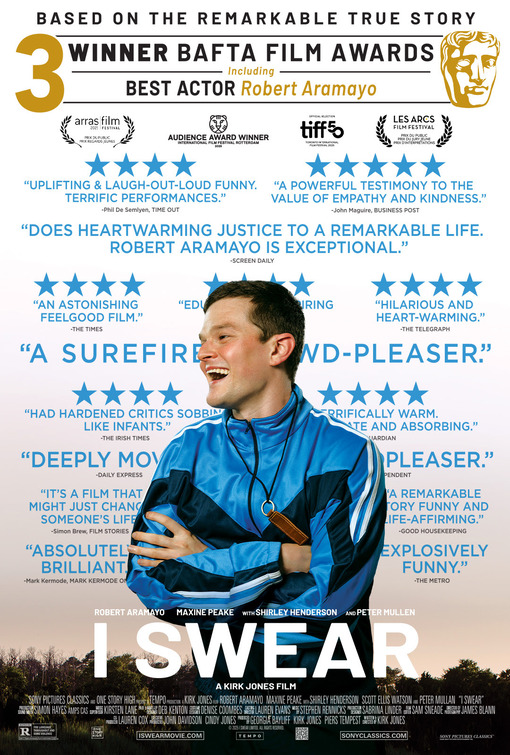
 Rating 7/10
The subject of the 1989 BBC television documentary John’s Not Mad was largely unknown to Americans until the 2026 BAFTA Awards brought him into public view. John Davidson was in the audience as I Swear, an adaptation of his life, competed for five awards. He lives with severe Tourette syndrome. During a live segment presented by Michael B. Jordan and Delroy Lindo, he involuntarily shouted a racial slur. The uncomfortable moment was widely reported, and people were quick to take sides. The discourse that followed underscored how widely misunderstood neurological conditions remain. This movie aims to inform.
John Davidson is from a working-class family in Scotland who dreams of becoming a footballer. Those plans are upended when he begins experiencing uncontrollable tics and outbursts that isolate him at school and from his parents. The troubled teen struggles at home, where his relationship with his mother (Shirley Henderson) grows increasingly strained. A turning point comes when he’s taken in by the Achenbach household, led by the compassionate Dottie (Maxine Peake). Through them, John gets a job at a local community center, where he works under his boss, Tommy Trotter (Peter Mullan). This perceptive mentor challenges how John sees himself, setting him on a path toward finding purpose in a world that has long misunderstood him.
At the center is a BAFTA-winning performance by Robert Aramayo as the protagonist. It’s a demanding role, and Aramayo does the heavy lifting required to make us invest in an individual who, on the surface, is constantly pushing people away. Davidson is written and performed as a deeply lamentable figure. His involuntary spasms occur at the worst possible moments. And yet, through Aramayo’s careful handling of vulnerability and discomfort, the character study asks us to understand him, even when the behavior itself is bizarre.
That tension becomes the drama’s defining tool. Much of I Swear mines awkward humor, often using Davidson’s condition as a source of comedy. It’s a risky approach, but one that mostly works, eliciting laughs while keeping the viewer emotionally connected to his experience. Writer-director Kirk Jones, drawing on the same crowd-pleasing instincts he showcased in Waking Ned Devine, crafts a picture that feels distinctly British, blending a warm tone that is quirky at times but ultimately charming.
And charm it does. The account is undeniably entertaining, built on traditional narrative beats that guide the spectator. But that familiarity is also where the screenplay falls short. For all its emotional simplicity, it rarely pushes beyond the routines of a broadly appealing depiction. The result is a production that invites our sympathy but doesn’t grant enlightenment. You certainly feel for Davidson. His isolation is palpable, but the film stops short of offering greater insight into Tourette syndrome itself.
That leaves I Swear in an interesting middle ground. It succeeds as a heartfelt, engaging portrait of a man in crisis. Its tried-and-true devices elicit both laughter and compassion. But it doesn’t quite transcend convention. It entertains comfortably in the way accessible, well-crafted dramas often do, but without much depth. Whether that’s enough will depend on what you’re looking for. If you want a moving, easily digestible story, you will likely walk away satisfied. But if you’re hoping to leave with a deeper understanding, you may find yourself wanting to swear, too.
04-21-26