
 Rating 7/10
Near the end of The Devil Wears Prada, Andy Sachs (Anne Hathaway) makes a decisive break. Afraid of becoming like Miranda Priestly (Meryl Streep), she tosses her work phone into the Fontaines de la Concorde and walks away from Runway magazine for good. She promptly gets a job at the New York Mirror newspaper and reclaims her sense of self. It’s a clean, definitive ending, one that never seemed to invite a sequel.
Flash forward to Summer 2026
Twenty years later is an eternity in the fashion world. Andy’s newsroom is abruptly laid off via text during an awards gala. She is now scrambling for relevance in a collapsing media landscape. Oh dear! Wherever will she work? That desperation pulls her back, somewhat reluctantly, into the orbit of Runway magazine. Its director, Miranda, faces a modern crisis: backlash over endorsing a brand that uses sweatshop labor. In a bid to restore credibility, the CEO of Runway’s parent company, Irv Ravits (Tibor Feldman), and his son (B.J. Novak) hire Andy as features editor. They want to signal a shift toward more serious journalism. Andy needs stability; Miranda needs legitimacy. Their reunion is predicated on necessity, not choice. Neither is entirely comfortable with the arrangement.
To screenwriter Aline Brosh McKenna’s credit, who also wrote the original, this setup works better than expected. The contrivance of bringing Andy back into Miranda’s world is handled with enough narrative logic to avoid too much eye rolling. More importantly, McKenna resists simply retelling the same story. Instead, she reframes the dynamic within a fashion industry and workplace culture that has evolved. Miranda’s once-feared demeanor now reads as outdated, even problematic, and Andy’s struggle shifts from survival to purpose, as she attempts to carve out meaningful journalism in a click-driven environment.
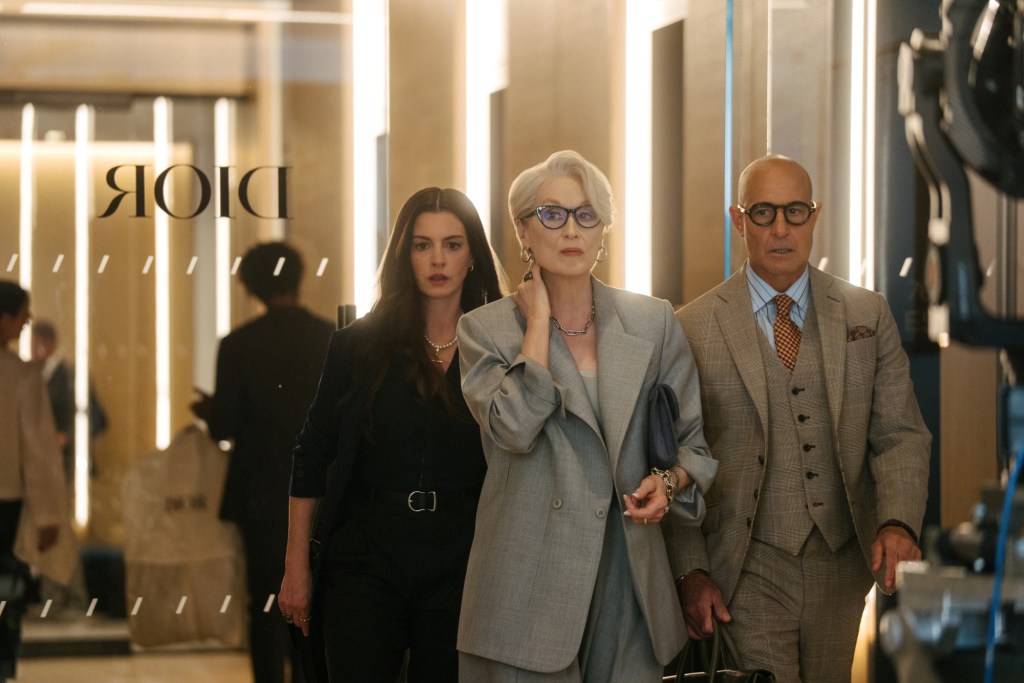
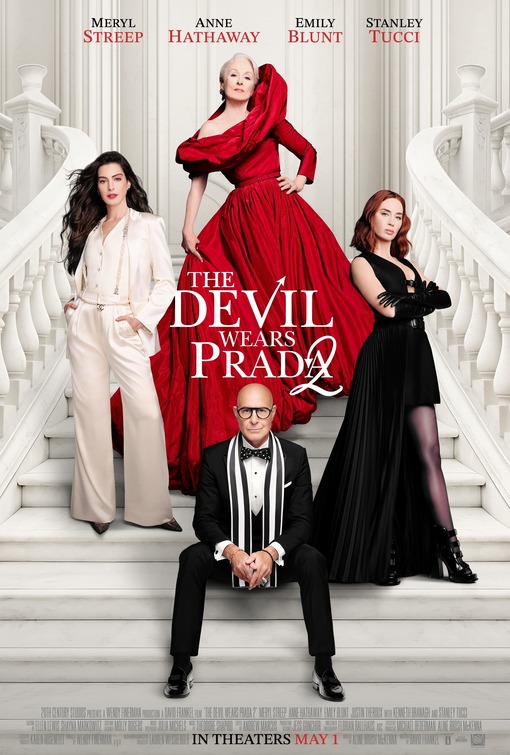
Where the dramatic structure stumbles is in its sheer sprawl. The cast is stacked to the point of congestion. Stanley Tucci returns effortlessly as Nigel, still entrenched at Runway, making his reentry the easiest and most organic of the bunch. Emily Blunt’s Emily Charlton also slots back in cleanly, now a senior executive at Dior, a natural and satisfying evolution that ties her directly into Runway‘s survival. But the account does not stop there. It keeps piling on. Lucy Liu appears as Sasha Barnes, a wealthy, elusive socialite. Andy is tasked with profiling her in a make-or-break feature, who also happens to be the ex-wife of Justin Theroux’s Benji Barnes, a socially awkward tech billionaire whose business dealings further complicate the magazine’s future and who, in true soap opera fashion, is now romantically involved with Emily. Andy, meanwhile, gets an undercooked romantic development with Patrick Brammall as Peter, an Australian contractor who never quite feels integrated into the larger saga. At the same time, Kenneth Branagh pops in as Miranda’s new husband, more a symbol of her shifting personal life than a fully realized personality.
And then there is the extended Runway ecosystem. Tracie Thoms returns as Lily, now an art gallery owner, while Rachel Bloom plays Andy’s book editor friend Tessa, urging her toward an exposé on Miranda. Down in the trenches, the assistants form their own mini ensemble: Simone Ashley’s hyper-chic first assistant, Caleb Hearon’s perpetually desk-bound second assistant, and Helen J. Shen’s quietly efficient counterpart, each further crowding the bloated plot. Every corner of the Runway world is given its own subplot, competing for attention. Individually, these elements are compelling, but collectively, they feel overstuffed. The clarity of the central tension between Andy and Miranda gets lost in the shuffle.
This overcomplication also muddies the film’s emotional core. Miranda, once a formidable and deliciously hissable antagonist, is repositioned as something closer to a victim. Watching her struggle with hanging up her own coat, being corrected for outdated language, and being forced into cost-cutting indignities like flying coach can be amusing. But the shift does not change our loyalties. The screenplay clearly wants us to sympathize with Miranda, yet her past behavior makes that a difficult ask. At one point, a character finally turns the tables on Miranda. It feels like a long-overdue catharsis, and I cheered Miranda’s comeuppance. However, the script frames it as something bad.
Nevertheless, there is plenty to enjoy. Visually, the production is as polished as ever. Cinematographer Florian Ballhaus brings back that same glossy sophistication that made the first one so easy on the eyes. Every office, couture look, and Parisian backdrop has an aspirational glow. And the costumes, really the fashion, by Molly Rogers, are exactly what fans are here for. This is a movie that understands the pleasure of looking at beautiful things and celebrates it. The dialogue, too, remains sharp, with the screenplay often winking at its own absurdities. Tessa’s cutting rebuke to Andy, “Stockholm called, they want their syndrome back,” is so witty. It doubles as both a punchline and a pointed critique of Andy’s behavior, acknowledging what the audience is already thinking. Even the cameo flourishes, including a well-placed performance by Lady Gaga, add to the breezy, crowd-pleasing appeal without completely derailing the story.
Is it better than the original? No. But as far as belated sequels go, especially ones arriving two decades later, this is one of the more successful entries. It’s an entertaining return to a world that still has some style left. It may not always know exactly who it wants you to root for, and the storytelling can feel a bit cluttered, but it rarely loses its ability to engage. This sequel confirms that while fashion may be cyclical, the film’s structure should not be so over-accessorized. Even when the fit is not perfect, the picture manages to strut confidently enough down the catwalk to remind you why you took your seat to watch the show.
04-30-26