
 Rating 6/10
The Allied invasion of Normandy is one of the most famous military operations ever undertaken. June 6, 1944, is a date etched into history. The Allies land on the beaches. The war’s turning point arrives. The challenge for this narrative is persuading us that any of it was ever in doubt.
That is where a certain smugness creeps in. The screenplay has the luxury of hindsight, so every confident prediction, flawed theory, and every dismissive objection from high command lands with a condescending wink. We are invited to watch characters be wrong before they even know they are wrong.
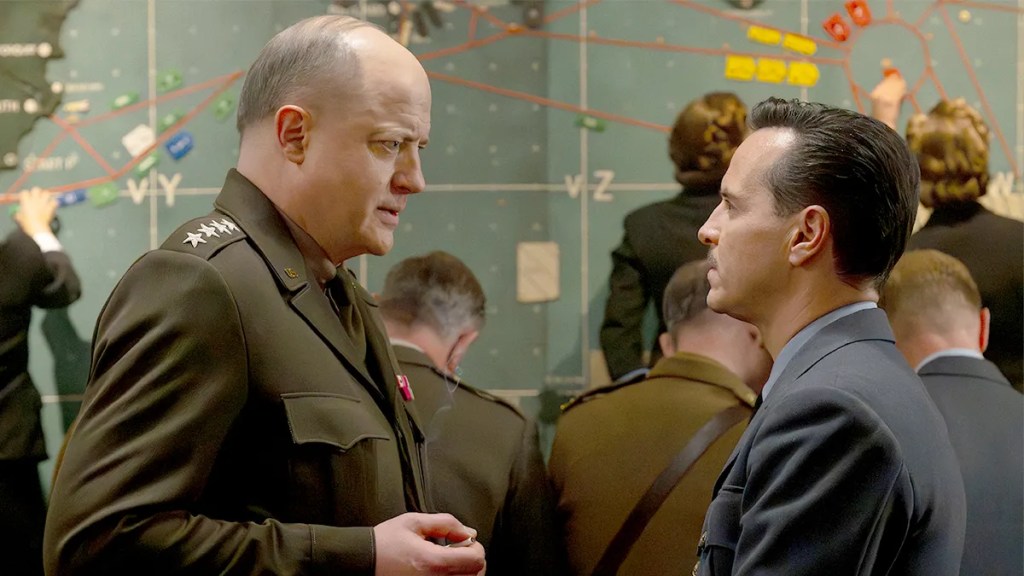
Directed by Anthony Maras and adapted from David Haig’s stage play, Pressure narrows its odd focus to a specific question: what if the weather didn’t cooperate? In the days leading up to D-Day, Allied commanders are gathered at Southwick House trying to determine when to launch Operation Overlord. Success depends on a slim weather window in the English Channel, and the fate of thousands rests on competing forecasts. One meteorologist believes a massive storm system is approaching. Another insists conditions will be ideal. Caught in the middle is General Dwight D. Eisenhower, forced to make perhaps the most consequential decision of the war.
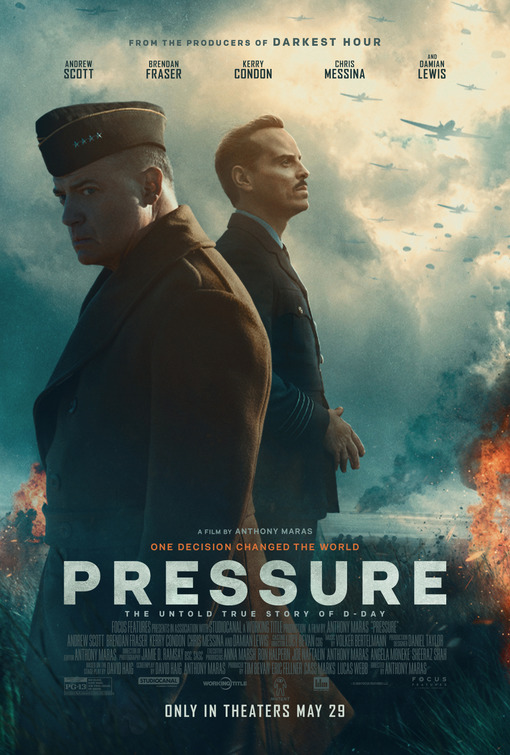
The key players all serve a purpose within this debate. Eisenhower, played by Brendan Fraser, is the decision-maker carrying the unbearable weight of responsibility. James Stagg, portrayed superbly by Andrew Scott, is the cautious Scottish meteorologist whose data suggests disaster may be looming. Irving P. Krick (Chris Messina ) is the confident American forecaster who trusts historical patterns and his own certainty over the warnings of others. Bernard Montgomery (Damian Lewis) pushes for action, while Kay Summersby (Kerry Condon) serves as Eisenhower’s confidante behind closed doors.
The problem is that nearly everyone falls into familiar roles you can identify from a mile away. Krick is the American know-it-all who may not know quite as much as he thinks. Montgomery is the blustering blowhard demanding action. Stagg is the brilliant outsider and fly in the ointment whose warnings nobody wants to hear. Summersby begins as a guarded observer before gradually recognizing just how sharp Stagg really is. None of this is inherently bad, but it reduces the clash of complicated personalities to a collection of familiar archetypes moving into their assigned positions.
Fortunately, the cast is strong enough to elevate the material. Andrew Scott does the heavy lifting here, delivering a performance so compelling that the drama remains engaging even when its trajectory is predetermined. Everything hinges on Scott selling the idea that weather forecasts have the same tension as a confrontation on the battlefield. He brings a mix of intelligence and anxiety that reminds us how a great actor can elevate material that might otherwise feel purely procedural.
Brendan Fraser is less convincing. He certainly captures Eisenhower’s burden and decency, but physically he never quite disappears into the role. Fraser is too soft around the edges to effectively embody the steely Supreme Commander of the Allied Expeditionary Force. He’s not a disaster per se, but the portrayal never quite clicked for me.
The larger issue is that the movie’s biggest question comes with a well-documented answer. The people spend most of the time debating which date should be chosen for the invasion. While the discussions are thoughtfully staged, there is an unavoidable sense of watching dominoes fall precisely where they were always destined to land.
Yet the saga remains worthwhile because it illuminates a fascinating aspect of history that many viewers, myself included, may never have appreciated. We often think of D-Day in terms of military strategy, courage, and logistics. This account reminds us that something as ordinary as the weather may have played a decisive role in changing the course of World War II. Even when the destination is written in the history books, Pressure makes an absorbing case that getting there was far more uncertain than we ever imagined.
06-02-26