
 Rating 4/10
Steven Spielberg has spent much of his career proving that aliens are the wondrous foundation of great cinema. From Close Encounters of the Third Kind and E.T. the Extra-Terrestrial to War of the Worlds, his stories work when spectacle serves engaging characters and a strong emotional core. Disclosure Day has plenty of big ideas, but it sadly doesn’t deliver more that connects on a deeper level. It lumbers from one talky scene to the next in service of a supposedly grand exposé: we are not alone, and the government has been hiding the truth. It’s a simple notion, as well as a familiar one. That’s not necessarily a problem. The trouble is that Spielberg doesn’t find a fresh or compelling way to explore this idea. Despite all of the convoluted mythology and exposition, the central revelation remains surprisingly basic.
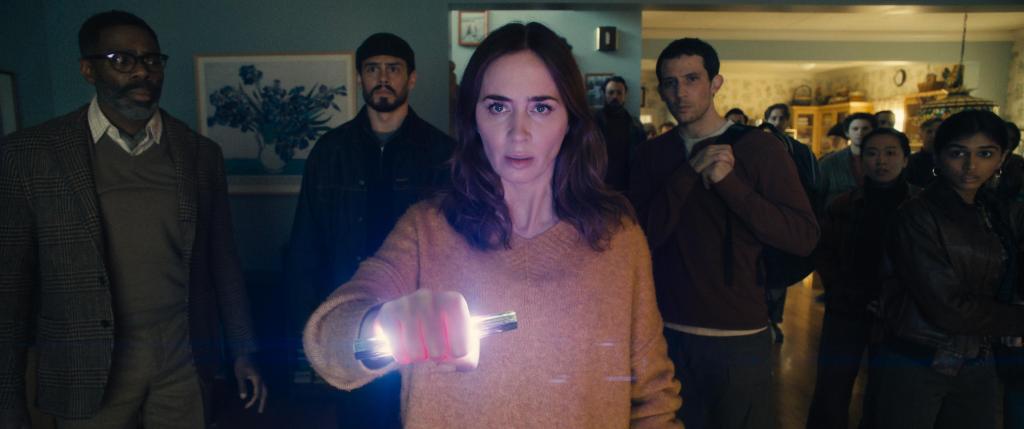
In the near future, the threat of World War III is looming. Daniel Kellner (Josh O’Connor) is a cybersecurity specialist-turned-whistleblower who steals classified files from a powerful organization called Wardex, and Margaret Fairchild (Emily Blunt) is a Kansas City television meteorologist whose existence is upended when she suddenly begins speaking languages she does not understand. As Daniel goes into hiding and Margaret struggles to understand her bizarre new abilities, the account piles on the apocalyptic stakes before building toward a declaration meant to change humanity forever.
The biggest problem is that this would-be blockbuster takes itself so seriously. Spielberg was once a master at balancing awe, suspense, human vulnerability, and yes, humor in one coherent story. Here, that sense of playfulness is virtually absent. The saga approaches the central idea with the profundity of a religious awakening, but it fails to present it in a fresh or dramatically exciting way. Instead of suspense, it offers exposition piled atop explanation. The account doesn’t earn our belief. It takes our devotion for granted.
The supremely sanctimonious screenplay from David Koepp clearly thinks it is asking insightful questions about faith and our place in the universe. Yet one of the more sensible moments comes when a nun (Elizabeth Marvel) casually dismisses the notion that extraterrestrials would somehow invalidate belief in God. That brief exchange hints at a richer conversation than the narrative is willing to explore. Instead, it relies on the simplistic assumption that once we learn about the reality of alien life, people will become more enlightened, more united, and less inclined toward conflict. The film lazily treats this premise as self-evident rather than something that needs to be explored or earned.
The picture remains firmly rooted in the most common conventions of the extraterrestrial genre. It may use terms like UAPs instead of UFOs, but beneath the updated vocabulary lies a collection of conventional conspiracy-thriller clichés. We get classified files, shadowy government agents furiously racing after him in black SUVs, Margaret giving psychic impressions of people she just met, a telepathic villain using otherworldly technology to track his enemies, and a legitimately thrilling sequence in which Daniel’s car is rammed into the side of a moving train. However, the frequent scenes of people explaining things are tedious. Even the visitors themselves look exactly like the big-headed, almond-eyed visitors audiences have seen for decades. The film never transforms its mythology into a sense of wonder. This movie never met a close-encounter trope it didn’t like, or a light source it couldn’t turn into a lens flare.
The characters do not help matters. O’Connor is reduced to a standard fugitive whistleblower displaying none of the charisma he displayed in Challengers and Wake Up Dead Man. Blunt fares worse as Margaret, a character defined largely by panic, tears, and facial tics, with little depth of who this woman is. Colman Domingo brings ersatz warmth and dignity to Hugo Wakefield, a Wardex defector and disclosure advocate. He is saddled with the task of building a life-size replica of Margaret’s childhood home. In a cast full of famous names, Courtney Grace is a bright spot as the NBC News anchor reporting on the events. She adds authenticity. Colin Firth, meanwhile, seems to recognize the absurdity of his role and this whole production. He exploits it, as Jon Voight did in Anaconda. He delivers a performance firmly rooted in camp.
The climax demands our wide-eyed belief. Spielberg has often approached beings from beyond Earth with unbridled optimism. He frequently suggests that a single revelation could unite the world. This whole enterprise wants that emotional payoff, imagining a world where a single broadcast instantly changes everything. In an era of deepfakes, AI-generated imagery, and widespread distrust of institutions, his naivete feels hopelessly outdated. It’s completely detached from reality.
That skepticism points directly to the film’s biggest weakness. This premise might have still worked if the storytelling were strong enough to make the impossible feel emotionally convincing. Instead, Disclosure Day becomes a solemn dissertation on the future of the human race. Spielberg wants to inspire awe, hope, and reverence, but that response isn’t earned. The movie spends so much time explaining its ideas without simply letting us feel them.
06-11-26
3 Responses
Yes! Yes! Yes – this is exactly what I was thinking, but I could not put it into words.
He’s still a good filmmaker, it’s just the story was too eye-rollingly unbelievable for me.
My first thought was, no one would believe it was actually happening. Everybody would think it was AI or deep fakes or whatever. Also, who watches the news anymore? I’m sure there’s still some people who do watch live television, but I don’t know any of them. Even my mother who’s in her mid-70s now, only watches streaming. I know that if this happened, I wouldn’t know about it. I mean unless they managed to turn my phone on for me or interrupt whatever I was streaming at the moment – there’s no way that I would know this was happening. Also, I totally agree about that anchor who tears up, the NBC anchor I guess? Whoever she was, she was believable. She got me to tearing up a little bit too. Hopefully, she gets more work from this film
Thanks for the thoughtful comment. That’s part of why the movie didn’t work for me. If this story had been set in the 1950s or even the 1970s, when a handful of television networks truly commanded a mass audience, it might have resonated much more strongly. The idea that people all over the world would be watching the same broadcast at the same moment today feels pretty far-fetched. Instead of being emotionally overwhelming, it almost plays like a comedy.
And while Spielberg is still an immensely talented filmmaker, I do think his storytelling instincts have dulled a bit over the years. For me, Close Encounters pulled off a sense of awe and wonder far more effectively than this film does.
I understand your review and it’s well written You’ve explained thoughts thoroughly. I on the other hand, really enjoyed this. A lot ! Yes, there is some silliness, but I bought in to the whole experience. I can’t explain it, but even though it’s sci fi fiction, it captured me fully to the point where I became emotional at the end. 8/10