

 Rating 7/10
Every Toy Story movie has centered on some existential threat to a toy’s purpose. The original feared replacement by something newer and shinier. The second was about being discarded because you’re damaged or no longer useful. The third explored the pain of being loved, but inevitably outgrown. The fourth questioned whether a toy’s identity must be tied to a child at all.
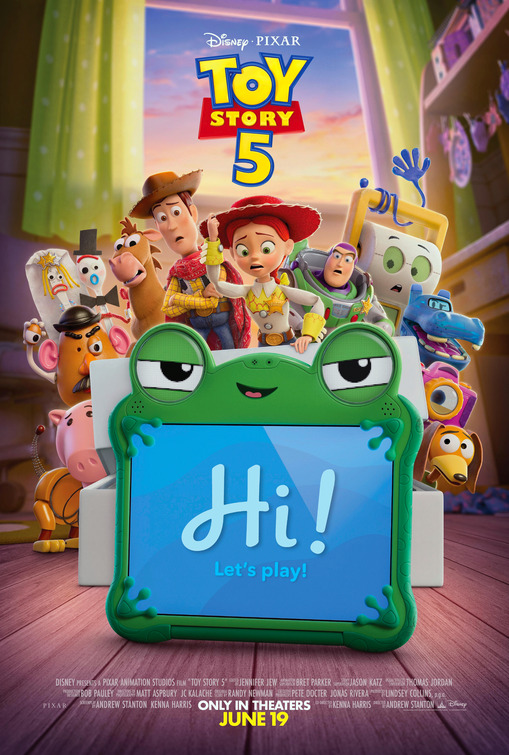
Toy Story 5 updates that formula for our current generation, introducing a more complicated threat: technology. A tablet named Lily (Greta Lee) competes directly for the attention Woody (Tom Hanks) and his friends once took for granted.
At first, I rolled my eyes a little. Lilypad could easily have felt like the latest in a long line of things adults have blamed for ruining childhood. Once it was television. Later it was video games. Now it is tablets, smartphones, and social media. There is nothing especially original about grown-ups worrying that the latest screen might destroy imagination.
What keeps Toy Story 5 from becoming a finger-wagging lecture about how people should behave is that the screenplay is more nuanced than simply saying, “technology is bad.” Lilypad is a frog-themed tablet that her parents (Lori Alan and Jay Hernandez) gifted to 8-year-old Bonnie (Scarlett Spears) to help her connect with other children. More than just an educational gadget, it serves as a digital hub with a social platform. It can organize playdates and facilitate communication.
For the other characters, the threat is not that Lilypad is evil. It is that Lilypad replaces them as a gateway to make-believe. That is what allows Toy Story 5 to update the franchise’s longstanding anxiety about obsolescence in the digital age, asking what happens when a child’s most treasured plaything isn’t even found in a toy box.
Since Woody’s departure, Jessie (Joan Cusack) has taken over as sheriff of Bonnie’s room, but faces a new challenge. Bonnie receives a frog-themed tablet named Lily, designed to help her connect with other children. However, the device soon becomes the center of her attention, leaving her toys sidelined. Lily tries to help Bonnie make friends by sending a social media request to one of her classmates, which leads to Bonnie being invited to a sleepover.
Bonnie brings Jessie and Bullseye along, but the other kids tease her for still playing with toys. Embarrassed, she sends them home. Determined to get back to Bonnie, Jessie and Bullseye set out to find her. However, a well-meaning couple discovers them and, finding Emily’s address on Jessie’s tag, returns them to the farmhouse of their original owner. There Jessie encounters a new generation of toys and meets a spirited young girl named Blaze (Mykal-Michelle Harris) whose vivid imagination may hold the key to helping Bonnie find the friendship she’s been missing.
There are so many characters here that even the welcome new additions have to fight for screen time with all the familiar faces the screenplay feels obligated to include. The main story belongs to Jessie and Bonnie. Still, the tale also finds room for Woody, who returns from his travels with Bo Peep (Annie Potts) to help, and Buzz (Tim Allen), who gets pulled into a separate escapade involving a stranded cargo ship full of advanced Buzz Lightyear toys that are convinced they are real Space Rangers on a mission to reach Star Command.
The narrative also introduces several new tech-based toys, the best of which is Smarty Pants, a toilet-training gizmo voiced by Conan O’Brien. There’s also Snappy (Shelby Rabara), an excitable toy camera, and Atlas (Craig Robinson), a cheerful talking GPS hippo. These characters are fun, even if the story sometimes struggles to balance them alongside the rest of the cast.
One of the most delightful visual flourishes arrives through Blaze’s creative play. During playtime, this collection of tech-themed toys is transformed into heroes of a whimsical fairy tale rendered in a gorgeous 2D animation. It’s a welcome departure from the animated feature’s standard style and becomes a celebration of the imaginative play that the screenplay thinks is disappearing in a screen-driven world.
Viewed on its own terms, this account is thoroughly enjoyable. The animated feature doesn’t offer a groundbreaking take on technology, but it is thoughtful enough to recognize that tablets and social media are tools rather than villains. I loved Conan O’Brien’s scene-stealing Smarty Pants; I got a kick out of finally seeing Buzz Lightyear do the thing he’s always claimed he could do. The animation remains as breathtaking as anything being produced today. This chapter never loses sight of how the franchise uses toys to explore the changing realities of childhood.
I’m in the camp that the first three Toy Story films form one of the great trilogies in movie history. Subsequent installments have felt more like a financial opportunity than a necessary continuation. That’s not necessarily a criticism. Great art has always found a way to exist alongside commerce. Shakespeare was writing for the marketplace, too. The question is not whether a work was designed to make money, but whether it justifies itself upon arrival. Toy Story 5 succeeds on that level. It may not be essential, but it is beautifully crafted and far more heartfelt than a fifth entry had any right to be.
06-18-26