
 Rating 8/10
If the words The Odyssey bring back homework memories of a teacher assigning another chapter of Homer, Christopher Nolan’s adaptation will remind you why this legend has survived for 2,800 years. This isn’t some dusty relic of ancient literature. The Odyssey is a classic adventure.
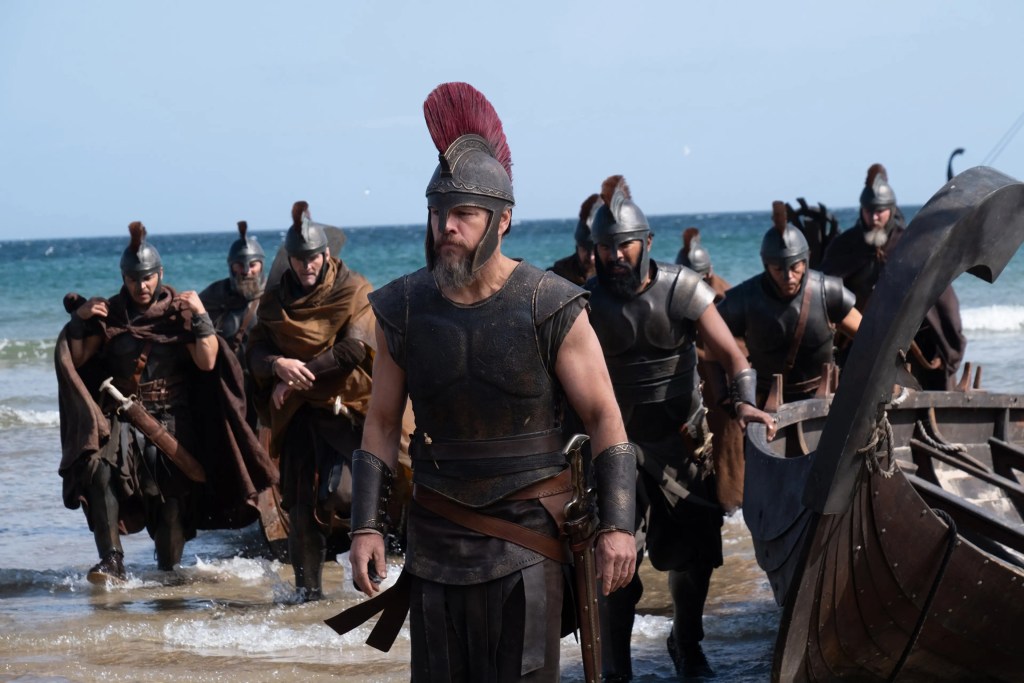
The tale unfolds in the world of Greek mythology shortly after the fall of Troy, around the 12th century BC, though Homer wrote it centuries later. Odysseus is the brilliant but flawed king of Ithaca. His greatest wish isn’t glory or conquest. He simply wants to get home to his wife, Penelope, and his son, Telemachus, after the Trojan War. Standing in his way are monsters, shipwrecks, seductive temptations, angry gods, and difficult choices. Each one unfolds on a different island or shore. It’s almost as if the sea itself is determined to keep him from the family he loves.
Nolan embraces the awe-inspiring, old-Hollywood spectacle. Yet he tells this epic with such clarity. Despite juggling mythology, gods, monsters, and dozens of recognizable actors, the narrative isn’t confusing. The all-star cast is led by a central trio: Matt Damon as Odysseus, Tom Holland as his son Telemachus, and Anne Hathaway as his faithful wife Penelope. There are plenty of other familiar faces, but I’ll get to them. The result is a sweeping mythological journey rooted in antiquity, yet it remains accessible. In many ways, Christopher Nolan seems to have been working toward this production for his entire career. Long before superheroes and cinematic universes, audiences were thrilled by tales of mythic heroes facing impossible odds on the long road home. The Odyssey is an exhilarating story, even though Nolan’s ambitious telling sometimes makes the long voyage feel very long indeed.
Matt Damon has aged into an elder-statesman leading man. Damon brings the weathered authority of a latter-day Russell Crowe to Odysseus. The performance is not revelatory, but it gives the chronicle a sturdy center. Damon has the presence required to carry a production of this size, and it rests comfortably on his shoulders. Tom Holland, meanwhile, possesses the callow quality that has defined many of his youthful roles; it can be difficult not to still see traces of Spider-Man in him. Yet that isn’t necessarily a liability here. Telemachus is an inexperienced young man trying to emerge from his father’s shadow, and Holland is a distinctly modern embodiment of that uncertainty. Anne Hathaway is the strongest of the three, giving Penelope a regal composure that recalls the iconic women of classical cinema. Hathaway belongs to a long tradition of performances. I’m thinking Irene Papas in The Trojan Women and Geneviève Bujold in Anne of the Thousand Days. These are women who project authority not through speeches or grand gestures, but through quiet resolve. Hathaway brings those same qualities to Penelope, making her fully capable of commanding the narrative in Odysseus’s absence.
Nolan understands what has kept The Odyssey alive for nearly three thousand years. This is a first-rate adventure. Every island brings another test of ingenuity. Odysseus survives by outthinking his enemies instead of overpowering them. The structure is episodic, and some encounters are more captivating than others, but there’s always the promise that anything could happen. That feeling keeps our attention, even when the running time begins to wear on us.
The standout sequence for me belongs to Samantha Morton as the enchantress Circe. Morton is mesmerizing. She’s welcoming but a little mysterious from the moment she appears. Without giving away the surprise, Nolan stages the crew’s meeting with her like something out of a horror movie. Watching these hardened warriors undergo a grotesque transformation is genuinely terrifying. Honestly, one of the scariest scenes I’ve seen in any movie this year. All the more impressive because the film does not belong to the genre.
The Cyclops confrontation is also a highlight. Nolan’s commitment to practical effects is so rewarding here. The cave has real scale, and the giant has a genuine physical presence, not your standard CGI creation without any physical weight. It’s a scene that reminds us that practical effects will always have an immersive quality that computer-generated imagery can never match.
Not every trial lands with the same impact. The Sirens’ interlude is haunting, but Nolan makes the odd decision not to let us actually hear their irresistible song. It’s a disappointing creative choice. Instead, we experience the temptation entirely through Matt Damon’s agonized performance as Odysseus strains against the ropes securing him to the mast. I will admit it has the effect of making us realize that Odysseus is not an invincible warrior. He is a man with weaknesses, but with a fierce desire to keep going. Nevertheless, by denying us what Odysseus hears, Nolan turns the scene into something we can only observe rather than experience. Hearing the Sirens would have made the passage far more hypnotic.
Charlize Theron is Calypso, a figure who threatens to keep Odysseus from completing his journey. She clearly wants him to remain with her, but her motives remain vague. Is she seducing him, imprisoning him, testing his devotion to Penelope, or some combination of all three? Theron lends the beautiful character a dangerous allure, but the episode ends before Calypso’s purpose comes into focus. Her character needed more time.
Outside the central trio, Robert Pattinson creates a memorable impression as Antinous, the most ruthless of Penelope’s suitors. He plays him as a sniveling, entitled opportunist, wearing a contemptuous sneer that renders his very existence an aggravation. Pattinson is amusing and threatening in equal parts, capturing the cruelty of a man who believes Odysseus’s prolonged absence has entitled him to Penelope and the throne. Himesh Patel brings humanity to Eurylochus, Odysseus’s loyal second-in-command, while Zendaya lends a solemn, but hazily defined presence to the goddess Athena.
Lupita Nyong’o and Elliot Page appear briefly in supporting roles. Ironically, two of the most discussed casting choices before the film’s release barely register onscreen, making the controversy surrounding their involvement feel vastly overblown.
I also appreciated Nolan’s decision to avoid faux-Shakespearean dialogue. Everyone speaks in clear, contemporary English without exaggerated accents or stilted attempts at sounding “ancient.” It keeps Homer’s saga approachable without ever slipping into modern slang. Thank goodness no one ever says “bro” or “dude.” The one exception is an especially jarring use of the F-word, which briefly pulled me out of the classical world Nolan had otherwise worked so hard to create.
The episodic structure is entertaining, yet it’s also what keeps the journey from sustaining its momentum. Like Odysseus himself, we travel from one island to the next. Individually, these encounters are consistently engaging, but eventually they begin to pile up. At just under three hours, the voyage occasionally drags.
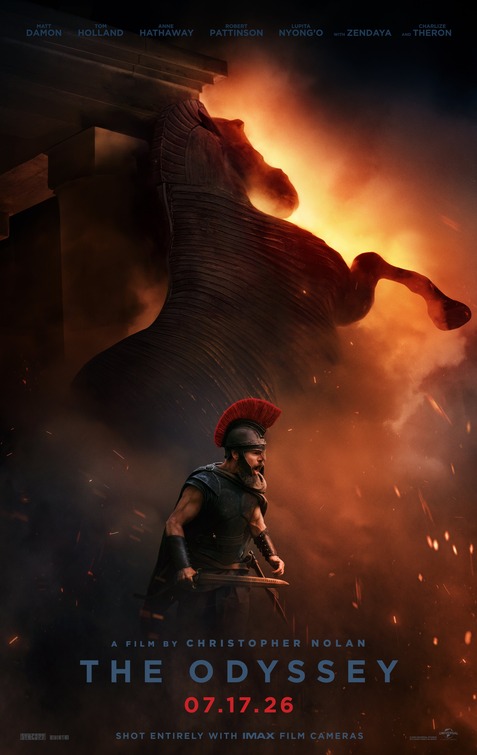
That tempers my enthusiasm, but it doesn’t erase what Nolan has accomplished. This is majestic Hollywood entertainment in the tradition of Lawrence of Arabia, Ben-Hur, and the great roadshow epics of another era. It is an enormous production filled with mythical creatures, monumental sets, and breathtaking effects. Ludwig Göransson’s thunderous score and Hoyte van Hoytema’s magnificent cinematography add to the spectacle, while some of today’s most recognizable stars bring it to life. Matt Damon, Tom Holland, Anne Hathaway, Zendaya, Robert Pattinson, Charlize Theron, and Lupita Nyong’o have been assembled by an auteur and placed at the service of one sweeping cinematic vision.
This is why we go to the movies.
07-16-26