
 Rating 6/10
It opens with an Oscar Wilde quote: One should always be in love. That’s the reason one should never marry.
There must be something inherently relatable about inviting the neighbors over and discovering their private life is, shall we say, more adventurous than yours. The Invite is the latest incarnation of a 2020 Spanish comedy that has already inspired remakes in Italy, Switzerland, France, and South Korea. A Dutch-language adaptation is coming in 2027. Apparently marital discord is universal.
For the American edition, director Olivia Wilde works from a screenplay by Will McCormack and Rashida Jones, keeping the premise simple: put two couples around a dinner table, let polite conversation give way to savage honesty, and watch all the things they don’t normally say to each other come tumbling out.
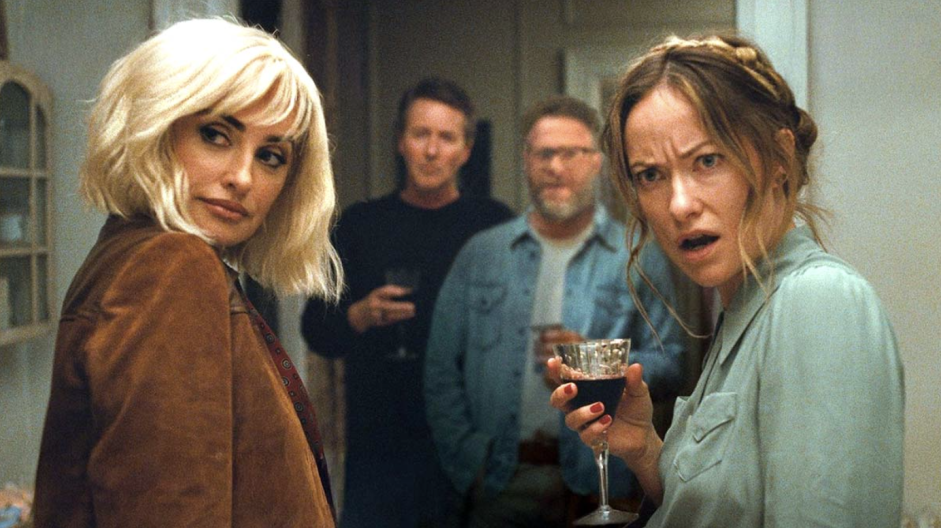
This all feels extremely familiar. Anyone with even a casual knowledge of 1960s cinema will recognize the influences. It’s like adding heaping amounts of Who’s Afraid of Virginia Woolf?, a dash of Bob & Carol & Ted & Alice, and then transporting the whole thing to present-day San Francisco. Joe (Seth Rogen) is a former musician whose band once scored a hit, but whose career stalled. He now teaches at a conservatory in the East Bay, a career turn he regards as a defeat. When he arrives home, he learns that his wife Angela (Olivia Wilde) has invited the couple upstairs, Pina (Penélope Cruz) and Hawk (Edward Norton), to dinner.
This is not welcome news. Joe and Angela’s marriage has deteriorated into near-constant bickering. Furthermore, their neighbors have become a particular source of irritation thanks to the sounds of their lovemaking coming through the ceiling. Joe intends to confront them, but Angela is eager to make a good impression. She thinks they seem cool and would prefer that her husband behave himself. Into this tense situation walk two people who couldn’t be more different from their hosts. Joe and Angela soon discover that Pina and Hawk have a far more uninhibited relationship than their own. You’d think a couple living in San Francisco wouldn’t be surprised to learn that their new friends are in an open relationship. Yet without their shock, there’s no story.
The Invite is structured as one long discourse punctuated by a stream of revelations. Joe and Angela are arguing about the evening before the guests even arrive. Pina and Hawk immediately admit they heard the commotion and wonder whether another night might be better. Joe openly acknowledges the fight and warns them that they are walking into a “contentious environment.” Hawk gleefully responds, “We love a contentious environment!” That’s funny, and there are plenty of moments like it.
All four actors contribute, but I was most impressed by Olivia Wilde as Angela, who also directs. She is a bundle of nervous energy. Angela’s desperate desire to please begins unraveling almost immediately when she offers Pina jamón and cheese, only to learn that Pina doesn’t eat meat or dairy. Pina delivers the news with brute force, not apologetically. When the soufflé Angela made burns, she surreptitiously dumps it in the trash, hoping her guests won’t notice. Wilde’s comedy is as physical as it is verbal, and I delighted in the way she casually discards the inedible dish. The discussion builds through these little bursts of awkwardness. Pina and Hawk also whisper to each other in Spanish when they don’t want their hosts to understand. The vocabulary is simple enough that even my rusty high school knowledge allowed me to pick up some of what they were saying.
The chaos settles down a bit once the couples split into pairs. Joe and Pina smoke marijuana in Joe’s office while Hawk marvels at Angela’s flair for interior design. When the four reunite, however, the evening gradually turns toward the depressing question of whether Joe and Angela’s marriage has run its course.
Pina and Hawk’s unconventional arrangement initially makes them seem like the evening’s provocateurs, especially as they freely discuss their various dalliances. But the witty reversal is that their openness forces their hosts to confront everything they have spent years avoiding. Whether Joe and Angela are willing to experiment with their dinner guests is the superficial question they’re dancing around. The real issue is whether they’re willing to experiment with the idea of being married to each other.
There’s a certain schadenfreude in watching couples abandon the fake pleasantries and get cattier as the evening devolves. The banter zips and zings between comedy and pathos, and although the movie is indeed hilarious, there’s something artificial about it all. These aren’t likable people you want to spend time with. They feel like characters in a stage production delivering meticulously constructed dialogue for our amusement. That makes sense, since the story originated as a play. That theatricality kept me from embracing these individuals or truly caring whether they fix their marriage.
Even the music is determined to join the repartee. Devonté Hynes’ string-heavy score punctuates nearly every bombshell with an added dramatic flourish. It’s so overbearing that after a while it becomes a joke, and I grew to enjoy it. The score is like another guest who has crashed the party. It keeps interrupting the conversation to emphasize how uncomfortable things have become.
That describes The Invite itself. It’s clever, and even insightful at times, but never subtle. I enjoyed listening to these four say outrageous things, even when I didn’t believe them to be real personalities. That’s the movie’s limitation. This is a dinner party you’re happy to eavesdrop on from the apartment next door, but not one you really want to attend in full.
08-11-26