
 Rating 7/10
I wouldn’t call myself an Anthony Bourdain fan, but I am a fan of the world he inhabited. I love good food, eating out, chefs, and shows like Top Chef. Bourdain was a frequent guest judge before becoming a recurring judge on Season 8, All-Stars. His critiques could be sharp, funny, even brutal, but they were grounded in an unmistakable respect for cooks and the culture surrounding food.
Bourdain has always fascinated me. The life we saw from the outside seemed so perfect. He traveled the world, ate incredible food, met charming people, achieved fame and financial success, and built a career around experiences most of us could only dream of having. And yet, in 2018, he took his own life. It’s a potent reminder of how little a person’s outward circumstances can tell us about what they may be experiencing internally. Tony never goes there. In fact, it doesn’t even reach the period when the public came to know him. It’s only interested in showing us the people that shaped him into the man he would become.
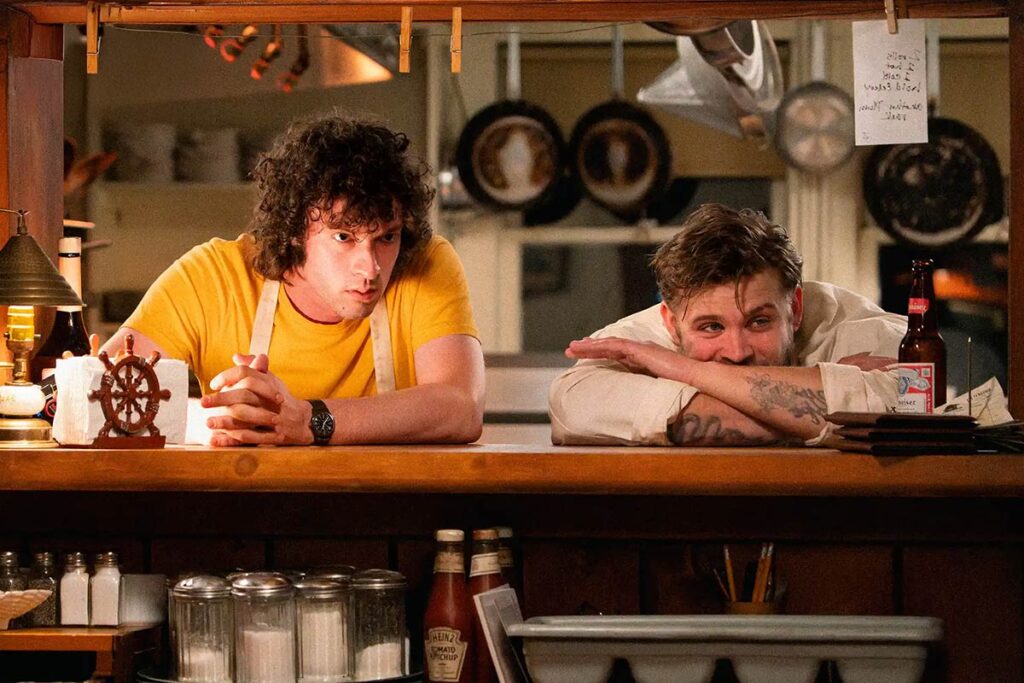
We travel back to 1975, long before Tony became Anthony Bourdain. At 19, he is a Vassar College student who dreams of being a writer but finds himself adrift after a hoped-for fellowship falls through. He impulsively follows his high school love, Nancy Putkoski, to Provincetown, Massachusetts, where a lack of money leads him to take a job washing dishes at a local seafood establishment. What begins as a way to get by becomes a revelation. He is seduced by the heat and chaos of the kitchen, the camaraderie of the cooks, and the exhilarating, sometimes dangerous lifestyle surrounding restaurant culture.
What makes this portrait so rich is the way the future chef, writer, and television personality emerges through the people he encounters. Each seems to awaken a different part of him.
Emilia Jones’ Nancy is important because Tony is desperate to impress her. She initially keeps him at arm’s length, but becomes more interested when she believes he has won a prestigious writing fellowship and is on his way toward becoming the writer he claims he wants to be. Sensing that admiration, keeps the lie going even as the two grow closer. Their relationship exposes both his ambition and his own self-doubt. He wants Nancy to fall for the person he hopes to become. That insecurity drives him to become the man she already believes he is.
Antonio Banderas’ José Vatel, known simply as “Chef,” is the owner and head cook of the Flagship, a rough-around-the-edges seafood joint in Provincetown. When Tony arrives broke and stranded, Chef gives him somewhere to sleep and a job washing dishes. Every morning, he wakes him by throwing water on him, a funny ritual that captures their relationship: He is still an undisciplined 19-year-old, while Chef is trying to teach him that kitchen life demands that you show up, work hard, and take responsibility. Chef gradually brings him into cooking, becoming a taciturn mentor who gives him his first real sense that this chaotic culinary world might also be a place where he belongs.
Perhaps most influential is Leo Woodall’s Sal, a troubled oyster shucker with swagger who fascinates Tony. Sal has the reckless disregard for rules that the inexperienced young man finds irresistible. Sal pulls him into the wilder side of restaurant life: the drinking, drugs, partying, and sense that the cooks are their own little tribe living by a different set of rules. Sal is a bad boy and an important influence. He begins absorbing some of that attitude himself. Where Chef is the stern mentor nudging him toward discipline, responsibility, and an actual profession, Sal represents the self-destructive side of the same environment.
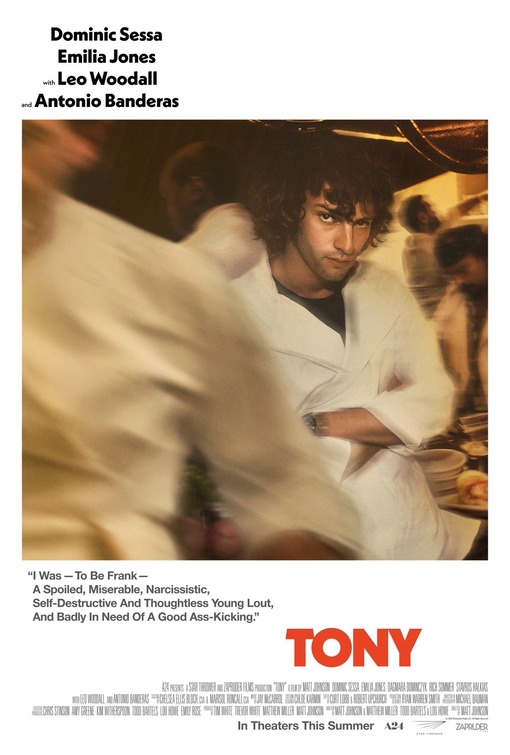
That brings me to Dominic Sessa in the titular role. Sessa isn’t doing a Bourdain impersonation, but he doesn’t have to. He portrays an awkward, insecure 19-year-old, with just enough flashes of arrogance to convince us that he could eventually become that guy.
Having the temerity not to race ahead to Bourdain’s career highlights shows remarkable restraint. We never get to his breakthrough memoir Kitchen Confidential, his television fame, or eventually No Reservations, the travel-and-food series that made him an icon. Kudos to director Matt Johnson, who co-wrote the screenplay with Matthew Miller, Todd Bartels, and Lou Howe, for having the wisdom to make this a coming-of-age movie rather than a greatest-hits biopic. Instead, we watch Chef’s discipline, Sal’s bravado, and Nancy’s expectations beginning to shape him. Even at the end, decades of cooking, writing, traveling, success, failure, addiction, love, and loss lie ahead. But the pieces are there. The movie is called Tony, after all, not Anthony Bourdain. We’re watching Tony, before the name Anthony Bourdain meant anything to anybody, and that’s precisely what makes this portrait so fascinating.
08-20-26