

 Rating 7/10
I get a kick out of seeing animated characters interact with flesh-and-blood actors. Who Framed Roger Rabbit is the gold standard, but it’s hardly the last to revisit the formula. I thoroughly enjoyed Chip ‘n Dale: Rescue Rangers in 2022. And now it’s particularly satisfying to see the Looney Tunes inhabit the real world. Dave Green directs from a screenplay by Samy Burch (May December), based on a story she conceived with James Gunn (Guardians of the Galaxy) and Jeremy Slater (Fantastic Four).
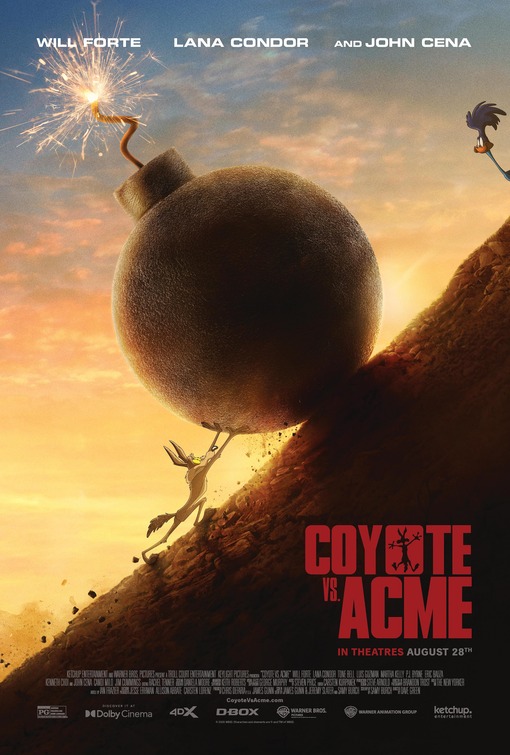
The fact that we’re able to see Coyote vs. Acme at all is something of a miracle. Warner Bros. announced in 2023 that it would shelve the completed feature, reportedly planning to take a $30 million tax write-off rather than release it. The decision provoked a backlash, eventually prompting Warner Bros. to allow the film to be shopped elsewhere. Ketchup Entertainment acquired the worldwide rights for a reported $50 million in 2025 and finally gave it a theatrical release. That alone is gratifying. This is the kind of colorful delight that plays so well on a big screen with an audience.
For anyone living under a rock and not crushed by one, Wile E. Coyote has been chasing the Road Runner through the desert for decades, devising traps constructed from merchandise ordered from the ubiquitous Acme Corporation. His plan always backfires. Wile E. either gets flattened, blown up, dropped from a cliff, or destroyed in some way. The Road Runner escapes with a cheerful “Beep, beep!” In 1990, New Yorker writer Ian Frazier took that familiar setup one step further, imagining Wile E. suing Acme over the countless products that had caused him so much pain. This movie takes that brilliantly logical idea and runs with it.
Enter Kevin Avery (Will Forte, who starred on SNL from 2002 to 2010). He’s a down-on-his-luck personal-injury attorney whose firm specializes in representing cartoons. Wile E. arrives at Kevin’s office with a collection of faulty goods accumulated over decades. Kevin is scared to take on an organization as powerful as Acme, but Wile E. pushes him to take the case. Acme responds by sending in Buddy Crane (John Cena), its slick company lawyer. Buddy offers Wile E. $50,000 to make the problem disappear. Wile E. tears up the settlement and sets it on fire.
This is where the story gets ingenious. Seventy years of slapstick is now evidence in a product-liability case. The defense argues that Wile E. is responsible for his own injuries. After all, nobody forced him to strap on rocket skates, launch himself from giant slingshots, or purchase explosives in an attempt to eat a bird. Conversely, Wile E. contends that the company sold items that didn’t function as promised.
The saga also turns the Coyote’s legendary persistence into an emotionally compelling theme. Kevin repeatedly wants the easy way out. He’s spent years settling cases instead of fighting them, and when things become difficult, his instinct is to quit. Wile E. Coyote, of all characters, has to teach him not to give up. That’s particularly impressive because he never speaks, communicating through signs, facial expressions, and physical reactions. His refusal to give up makes him surprisingly easy to root for. A character defined by his refusal to stop chasing the Road Runner suddenly becomes a symbol of perseverance.
The audacity of making Foghorn Leghorn the CEO of Acme is rather amusing. The giant Southern rooster is now a blowhard executive. His defense boils down to the chilling idea that cartoons can survive enormous amounts of pain, so what does it really matter what the company does to them? That’s an insightful way to take one of the fundamental rules of Looney Tunes and turn it into corporate satire. We laugh because Wile E. can survive anything, but the screenplay asks what happens when a corporation uses that same logic to justify exploiting him.
Other favorites, including Bugs Bunny, Daffy Duck, Porky Pig, Tweety, and Taz, are cleverly woven into the narrative. These are not just obligatory cameos. Bugs even turns up as a key whistleblower, helping Kevin uncover some of Acme’s secrets.
The human characters are fine, although none of them have the appeal of Wile E. Coyote. The live-action performances never approach the energy of their animated counterparts, giving stretches of the story an unnecessarily downbeat feel. The animation is uneven as well, with Foghorn Leghorn looking particularly rough, and a premise this straightforward probably didn’t need to run much more than 90 minutes. Those shortcomings do hold it back, but they don’t outweigh how much I enjoyed.
The blend of live action and animation succeeds because it keeps the insanity of the original shorts intact. Those anything-goes rules don’t remain confined to the animated personalities. Looney Tunes physics invade the real world, and that’s the fun. A painted tunnel becomes very real when Kevin and Paige (Lana Condor), his niece and legal assistant, find an actual train barreling toward them. I also laughed when Wile E.’s Magnet Glove sends him toward an oncoming truck. Realizing what’s about to happen, he holds up a sign that simply reads, “&%@.”
So thank you, Ketchup Entertainment, for stepping in and giving Coyote vs. Acme the theatrical release it deserved. They reportedly paid around $50 million for worldwide rights and recouped a significant portion through foreign presales before the movie even opened. Whatever one thinks of Warner Bros.’ choice to unload it, Ketchup’s decision to pick it up is looking pretty smart. And the kicker? Unlike most of Wile E.’s schemes, this one actually works.
08-27-36