

 Rating 7/10
There was a time when the romantic comedy was a moviegoing institution. Working Title Films helped define the genre boom of the 1990s and early 2000s with Four Weddings and a Funeral, Notting Hill, Bridget Jones’s Diary, and Love Actually. The production company is back with Finding Emily. Full disclosure: this doesn’t join that illustrious company. Yet there’s something suitably chivalrous about the studio’s attempt to revive the formula in 2026, when theatrical stories of this sort are rare.
Longtime Working Title veterans Tim Bevan and Eric Fellner are the producers, with Alicia MacDonald making her feature directing debut from a screenplay by Rachel Hirons. Finding Emily relies on familiar conventions but updates them for a generation more skeptical of the grand gesture.
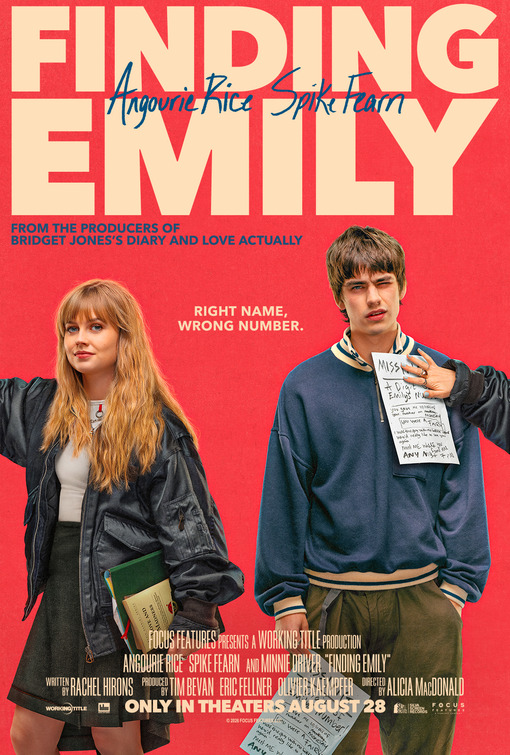
Aspiring musician Owen (Spike Fearn) meets a young woman named Emily (Sadie Soverall) while working as a sound engineer at a student-union bar at Manchester City University. He is immediately smitten and gets her number, only to discover the next day that it is missing a digit. Owen becomes obsessed with finding the girl and soon crosses paths with another Emily (Angourie Rice), a psychology student researching the irrational behavior caused by love. She sees his search as the perfect case study for the thesis and offers to help. Together, they begin an elaborate quest to find the right Emily among hundreds of possibilities. His quest soon divides the campus: some see Owen as a hopeless romantic, while others think his behavior has crossed the line into creepy.
A romantic comedy ultimately lives or dies on the charisma of its leads, and Finding Emily has two appropriately captivating ones. Spike Fearn plays Owen Brompton with a sweetness that makes his fixation on a girl he met only fleetingly seem believable. His Britpop-styled haircut gives him more than a passing resemblance to Oasis-era Liam Gallagher. Australian Angourie Rice, meanwhile, plays the American Emily Raine like a brainy psychology-student vision of Taylor Swift. Together, they make us invested in the search, even though anyone familiar with the formula can see where this is headed.
The film opens with a Sigmund Freud epigraph: “Love is a state of temporary psychosis,” an idea Emily tries to incorporate into the thesis. Owen unwittingly becomes the ideal test subject. He is a lost puppet, with Emily pulling the strings and pushing him into increasingly embarrassing acts in the name of finding his mystery woman. His exploits make terrific material for her research. That setup is clever, but it also requires some awfully convenient plotting. In 2026, are we really supposed to believe that a guy knows a woman’s first name, where she goes to school, and all but one digit of her phone number, and still can’t track her down? Try the possible numbers. Search Instagram or Facebook. At least before making a public spectacle of yourself in front of the whole university on a livestreamed podcast.
And yes, Finding Emily falls back on that durable rom-com notion that proving how much you care somehow requires publicly humiliating yourself. Emily spends much of the movie encouraging Owen to do exactly that while she observes the results. That should make her harder to like. In all fairness, the movie eventually turns the tables and has Emily subject herself to much the same indignity. The developments aren’t surprising. Some are downright manipulative. However, Rice deserves considerable credit for keeping Emily likable even when the character isn’t behaving particularly well. That’s the movie’s saving grace: we may not always buy the contrivances that bring Owen and Emily together, but we buy Fearn and Rice.
09-01-26
4 Responses
I really enjoy these types of rom-coms. Yes, not as good as the ones you mentioned, but I liked the predictable story. The leads were very likable too. 7/10
It embraces being a romantic comedy. So many modern entries feel the need to wink at the genre. Finding Emily mostly plays it sincerely.
This was a really sweet movie, and reading your review reminded me how much I enjoyed it. Mostly because I loved all those rom-coms of the 90s, even the ones that kind of phoned it in. It did have the embarrassment trope at the end, which is not something I love in a rom-com, but it wasn’t the worst example I’ve seen. I will admit while watching this movie it was kind of hard to tell what time period it was meant to be. Partially because of the way the story was set up, but mostly because he (Owen) looked so much like a britpop throwback.
I had the same feeling about the time period. Between Owen’s Britpop look and the very ’90s rom-com construction, the movie almost exists in its own little time warp. That’s the movie’s charm. It’s t’s less interested in updating the genre than in recreating the feeling of those movies. And I’m with you on the embarrassment finale. I could have done without it, but at least it didn’t derail all the goodwill the movie had built up by then.