

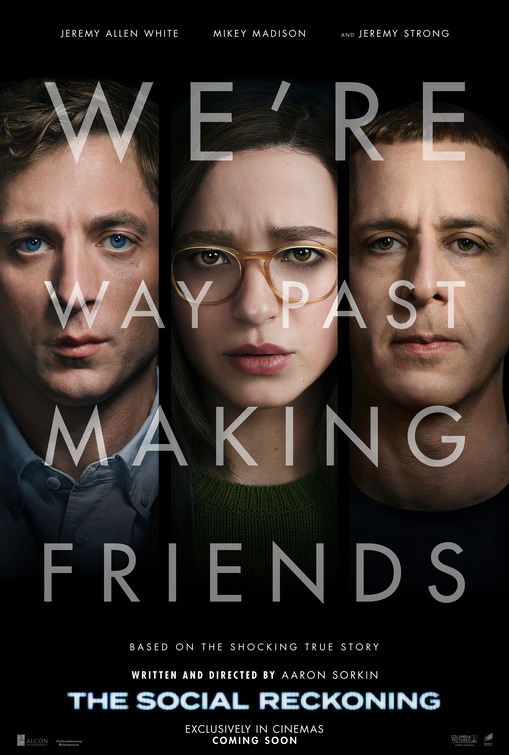
Rating 4/10
I don’t like comparing one movie to another when writing a review. I prefer to judge each film on its own merits. But as a continuation of The Social Network, The Social Reckoning demands it. Both were written by Aaron Sorkin and concern Facebook’s impact on society. Where David Fincher found the human drama beneath the birth of a social media empire, Sorkin offers a finger-wagging lecture on its consequences.
The Social Network had such panache. Fincher’s sense of style gave Sorkin’s rapid-fire discussions a charge. Jesse Eisenberg’s Mark Zuckerberg was fascinating: a young man whose ambition eclipsed his humanity. Some suggest this sequel corrects the original’s supposedly flattering portrayal. That’s a bizarre reading. Zuckerberg was never a hero. Fincher understood that a character could be mesmerizing and troubling at the same time.
The sequel follows Frances Haugen (Mikey Madison), who joined Facebook’s civic integrity team in 2019 to combat misinformation and election interference. Haugen grew disillusioned after the company dissolved the division following the 2020 election. Working with Wall Street Journal reporter Jeff Horwitz (Jeremy Allen White), she exposes documents revealing how Facebook’s algorithms amplified polarizing content, often with the company’s knowledge.
There’s a compelling movie buried in this presentation. Unfortunately, Sorkin smothers it under tech jargon and endless explanations. For much of the opening stretch, it’s difficult to discern what the story is about, much less why we should care. Haugen and various executives rattle off statistics and percentages as though racing to deliver as much information as possible before the two-hour mark.
It’s baffling how Sorkin could render a riveting drama so dull. A whistleblower risks her career, a journalist uncovers the truth, and one of the world’s most influential companies finds itself under fire. All the ingredients are there. Yet Sorkin drains the saga of excitement. He jumps between 2019 and 2021, using a sliding timeline at the bottom of the screen to remind us what year we’re in. It’s a clumsy device. There’s no apparent reason to shuffle events out of order other than to inject some unpredictability. Sorkin keeps telling us these discoveries matter without showing us why. He can write zippy dialogue, but he needs to stop directing his own screenplays. He lacks the cinematic imagination to bring his words to life.
Once the fog of exposition clears, the screenplay’s grand revelation is depressingly superficial: Facebook’s algorithms can turn ordinary people into extremists after a few likes and shares. The logic recalls moral panics that blamed heavy metal for Satanism or video games for creating killers. The January 6 attack on the Capitol is presented as the grim culmination of Facebook’s influence, with characters staring at screens as though witnessing the apocalypse. Facebook bears responsibility for promoting divisive content. But an app didn’t create the political movement it exploits. Sorkin doesn’t make that distinction.
Jeremy Strong fares far worse as Zuckerberg. Gone is the nuance of Eisenberg’s character. He’s now a fuming villain relegated to the sidelines. Strong plays him as a dead-eyed Roomba programmed with two settings: (1) mechanical indifference and (2) petulant meltdown whenever he meets resistance. Billy Magnussen, Bill Burr, and Wunmi Mosaku play members of his inner circle tasked with preparing him for Congress. Making him seem human proves impossible.
Then comes the narrative’s self-congratulatory conclusion. Sorkin stages Haugen’s disclosures as though exposing the truth has won the war. That triumphant coda feels like wishful thinking, not the genuine reckoning the title promises.
The “bombshells” behind The Social Reckoning made national headlines and prompted congressional hearings. Yet five years later, Zuckerberg remains as powerful as ever. Fincher’s The Social Network made us care about Facebook’s founding by showing how a brilliant but callous individual could change the world. Sorkin, meanwhile, scolds us about the effects of that creation. He’s convinced Facebook’s role in fueling political polarization is enough to inspire our interest. But even an audience inclined to agree with him needs more than a condemnation. These complicated matters demand thoughtful exploration. Sorkin gives us the outrage but no insight.
10-08-26