
 Rating 8/10
During gym class, a teacher named Frida notices bruises on a teenage student named Elia. She’s concerned. Hey, I would be, too. What’s troubling is how quickly the officials asking questions settle on an answer. Director Cristian Mungiu (4 Months, 3 Weeks and 2 Days) drew inspiration from the 2015 Bodnariu case, in which Norwegian authorities placed all five children of a Romanian-Norwegian Pentecostal couple in foster care after their two older daughters spoke at school about physical punishment at home. In Fjord, how Elia got those marks remains an open question.
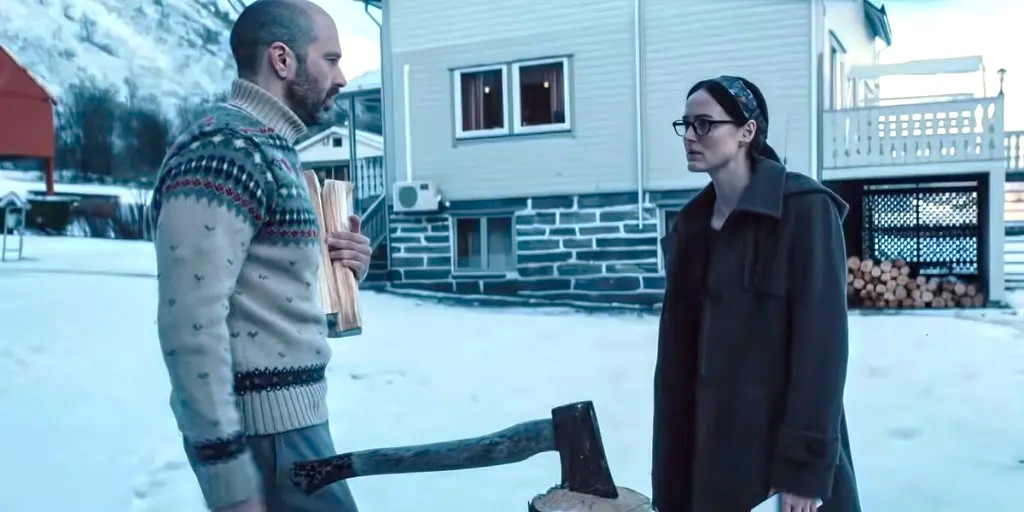
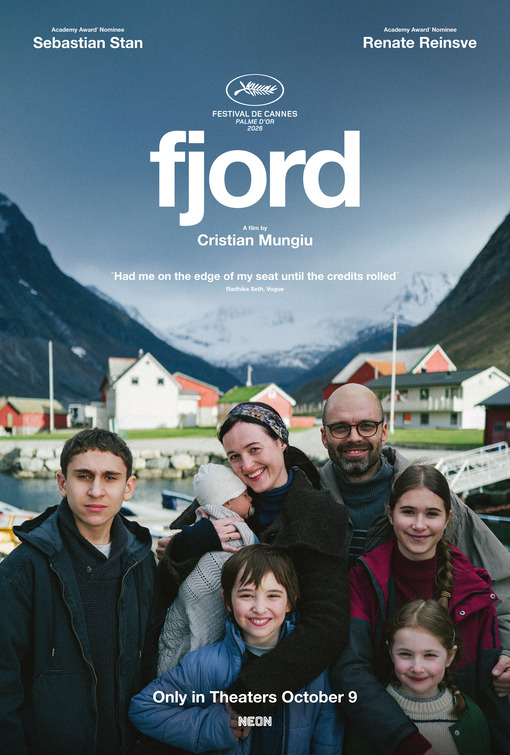
Mungiu takes his time introducing Elia’s family, the Gheorghius. Mihai (Sebastian Stan), a Romanian engineer, and his Norwegian wife, Lisbet (Renate Reinsve), have moved to a Norwegian coastal village to be closer to Lisbet’s family after the deaths of his parents. A fjord is a long, narrow inlet between steep slopes, and it’s a fitting title for a story about people who live so close together yet see things so differently. Her mom and dad are devout evangelical Christians raising five children in a community considerably more liberal than their household. Mihai and Lisbet seldom smile. They’re strict, sometimes to a fault, yet Stan and Reinsve make their affection for all five feel genuine. I liked them. They’re a loving family.
The two grade-schoolers (Teodora Sabina Barau and Filip Sebastian Barau) barely register, but the older siblings have a life of their own. Elia (Vanessa Ceban) and Emmanuel (Jonathan Ciprian Breazu) befriend their neighbor Noora (Henrikke Lund-Olsen) and set about winning her over to their faith. At one point, Elia even appears to walk on water. As the girls grow closer, Noora’s friend Elsa (Sofie Vartdal) grows jealous, and Elia’s father begins to suspect there’s more to the friendship. The young actors are so natural here. For Elia, sharing her faith is part of the pleasure of getting to know someone. What I saw between the girls was an innocent camaraderie. They seemed good for each other.
Once Frida reports what she saw, authorities give little consideration to plausible explanations. Perhaps it happened during wrestling in gym class or in a fight with a sibling. Mihai admits to spanking his children, which is illegal in Norway. That gives the authorities grounds for concern, although it still leaves open what happened to Elia. Mihai hardly helps himself. On his church’s recommendation, Mihai hires a lawyer, Rita Berg (Anne Kokkinn). She finds him so difficult that she quits after their first meeting with child services. Mihai is clearly losing patience even when it would be in his interest to bite his tongue. Yet it’s easy to share his frustration when every answer he gives seems to count against him.
Their neighbor Mia (Lisa Carlehed), Noora’s mother, takes over as the family’s lawyer. Her husband, Mats Halberg (Markus Tønseth), is the headmaster at Elia’s school. Mia wonders whether the language barrier led Frida to misunderstand what the Gheorghiu kids told her. Then Frida reveals that she’d already contacted child welfare after Elia’s little sister Judith told a classmate that being gay went against God’s will. I could understand Frida taking Judith aside to talk about what she’d said. But did Judith’s remark make Frida more inclined to believe that the Gheorghius had hurt Elia? Mungiu also wrote the film, and his screenplay is excellent. I especially liked how gradually the questions about Elia’s bruises widen into a debate over everything her parents believe.
As a Christian myself, I was surprised by how much I wanted Mungiu to show the child welfare workers the same sympathy he offers the parents. Frida and the caseworker Gunda (Ellen Dorrit Petersen) treat the parents with clinical detachment. Separating the family seems like a foregone conclusion. I wanted to see a flicker of doubt from either woman. How much of what troubled them was about safety, and how much was about the values the Gheorghius held?
Reinsve is especially affecting when Lisbet realizes the authorities intend to take her baby, too. She pleads that she’s breastfeeding. The officials want the infant examined for signs of shaken baby syndrome. Lisbet places the infant in the car herself. As the car pulls away, she staggers back. Reinsve makes you feel what it costs this mother to be separated from her child.
At two hours and 26 minutes, Fjord could edit out a few of those official exchanges. I’d keep the scenes of Elia and Emmanuel getting to know Noora, though. There’s an irony in their closeness. The siblings want to win Noora over to their faith, and she’s willing to listen. You’d think Mihai would be pleased. Then Elia and Noora grow closer than he’d like. What feels so true to teenage life is that Elia can believe what her father taught her and still have her own ideas. By the time the authorities intervene, I deeply care about Elia and Emmanuel. I wish Mungiu had shown the same curiosity about the child welfare workers.
Fjord is a movie that will prompt discussion. I bring my own assumptions. In Norway, it’s illegal for a parent to spank a child. Here in the States, plenty of people hear the word “spanking” and fondly defend the practice in their own childhood. I can understand why Frida reported Elia’s bruises. I had a much harder time understanding how the authorities decided that all five children, including a nursing baby, had to be removed from their home. Mungiu gives me room to question Mihai’s judgment but still care about him as a father. I wish he’d done as much for the people on the other side. Fjord asks us to think twice before judging the parents, but it makes the child welfare workers rather easy to condemn.
11-03-26