

 Rating 6/10
Godzilla Minus Zero was one of my most anticipated releases of the year. That’s because its predecessor was my second-favorite movie of 2023 and the greatest Godzilla picture I had ever seen. (I’d say the greatest ever made, but I haven’t seen them all.) Expectations were understandably high. Director Takashi Yamazaki’s sequel delivers a spectacle and enough monster mayhem to earn a recommendation. But man, once the action stopped, the film struggled to hold my attention.
The story begins in 1949, four years after World War II and two years after Godzilla destroyed Tokyo’s Ginza district. Former kamikaze pilot Kōichi Shikishima (Ryunosuke Kamiki) is trying to build a peaceful life with his wife, Noriko (Minami Hamabe), and their adopted daughter, Akiko (Sae Nagatani). The titles suggest the country’s predicament: Minus One pushed an already devastated Japan below zero; Minus Zero finds it struggling to recover. Wouldn’t you know it. Another monster has arrived to complicate the rebuilding.
That would be a winged dragon called King Ghidorah. Naming him is not a spoiler; he appears in the opening scene. Kenji Noda (Hidetaka Yoshioka), now heading the Large-Scale Disaster Response Bureau, recruits Shikishima to help confront the creature. Their efforts make matters worse, leaving a country still recovering from war facing an even greater threat. The situation becomes so desperate that Godzilla starts looking like a solution.
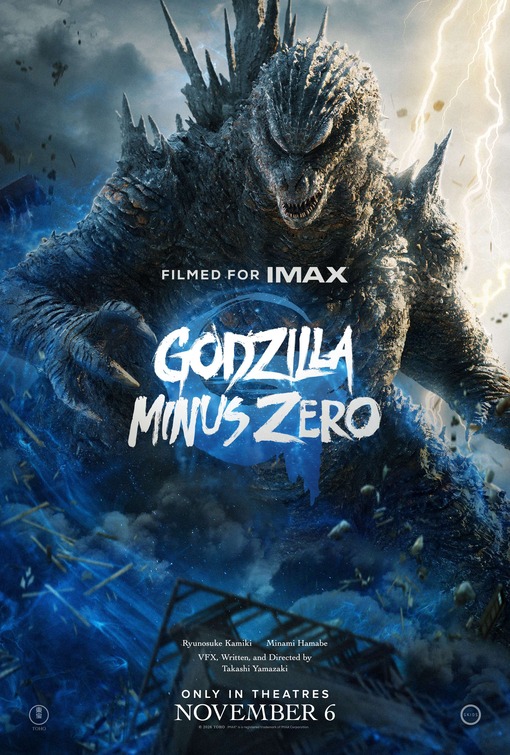
When the monsters take over, the display is magnificent. Minus One won the Academy Award for visual effects, and the work here offers that same sense of awe. Ghidorah unleashes lightning, Godzilla’s dorsal plates rise and glow blue, and suddenly I’m a kid again, delighted by the sheer size and destructive power of these creatures. The aerial sequences are especially exhilarating. Planes circle a flying adversary so massive that their mission is absurdly dangerous before anyone fires a shot. The contrast between those vulnerable aircraft and the creature dominating the sky makes the action thrilling. This is pure cinematic magic.
The sound gives those images physical force. I saw it in Cinemark XD, where the surround sound made the auditorium rumble. The monsters don’t merely roar; they seem to shake the room’s foundations. It’s also playing in IMAX, but my screening certainly wasn’t lacking in impact. Naoki Satō’s score adds grandeur, while the returning Akira Ifukube theme delivers a welcome nostalgic thrill, just as it did in Minus One. With its music, the technical wizardry, and those tremendous roars, this is a presentation made for the big screen.
It’s considerably less skilled at holding our interest when the monsters are offscreen. Godzilla remains on the sidelines for much of the running time. Ghidorah is a formidable substitute, but he disappears for long stretches too. I haven’t timed the kaiju action. I can only say that, while watching, I became increasingly conscious of its absence.
I’ve done my homework. I know that the average Godzilla film contains maybe 15 minutes of actual kaiju mayhem if we’re lucky. These productions always contain more conversation than destruction, so I wasn’t expecting nonstop combat. The difference is whether the human drama makes you forget you’re waiting for the monsters. Minus One managed that to perfection. This sequel? Not so much.
The previous entry gave Shikishima’s guilt a compelling direction: a kamikaze pilot who believed he should have died gradually discovered reasons to live. His makeshift family mattered because we watched those relationships develop. Here, renewed danger sends the household back into prolonged discussions of whether they can risk leaving their daughter behind. Noriko is still enduring the consequences of Godzilla’s earlier attack, making her future uncertain.
World War II continues to haunt people trying to rebuild their lives. They deserve a future beyond sacrifice. I get that, but the expressions of grief are repetitive. The screenplay keeps reminding us what these people have been through. Everyone keeps suffering, but little actually happens. Kanji Murakami (Min Tanaka) is a biologist whose family died in Hiroshima. A meteorologist (Masami Nagasawa ) blames herself for deaths in a storm she correctly predicted, despite the authorities ignoring her warnings. She did her job. They didn’t listen. Yet the script keeps returning to her distress. Fortunately, Noda brings some welcome personality, and his wild, Einstein-like gray hair deserves its own billing.
Less welcome were Akiko’s recurring bouts of ear-splitting crying. A frightened child is understandable under these circumstances, but her wails feel like a cue for an emotional response. The volume overwhelmed whatever sympathy these scenes were trying to generate. The monsters weren’t the only ones testing the sound system.
At two hours and fifteen minutes, Godzilla Minus Zero feels closer to three. I imagined a leaner, ninety-minute version that preserved the family stakes while moving more decisively toward its astonishing confrontations. There is a great movie here, and its best passages are wonderful. They just have to carry too much dreary melodrama along with them.
I left disappointed, but I also left remembering those planes, those glowing blue plates, and the glorious racket of two enormous creatures making a mess of Japan. That’s enough for a qualified thumbs-up. Godzilla Minus Zero takes a while to find its footing, but when it does, it’s a stomping good time.
11- 05-26